Every dollar a nonprofit spends on overhead is a dollar that does not reach the people it was raised to help. This tension sits at the heart of every decision a charity makes — including the decision about how to build its website. Spend too much on a custom design, and donors rightfully question where their contributions are going. Spend too little, and the website looks unprofessional, undermining the trust that drives donations in the first place.
In 2026, the stakes are higher than ever. Online giving grew by double digits over the past several years, and digital-first donors now expect the same polished web experiences from charities that they get from the commercial brands they shop with daily. A clunky, outdated website does not just look bad — it actively discourages donations. Studies from nonprofit technology organizations consistently show that a significant percentage of potential donors abandon the giving process when the website experience feels untrustworthy or confusing.
This guide walks nonprofit leaders through everything they need to know about building a charity website that inspires confidence, drives donations, and respects the budget constraints that every mission-driven organization faces.
Why Your Charity Needs a Professional Website
The days when nonprofits could rely solely on in-person fundraising galas, direct mail appeals, and community word-of-mouth are behind us. The modern donor discovery journey begins online. A potential supporter hears about your cause through social media, a news story, or a friend’s recommendation. Their next step is almost always the same: they search for your organization and visit your website.
What they find in those first few seconds determines whether they donate, volunteer, or leave. Research from nonprofit usability experts confirms that donors form trust judgments about charities within moments of landing on their websites. A professional, well-organized website communicates legitimacy, transparency, and competence. A dated or cluttered website raises suspicions — even if the organization behind it is doing extraordinary work.
Beyond first impressions, a professional website serves as the operational hub for every aspect of your nonprofit’s public engagement. It hosts your donation processing. It promotes your events. It recruits volunteers. It tells the stories that connect donors emotionally to your mission. It publishes news and updates that keep supporters engaged between campaigns. And it captures email addresses that fuel ongoing relationship-building.
Without a dedicated, purpose-built website, each of these functions lives on a different platform — donations on GoFundMe, events on Facebook, volunteer signups through Google Forms, and news through email blasts. This fragmentation confuses supporters, dilutes your brand, and makes it nearly impossible to create the cohesive donor journey that converts casual interest into committed giving.
The 10 Features Every Charity Website Must Include
Not all nonprofit websites are equally effective at driving donations and engagement. The most successful charity websites share a common set of features that work together to build trust, communicate impact, and make giving effortless.
1. A Compelling Donation System
The donation system is the revenue engine of your website. It needs to be prominently accessible from every page — ideally through a persistent “Donate” button in the main navigation that contrasts sharply with the surrounding design elements.
Effective donation pages include preset giving amounts (such as $25, $50, $100, $250) alongside a custom amount field. They offer the option to convert a one-time gift into a recurring monthly donation. They display a brief, emotionally resonant statement about the impact of each giving level — for example, showing that $50 provides clean water for a family for one month. And they complete the transaction in as few steps as possible, with mobile optimization that allows donors to complete their gift in under two minutes on a phone.
Campaign-specific donation pages are equally important. Rather than funneling all giving through a single general donation page, charities that create dedicated pages for specific campaigns — disaster relief, annual fund, capital projects, specific programs — see higher conversion rates because donors feel their contribution is targeted and purposeful.
2. Impact Storytelling
Data tells the mind, but stories move the heart. The most effective charity websites lead with stories — real accounts from real beneficiaries that illustrate what the organization’s work looks like on the ground. These stories should be woven throughout the site, not confined to a single “Impact” page.
The homepage should feature a current story or campaign. Individual program pages should include beneficiary testimonials. Blog posts should share updates and progress reports. And the about page should tell the founding story — why this organization exists and what drives the people behind it.
Impact statistics should complement stories, not replace them. Animated counters that display numbers like lives changed, meals served, children educated, and funds distributed create visual proof of scale. But it is the individual stories that create the emotional connection that opens wallets.
3. Event Management Pages
Charity events — galas, walkathons, community gatherings, awareness campaigns — are major fundraising and engagement drivers. Your website needs to promote these events effectively with an event archive page that lists upcoming activities and individual event detail pages with full information including date, time, location, program schedule, and registration or ticket purchase options.
Event pages should include compelling visuals from past events to show prospective attendees what to expect. Countdown timers for upcoming events create urgency and excitement. And post-event, the pages should be updated with photos and results to demonstrate engagement and success.
4. Volunteer Recruitment and Team Showcase
Volunteers are the backbone of most charities. Dedicated volunteer pages that explain available opportunities, time commitments, skills needed, and the impact of volunteer work attract and convert potential supporters who may not be ready to donate financially but want to contribute their time.
Team showcase pages that introduce board members, staff, and key volunteers with photos and brief bios humanize the organization and build personal connections. Transparency about who runs the organization reinforces trust and accountability.
5. E-Commerce for Cause-Related Products
Many nonprofits generate significant supplementary revenue through merchandise sales — branded apparel, awareness products, holiday gift sets, and cause-related items. A complete e-commerce section with shop pages, product details, cart, checkout, and wishlist functionality gives supporters another way to contribute while receiving something tangible in return.
E-commerce also serves as an awareness tool. A supporter wearing a branded t-shirt or using a cause-related product becomes a walking advertisement for your mission.
6. Blog and News Section
Regular content publishing keeps your website fresh, improves search engine rankings, and gives supporters reasons to visit repeatedly. A blog section for news, stories, impact reports, and organizational updates establishes ongoing communication channels beyond email.
Multiple blog layout options — list views for longer editorial content, grid views for visual stories, and detail pages with comments — provide flexibility to publish different types of content in the most appropriate format.
7. Organization History and About Pages
Donors want to know who they are giving to. Dedicated about pages that cover your founding story, mission statement, leadership team, organizational timeline, and achievements build the credibility that casual visitors need before making their first donation.
A timeline or history section that shows your organization’s growth and milestones over the years demonstrates stability and longevity — critical trust signals for donors considering larger gifts or recurring contributions.
8. FAQ Page
A frequently asked questions page addresses common donor and supporter concerns proactively. Questions about how donations are used, what percentage goes to programs versus administration, how to get a tax receipt, how to volunteer, and how to contact the organization should be answered clearly and concisely.
An effective FAQ page reduces the volume of inquiries your staff handles and removes barriers to giving by addressing hesitations before they become reasons to leave.
9. Animated Statistics and Counters
Visual impact metrics — animated counters that display key numbers as visitors scroll — provide immediate, digestible proof of your organization’s reach and results. Displaying metrics like total funds raised, campaigns completed, lives impacted, and volunteers mobilized creates a powerful first impression of scale and effectiveness.
These counters should be prominently placed on the homepage and potentially on campaign-specific pages. The animation draws attention and the numbers provide the concrete evidence that justifies donor investment.
10. Trust-Building Design Elements
Every design choice on a charity website should reinforce trust. This includes transparent navigation that makes information easy to find, clean layouts that feel organized rather than cluttered, consistent branding that communicates professionalism, and prominently displayed contact information that shows the organization is reachable and accountable.
Partner logos, accreditation badges, and media mentions displayed in dedicated sections provide third-party validation. And a clear, accessible privacy policy reassures donors that their personal and financial information is protected.
How Much Does a Nonprofit Website Cost?
Budget transparency matters to nonprofits more than any other sector. Here is an honest breakdown of what building a charity website costs at every level.
| Approach | Cost | Recurring Fees | Code Ownership |
|---|---|---|---|
| Professional Agency | $5,000 – $60,000+ | $300–$5,000/year | Yes |
| DIY Builder (Squarespace) | $0 setup | $192 – $624/year | No |
| WordPress + Theme | $200 – $500 first year | $100–$300/year | Partial |
| Premium HTML Template | $14 – $59 one-time | None | Yes |
Key Insight: Every dollar a nonprofit saves on website development is a dollar that reaches its mission. A premium HTML template delivers professional donor-facing design at a price point that respects budget constraints.
Professional Agency: $5,000 to $60,000+
Hiring a web design agency specializing in nonprofits delivers a polished, custom website. Small projects start around $5,000 to $15,000. Mid-level projects with custom donation integrations and CRM connections run $30,000 to $60,000. Enterprise-level projects for large national charities can exceed $100,000.
For most small to mid-size nonprofits, agency costs represent a significant portion of their annual budget — money that board members and donors may question when it could be directed to programs.
DIY Website Builders: $192 to $624 Per Year
Squarespace offers nonprofit pricing at $192 to $624 per year depending on the plan. Wix offers similar functionality at comparable price points. These platforms are user-friendly but limit customization, lock your content to the platform, and add ongoing costs that accumulate year over year.
WordPress with Premium Theme: $200 to $500 Per Year
WordPress hosting plus a premium charity theme is a popular middle ground. Hosting costs $60 to $200 per year, themes cost $40 to $60, and essential plugins add another $100 to $200. The total first-year cost is modest, but WordPress requires ongoing updates, security monitoring, and occasional troubleshooting that can consume staff time.
Premium HTML Templates: $14 to $59 One-Time
For nonprofits that want maximum control at minimum cost, premium HTML templates offer the most favorable economics. A one-time purchase provides a complete, multi-page website with charity-specific features — no recurring fees, no platform lock-in, and full code ownership.
The template approach requires basic web skills for customization or a freelance developer for initial setup. But the total investment — template purchase plus setup assistance — is typically under $500, making it accessible even for newly formed organizations with minimal budgets.
Design Principles That Drive Donations
Lead with Mission, Not with Ask
The homepage should communicate your mission and impact before asking for money. Visitors who understand and connect with your cause are far more likely to give than visitors who feel pressured by an immediate donation request. Lead with a compelling story or impact statement, then make the donation mechanism easily accessible.
Use Warm, Human Imagery
Stock photos of smiling models undermine authenticity. Use real photos of real beneficiaries, volunteers, and staff whenever possible. Authentic imagery builds emotional connections that polished stock photography cannot replicate. If privacy concerns prevent showing beneficiary faces, use candid shots that convey emotion through body language, setting, and context.
Create Visual Urgency Without Desperation
Countdown timers for campaign deadlines, progress bars showing fundraising goal completion, and limited-time matching gift announcements all create urgency that motivates immediate action. But the tone should be hopeful and empowering, not desperate. Donors want to feel that their contribution is making a difference, not that they are propping up a struggling organization.
Maintain Consistent Branding
Consistent colors, fonts, and visual language across every page reinforces professionalism and builds brand recognition. Donors who see the same visual identity on your website, social media, email newsletters, and printed materials develop stronger brand associations and higher trust levels over time.
Choosing the Right Charity Website Template
Generic website templates force nonprofits to improvise critical features. A business template might have a contact form, but it lacks donation pages. A portfolio template might have a gallery, but it lacks event management. A blog template might have content pages, but it lacks volunteer recruitment features.
The ideal charity website template should include purpose-built donation campaign pages, event listing and detail pages, volunteer and team showcase pages, e-commerce for cause-related merchandise, blog and news publishing capabilities, and impact visualization with animated statistics.
Common Mistakes Nonprofits Make With Their Websites
Even well-intentioned nonprofits frequently make website decisions that undermine their fundraising effectiveness. Recognizing these common mistakes helps organizations build websites that actually drive donations and engagement rather than simply checking a box.
Making the donation process too complex. Every additional form field, every unnecessary page load, and every confusing instruction between a donor deciding to give and completing their gift creates an opportunity for abandonment. The most effective donation pages complete the entire process in under two minutes on a mobile device. If your donation process requires more than three steps, you are losing donors at every stage.
Leading with the ask instead of the mission. Websites that open with a giant “Donate Now” button before communicating what the organization does and why it matters feel aggressive rather than compelling. Donors give because they connect with a cause — not because a button was large enough. Lead with your mission, your impact, and your story. Make the donation mechanism easily accessible but not the first thing visitors encounter.
Using generic stock photography. Photos of smiling stock models holding hands in a field do not inspire trust. Donors want to see real beneficiaries, real volunteers, and real impact. If privacy concerns prevent showing faces, use candid shots that convey emotion through context — hands preparing meals, supplies being loaded, communities gathering. Authentic imagery dramatically outperforms polished stock photography in nonprofit conversion rates.
Neglecting recurring donation options. One-time donations are valuable, but recurring monthly gifts provide the predictable revenue that nonprofits need for long-term planning. Every donation page should prominently offer the option to convert a one-time gift into a monthly contribution. Organizations that make recurring giving easy and visible typically see monthly giving programs grow substantially year over year.
Hiding impact data. Donors want to know their money makes a difference. Nonprofits that display concrete impact metrics prominently — families served, meals provided, students educated, wells built — give donors the reassurance they need to commit. Organizations that bury this data in annual reports or omit it entirely lose the trust that drives larger gifts and long-term donor retention.
What to Look for When Evaluating Charity Templates
The nonprofit template market includes hundreds of options, but most are stripped-down designs with a donation button added as an afterthought. Before committing to a template, evaluate these factors that distinguish effective charity website solutions from superficial ones.
Donation system depth. A single donation page is not a donation system. Look for templates that include both a campaign archive (listing multiple active fundraising initiatives) and individual campaign detail pages where donors can learn about specific causes before giving. This structure supports organizations running multiple simultaneous campaigns — which is how most charities actually operate.
Event capability. Charity events are major fundraising drivers. Templates that include event archive pages and individual event detail pages save significant development time. Templates without event pages force you to build this functionality from scratch or rely on third-party event platforms that fragment your donor experience.
E-commerce integration. Cause-related merchandise, holiday gift catalogs, and fundraising products generate supplementary revenue that many nonprofits depend on. A template with a complete shop — archive, product detail, cart, checkout, and wishlist — provides this capability without expensive e-commerce plugin subscriptions.
Volunteer and team pages. These are not optional for charities. Templates that include dedicated team showcase and volunteer recruitment pages address a core nonprofit need that generic templates ignore entirely. Evaluate whether the template provides both archive views and individual profile pages for team members.
Storytelling infrastructure. About pages, history sections, and blog modules form the storytelling backbone of a charity website. Templates that include dedicated history or timeline pages, plus robust blog functionality, enable the narrative-driven content that inspires donor engagement and retention.
Impact visualization. Animated counter statistics that display key metrics create immediate visual proof of your organization’s reach. Not all charity templates include this feature, but it is one of the most effective trust-building elements a nonprofit website can display.
Why Aidup Delivers for Charities and NGOs
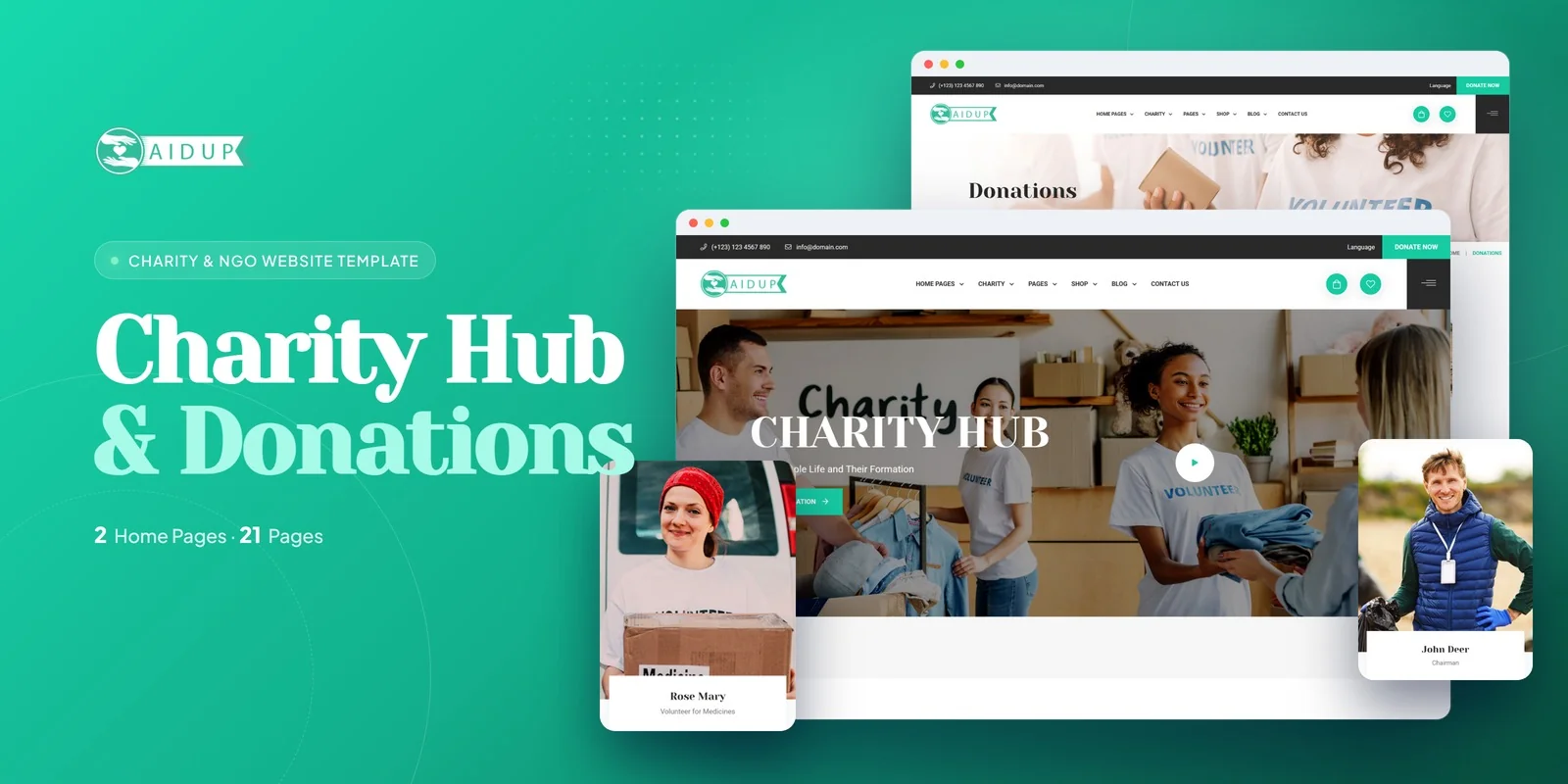
Aidup is a charity and donation HTML5 template built exclusively for charities, NGOs, humanitarian foundations, and nonprofit organizations. With 19 fully crafted HTML pages, it provides the comprehensive page set that purpose-driven organizations need without requiring custom development.
The template includes two unique home layouts for brand flexibility and a complete donation system with campaign archive and individual campaign detail pages — the exact structure needed for organizations running multiple fundraising initiatives simultaneously. The events module features both an event archive and full event detail pages for promoting galas, drives, awareness campaigns, and community gatherings.
For supplementary revenue, Aidup includes a five-page e-commerce shop — archive, product detail, cart, checkout, and wishlist — enabling nonprofits to sell cause-related merchandise and fundraising products. Volunteer and team pages provide the recruitment and showcase capabilities that most generic templates completely lack.
The template also includes dedicated history and about pages for organizational storytelling, an FAQ page for addressing donor concerns, and a blog module for ongoing news and content publishing. Counterup animated statistics bring impact numbers to life, while the countdown timer creates urgency around campaign deadlines.
Built on Bootstrap 4 with Slick carousels, Isotope grid filtering, WOW.js scroll animations, and Magnific Popup lightbox, Aidup delivers a production-ready nonprofit web presence at a price point that respects the budget realities of mission-driven organizations.
Frequently Asked Questions
What pages should a charity website have?
A charity website should include a homepage with mission statement and featured campaigns, donation pages for both general giving and specific campaigns, event listings with detail pages, volunteer recruitment pages, team and leadership showcase, about and history pages, a blog or news section, an FAQ page, and contact information. E-commerce pages for cause-related merchandise are increasingly common and valuable.
How much should a nonprofit spend on its website?
The appropriate budget depends on your organization’s size and revenue. Small nonprofits can launch professional websites for under $500 using premium HTML templates with freelance setup assistance. Mid-size organizations typically invest $5,000 to $15,000 for custom designs. Large national charities may spend $30,000 to $100,000 or more. The key principle is choosing an approach that delivers professionalism without diverting excessive resources from your mission.
What makes a good donation page?
An effective donation page includes preset giving amounts alongside a custom amount field, the option to set up recurring monthly donations, a brief impact statement showing what each giving level accomplishes, minimal form fields to reduce friction, mobile-optimized design for on-the-go giving, and secure payment processing. The entire donation process should be completable in under two minutes on a mobile device.
Can a charity website also sell merchandise?
Yes, and many nonprofits should. Cause-related merchandise — branded apparel, awareness products, holiday items, and charity-themed gifts — generates supplementary revenue while spreading awareness. Templates with built-in e-commerce features including shop pages, product details, cart, checkout, and wishlist make this possible without expensive e-commerce platform subscriptions.
How do I build trust with donors through my website?
Trust is built through professional design, transparent information about leadership and finances, real stories and photos from beneficiaries, clearly displayed contact information, partner and accreditation logos, an accessible FAQ addressing common concerns, and consistent branding across all pages. Animated impact statistics that show concrete results — lives changed, funds distributed, campaigns completed — provide visual proof that donations are making a difference.
Do I need a developer to set up a charity website template?
Not necessarily. Modern HTML templates are structured so that non-technical users can customize content by editing HTML files — replacing placeholder text, images, and links with your organization’s information. For more complex needs like payment gateway integration or custom form processing, a freelance developer can typically handle the setup for a few hundred dollars — a fraction of what a full agency project would cost.
How can a charity website help with volunteer recruitment?
Dedicated volunteer pages that describe available opportunities, time commitments, required skills, and the impact of volunteer work attract supporters who may not be ready to give financially but want to contribute their time. Team showcase pages introduce current volunteers and staff, creating a welcoming community feel. Registration forms capture volunteer contact details for follow-up and scheduling. These features are essential but missing from most generic website templates.
The nonprofit sector faces a unique paradox: the organizations that most need professional websites are often the ones least able to afford them. Grant budgets rarely include web development. Donor expectations for professionalism continue to rise. And the gap between what a modern donor expects from a charity website and what most small nonprofits can deliver grows wider every year. Closing that gap affordably is not just a convenience — it is a strategic imperative for organizations that depend on public trust and online giving to fulfill their missions.
Final Verdict
Building a charity website in 2026 requires balancing professionalism with budget responsibility. Donors expect polished, trustworthy web experiences, but nonprofit leaders must justify every expenditure. The solution is choosing a template specifically designed for charitable organizations — one that includes donation systems, event management, volunteer recruitment, impact visualization, and e-commerce capabilities out of the box.
Every dollar saved on website development is a dollar that reaches your mission. A purpose-built charity template delivers the professionalism donors expect at a cost that respects the budget realities of mission-driven work.