The recreational cannabis industry crossed $31 billion in U.S. sales last year, and that number keeps climbing. Twenty-four states plus Washington, D.C. now allow adults to purchase cannabis without a medical card, and the recreational segment accounts for roughly two-thirds of total cannabis revenue nationwide.
Yet most dispensary owners still run their business without a real website. They rely on third-party marketplaces, iFrame menus from platforms like Dutchie, or a bare-bones social media page that could get shut down overnight. The reason is straightforward: Google and Meta ban cannabis advertising, mainstream e-commerce platforms refuse cannabis merchants, and hiring a cannabis-specialized web agency costs anywhere from five to fifty thousand dollars.
That leaves a massive gap between what recreational cannabis businesses need and what they can actually afford. A well-built recreational cannabis website template closes that gap. It gives dispensary owners, CBD retailers, cannabis brands, and delivery services a professional, compliance-ready online storefront for a fraction of the cost of custom development.
This guide covers everything a recreational cannabis business needs to know before building a website in 2026: what today’s consumers expect, which compliance features are non-negotiable, how to handle the payment processing challenge, why organic search is your most valuable marketing channel, and how a purpose-built template like Recreational delivers all of it for $49.
The Recreational Cannabis Market in 2026
Understanding the market context explains why a strong website is no longer optional for recreational cannabis businesses.
The U.S. cannabis market is projected to reach roughly $47 billion in 2026. The recreational use segment dominated with a 66.9% revenue share in 2024, and it continues to grow at the fastest rate. The industry now supports over 425,000 full-time equivalent jobs across cultivation, processing, distribution, and retail.
Twenty-four states have legalized recreational cannabis: Alaska, Arizona, California, Colorado, Connecticut, Delaware, Illinois, Maine, Maryland, Massachusetts, Michigan, Minnesota, Missouri, Montana, Nevada, New Jersey, New Mexico, New York, Ohio, Oregon, Rhode Island, Vermont, Virginia, and Washington. Each state runs its own regulatory framework, which means compliance requirements vary by jurisdiction.
The consumer base is maturing rapidly. Recreational cannabis buyers are no longer a niche demographic. They include professionals, retirees, parents, and first-time users who expect the same polished online shopping experience they get from any other retail category. Over 70% of cannabis consumers use mobile devices to browse and shop, and 61% review online menus before visiting or ordering from a dispensary.
For dispensary owners, the takeaway is clear. Your website is your storefront, your menu, your compliance assistant, and your primary marketing channel, all at once. Operating without one means losing customers to competitors who invested in their digital presence.
What Recreational Cannabis Consumers Expect from a Website
Recreational shoppers are not patients researching treatment options. They are consumers browsing products, comparing options, and deciding where to spend their money. Their expectations mirror mainstream e-commerce, with a few cannabis-specific requirements layered on top.
Fast, mobile-first browsing. Over 80% of cannabis e-commerce traffic comes from smartphones. If your site loads slowly or forces users to pinch and zoom on a phone screen, they leave. Mobile-first responsive design is not a bonus feature. It is the baseline.
Product browsing with real structure. Recreational shoppers want to browse by category: flower, edibles, concentrates, vaporizers, accessories. Within those categories, they want to filter by strain type (indica, sativa, hybrid), potency, price, and brand. A flat list of products with no filtering drives customers to a competitor who organizes their catalog properly.
Strain comparison. This is unique to cannabis retail. Consumers want to compare strains side by side, looking at THC and CBD percentages, terpene profiles, effects, and pricing. A product comparison feature is not a luxury. It is a conversion tool that recreational shoppers actively look for.
Visual confidence. High-quality product photography, clean typography, and professional layout signal that a business is legitimate. In an industry where trust and legality are top-of-mind concerns, a polished website does more than attract customers. It reassures them.
Content that educates. Blog content about strain reviews, consumption methods, industry news, and local regulations builds organic search traffic and positions a dispensary as a knowledgeable, trustworthy source. Three-quarters of cannabis consumers say they research products online before purchasing.
Delivery and pickup options. The delivery segment is projected to grow from $2.95 billion to $18.65 billion over the next decade. Consumers increasingly expect click-and-collect, curbside pickup, and delivery options directly from a dispensary website. Checkout flows need to accommodate all three.
Recreational vs. Medical Cannabis Websites: Why the Distinction Matters
Not every cannabis website template works for a recreational business. Templates designed for medical cannabis dispensaries use different language, different UX patterns, and different compliance frameworks. Understanding the distinction prevents you from choosing a template that sends the wrong message to your customers.
Design and tone. Medical cannabis sites use clinical, pharmaceutical aesthetics: calm colors, clean sans-serif fonts, imagery that suggests wellness and therapy. Recreational sites lean toward lifestyle branding: vibrant product photography, bold typography, and design that feels like a premium retail experience rather than a pharmacy.
Language and messaging. Medical cannabis sites use terms like “patient,” “therapy,” “wellness,” “compassion,” and “dosing.” Recreational sites use “consumer,” “experience,” “flavor,” “effects,” and “deals.” Using medical language on a recreational dispensary site creates a disconnect that confuses visitors and undermines trust.
User experience priorities. Medical sites emphasize appointment booking, physician verification, and patient card validation. Recreational sites prioritize product browsing, strain comparison, shopping cart functionality, and quick checkout. The core user journey is fundamentally different.
Age verification. Medical cannabis typically requires patients to be 18 or older with a valid medical card. Recreational cannabis requires all visitors to be 21 or older, verified through a more prominent age gate before accessing any content or products.
Call to action. Medical sites drive toward “Book a consultation” or “Get your medical card.” Recreational sites drive toward “Shop now,” “Browse strains,” or “Order for pickup.” Choosing a template built for the wrong model means your primary conversion paths will not match what your customers actually want to do.
A recreational cannabis website template should be built from the ground up for the consumer shopping experience, not retrofitted from a medical cannabis framework.
Age Verification: The Non-Negotiable Compliance Feature
Every recreational cannabis website needs an age verification gate. This is not a suggestion. It is a legal requirement in every state that permits recreational sales, and failing to implement it properly can result in fines, license challenges, and legal liability.
Simple pop-up checkboxes are no longer sufficient. Regulators and compliance auditors increasingly view “Are you 21?” checkboxes as inadequate. They do not verify anything. Modern age verification approaches range from date-of-birth entry forms to full digital ID verification using document scanning, selfie biometrics, and knowledge-based authentication.
Session-based verification reduces friction. Best practice is to verify age once at the entry point and maintain that verification throughout the browsing session. Requiring re-verification on every page or at checkout creates abandonment. Once a visitor has confirmed their age, they should be able to browse freely for the remainder of their visit.
Data collection restrictions apply to minors. It is illegal under COPPA and state privacy laws to collect any personal information from minors, including email addresses for newsletter signups. Your age gate must prevent underage visitors from accessing any data collection forms on your site.
Geofencing adds a second compliance layer. For dispensaries offering delivery, geofencing technology can automatically block orders from prohibited jurisdictions and restrict purchase flows to legally permitted delivery zones. This prevents compliance violations from location spoofing and out-of-area orders.
Your website template should include, or provide clear integration points for, an age verification gate that appears before any content or product information is accessible. The gate should be full-screen, clearly branded, and impossible to bypass through direct URL access to interior pages.
Building a Product Catalog That Converts Recreational Shoppers
The product catalog is where recreational cannabis websites succeed or fail. Unlike a clothing store where shoppers browse by size and color, cannabis consumers evaluate products across multiple dimensions: strain type, potency, terpene profile, consumption method, price, and brand.
Multiple shop layouts serve different browsing styles. Some shoppers want a grid view to scan products quickly. Others prefer a sidebar layout that keeps category filters visible while they browse. Offering standard, left-sidebar, and right-sidebar shop layouts lets each customer find their preferred browsing experience without leaving your site.
Product detail pages need depth. A recreational cannabis product page should include the strain name, type (indica/sativa/hybrid), THC and CBD percentages, terpene profile, weight options, pricing, high-resolution photography, and a detailed description of effects and flavor. Thin product pages with just a name and price lose sales to competitors who provide richer information.
Product comparison drives higher-value purchases. When shoppers can compare two or three strains side by side, they spend more time on site and purchase with greater confidence. Comparison functionality that lets users select products and view their attributes in a structured table format directly increases average order value.
Category organization matters. Your shop should be navigable by product type (flower, pre-rolls, edibles, concentrates, topicals, accessories) as well as by effect (relaxation, energy, creativity, pain relief). Cross-referencing these two taxonomies gives shoppers multiple paths to find what they want.
The Payment Processing Challenge (and How to Plan for It)
Payment processing is the single most frustrating operational challenge for cannabis e-commerce businesses. Because cannabis remains federally illegal in the United States, traditional banks, major credit card networks, and mainstream payment processors refuse to serve cannabis merchants. Understanding this landscape before you build your website prevents costly mistakes.
Cash is still dominant, but declining. For years, most dispensary transactions were cash-only. This creates security risks, limits revenue potential, and makes online ordering nearly impossible. The industry has been forced to innovate around this constraint.
ACH and direct bank transfers are emerging as the preferred solution. Many regulators and financial institutions now view ACH payments as an acceptable digital payment method for cannabis businesses, provided proper compliance controls are in place. QR-code-initiated ACH transfers, where the customer scans a code and authorizes the transfer through a mobile interface, are becoming standard.
Specialized cannabis payment processors exist. Companies built specifically for the cannabis industry offer compliant merchant accounts with real-time settlement, mobile payment integration, and regulatory compliance built into the platform. Dispensaries that accept cashless payments see 30% or more completed online orders, and daily revenue increases by an average of $4,627 when digital payment options are available.
Workarounds are getting shut down. Regulators and card networks are actively cracking down on payment solutions that misclassify transactions to route cannabis payments through traditional processors. Non-compliant systems expose dispensaries to fines, frozen accounts, and license challenges. Any payment integration on your website must use a genuinely cannabis-compliant processor.
Your website template should accommodate payment flexibility. The payment landscape for cannabis is evolving rapidly. Your template should support integration with cannabis-specific payment processors, display clear payment method information to customers, and accommodate future payment technologies as they become available. Hardcoding a single payment solution into your site architecture limits your options as the industry matures.
Why Organic Search Is Your Most Valuable Marketing Channel
Cannabis businesses face advertising restrictions that no other legal retail industry deals with. Google Ads prohibits cannabis advertising. Meta (Facebook and Instagram) prohibits cannabis advertising. Most programmatic ad networks refuse cannabis merchants. TikTok, Snapchat, and X (Twitter) have varying levels of restriction that make paid social unreliable.
This makes organic search engine optimization the primary customer acquisition channel for recreational cannabis businesses. Your website is not just a storefront. It is your main advertising platform.
Semantic HTML structure matters. Search engines evaluate your site’s heading hierarchy, content structure, and HTML semantics to determine relevance. A website template built with clean, semantic HTML5 and a logical heading hierarchy (H1 through H6) gives your content the best chance of ranking for cannabis-related search queries.
Blog content builds organic traffic. Dispensaries with active blogs that cover strain reviews, consumption guides, industry news, and local regulatory updates consistently outperform competitors in organic search. Three blog layouts with matching detail pages (standard, left sidebar, right sidebar) let you publish content in the format that best suits each article type.
Local SEO captures nearby shoppers. For brick-and-mortar dispensaries, local search optimization is critical. Your website should include structured location data, Google Maps integration on the contact page, consistent NAP (name, address, phone) information, and schema markup for local business listings. When someone searches “dispensary near me” or “recreational cannabis [city name],” your site needs to rank.
Page speed affects rankings and conversions. Google uses Core Web Vitals as a ranking signal, and slow-loading pages lose visitors. A lightweight template built on a modern framework without bloated dependencies loads faster, ranks better, and converts more visitors into customers.
Mobile-first indexing is the default. Google primarily uses the mobile version of your site for indexing and ranking. A template that is not genuinely responsive and mobile-optimized will underperform in search results regardless of how good the desktop version looks.
Compliance Checklist for Recreational Cannabis Websites
State cannabis regulators inspect more than just your physical storefront. Your website is part of your compliance profile. Here are the features and policies every recreational cannabis website must address:
Age verification gate. Full-screen, session-based verification confirming visitors are 21 or older before accessing any content. Must not be bypassable through direct URL access.
No appeal to minors. Your design, imagery, language, and product descriptions must not use elements that could attract minors. Avoid cartoon characters, bright candy-like color schemes, slang that targets younger demographics, or imagery associated with youth culture.
State-specific disclaimers. THC content warnings, consumption advisories, and health disclaimers vary by state. Your site should include the disclaimers required in your operating jurisdiction, typically in the footer and on product pages.
Advertising compliance. Even on your own website, some states restrict how cannabis products can be promoted. Claims about health benefits, therapeutic effects, or medical use may be prohibited for recreational retailers. Stick to factual product descriptions.
Privacy policy. Cannabis businesses handle sensitive customer data. Your privacy policy must comply with state privacy laws and should explicitly address how customer data is collected, stored, and used, especially for age verification and delivery services.
Delivery zone restrictions. If you offer delivery, your website should clearly communicate which areas you serve and use geofencing or zip-code validation to prevent orders from outside your licensed delivery zone.
Lab results and testing information. Some states require or encourage displaying third-party lab testing results for cannabis products. Your product pages should have space for batch numbers, testing dates, and links to certificates of analysis.
Introducing Recreational: A Cannabis Shop Template Built for the Consumer Experience
Everything covered in this guide so far, the consumer expectations, the compliance requirements, the mobile-first design, the product catalog structure, the blog infrastructure for organic search, describes what a recreational cannabis website needs to succeed. Recreational is an HTML5 template designed to deliver exactly that.
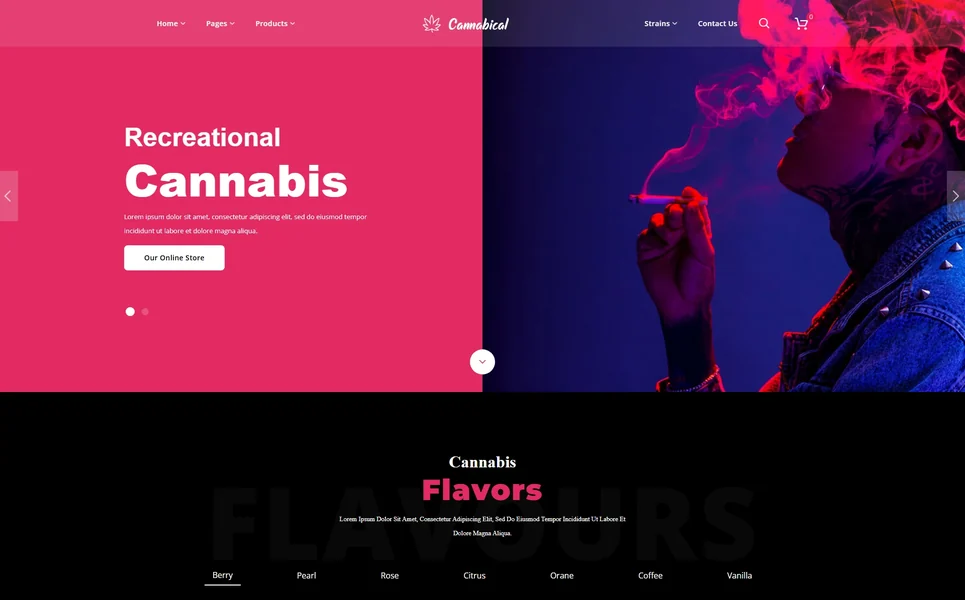
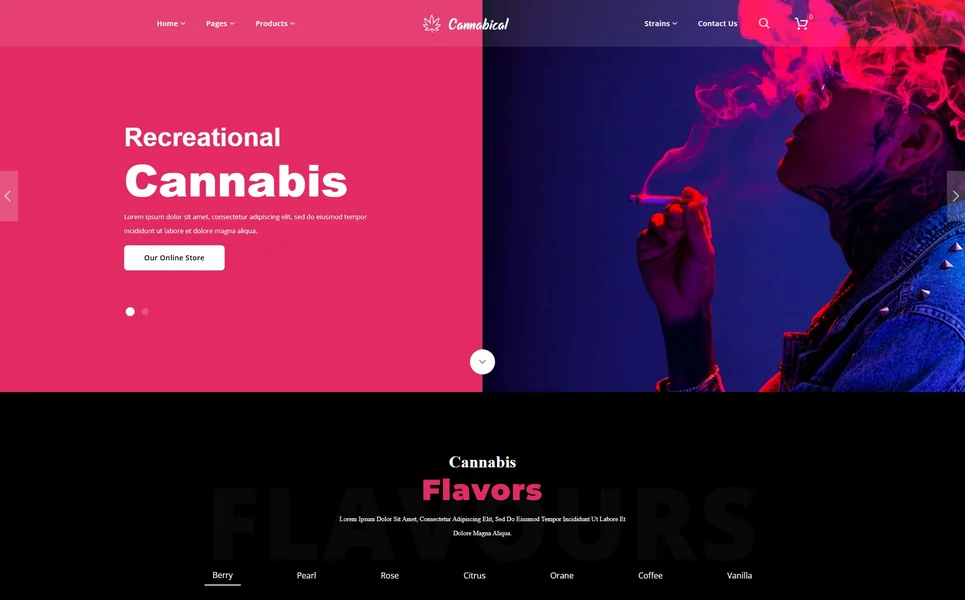
Recreational is a 16-page, conversion-focused HTML5 template built specifically for recreational cannabis shops, CBD retailers, and marijuana dispensaries. It runs on Bootstrap and jQuery, which means it is fully responsive across all devices, cross-browser compatible, and lightweight enough to load fast without server-side dependencies.
Here is what the template includes and why each piece matters for a recreational cannabis business:
Three shop layouts. Standard shop, left sidebar shop, and right sidebar shop give customers the browsing experience they prefer. The left sidebar layout keeps category filters visible during browsing. The right sidebar layout works well for featured products or promotional content. The standard layout maximizes product grid space for large catalogs.
Product detail page. A dedicated product page designed for strain descriptions, potency information, terpene profiles, weight options, pricing, and high-resolution product images. This is where cannabis shoppers make their purchase decision, and the page is structured to support that decision with the right depth of information.
Product comparison page. Side-by-side comparison for strains, edibles, concentrates, and accessories. This feature directly addresses one of the most common recreational shopping behaviors: comparing products before committing to a purchase.
Six blog pages. Three blog archive layouts (standard, left sidebar, right sidebar) and three matching blog detail layouts give you full flexibility for content marketing. Strain reviews, consumption guides, regulatory updates, and industry news each benefit from different layout approaches.
User authentication. Login and signup pages that match the dispensary design language. User accounts support order history, saved favorites, and personalized experiences that drive repeat purchases.
Contact page with map integration. Location details, embedded map, and contact form for store inquiries. This page feeds directly into local SEO and helps foot-traffic-dependent dispensaries convert online visitors into in-store customers.
Custom 404 page. A branded error page that keeps visitors within your store experience instead of bouncing them to a generic browser error. In a site with dozens of product pages, 404 handling matters for both user experience and SEO.
Template vs. Dutchie vs. Custom Development: The Cost Breakdown
Choosing how to build your recreational cannabis website is fundamentally a cost-versus-control decision. Here is how the three main options compare:
HTML5 template ($49 one-time). A template like Recreational costs $49 with no recurring fees. You own the code, host it wherever you want, and customize it without restrictions. You handle your own hosting (typically $5 to $30 per month), and you can integrate any cannabis-compliant payment processor without being locked into a proprietary ecosystem. Total first-year cost: roughly $100 to $400 including hosting and a domain name.
Dutchie or similar SaaS platform ($500+ per month). Platforms like Dutchie provide a complete technology stack: point of sale, e-commerce, payments, and loyalty programs. Dutchie facilitates over $15 billion in annual sales across 6,000+ dispensaries. The tradeoff is cost and control. Starting at $500 per month per location, that is $6,000 per year minimum. You are also locked into their proprietary payment processor (Dutchie Pay), your website lives on their platform, and your design customization is limited to what their system allows.
Custom cannabis web development ($5,000 to $50,000+). A cannabis-specialized agency builds your site from scratch with fully custom design, integrations, and features. This is the most flexible option but also the most expensive. Semi-custom WordPress builds with WooCommerce start around $500 to $7,500. Fully custom builds with advanced e-commerce, POS integration, and delivery management typically cost $5,000 to $50,000 or more depending on features and agency rates.
For a dispensary owner who wants a professional, compliance-aware website without SaaS lock-in or agency-level costs, a purpose-built template is the most practical starting point. You can always scale to a SaaS platform or custom solution later as your business grows. Starting with a $49 template that includes 16 pages, multiple shop layouts, product comparison, blog infrastructure, and user authentication is a strategic foundation, not a compromise.
How to Launch Your Recreational Cannabis Website
Getting from template purchase to a live, functioning cannabis website involves a straightforward sequence of steps. Here is the practical roadmap:
Step 1: Secure compliant hosting. Choose a hosting provider that accepts cannabis-related websites. Not all hosts do. Look for providers that explicitly state cannabis businesses are welcome in their acceptable use policy. Expect to pay $10 to $30 per month for reliable shared or VPS hosting.
Step 2: Register your domain. Your domain name should include your business name and ideally your city or state for local SEO. Avoid slang or terms that could trigger content filters. Keep it professional and memorable.
Step 3: Customize the template. Replace placeholder content with your actual business information, product catalog, imagery, and branding. Update colors, fonts, and logos to match your dispensary’s visual identity. The template’s clean, well-commented codebase makes this straightforward even if you are not a developer.
Step 4: Implement age verification. Add an age verification gate as the first thing visitors encounter. This can be built as a custom overlay using the template’s existing JavaScript framework, or you can integrate a third-party age verification service for more robust compliance.
Step 5: Set up your product catalog. Populate your shop pages with your actual product inventory. Include strain names, types, potency data, pricing, descriptions, and product photography. The multiple shop layouts let you test which format converts best for your specific product mix.
Step 6: Configure payment integration. Connect a cannabis-compliant payment processor. Research options in your state, as availability varies by jurisdiction. Display accepted payment methods clearly on your site.
Step 7: Publish initial blog content. Launch with at least three to five blog posts covering topics relevant to your local market: strain guides for beginners, what to expect when visiting your dispensary, local cannabis regulations, or product category explainers. This seeds your organic search presence from day one.
Step 8: Submit to Google Search Console and set up analytics. Register your site with Google Search Console, submit your sitemap, and install analytics tracking. Monitor which pages attract traffic, which products get the most views, and where visitors drop off.
Frequently Asked Questions
Do I need age verification on my cannabis website even if I do not sell products online?
Yes. Every recreational cannabis website needs an age verification gate, regardless of whether you sell online. Regulators require it for any website that promotes, displays, or provides information about cannabis products. Even a brochure-style site with your dispensary menu, location, and hours needs to verify that visitors are 21 or older before showing cannabis-related content.
Can I use Shopify or WooCommerce for a cannabis e-commerce store?
Shopify explicitly prohibits the sale of cannabis and cannabis-related products on its platform, and accounts can be terminated without warning. WooCommerce, as a self-hosted solution, is more flexible, but you still need a cannabis-compliant payment processor, which limits your options. An HTML5 template gives you full control over your site without platform restrictions, and you can integrate any payment processor that supports your jurisdiction.
How do cannabis websites handle payment processing?
Most cannabis websites use ACH (direct bank transfer) payments, often initiated through QR codes that customers scan with their phones. Specialized cannabis payment processors offer compliant merchant accounts. Some dispensaries accept debit card payments through PIN-based debit networks. Traditional credit card processing through Visa, Mastercard, and American Express is generally not available for cannabis businesses due to federal prohibition.
What compliance features should a recreational cannabis website include?
At minimum: a 21+ age verification gate, state-specific THC disclaimers, a privacy policy addressing cannabis customer data, no design elements that could appeal to minors, accurate product information including lab testing data where required, and clear delivery zone boundaries if you offer delivery. Check your state cannabis regulatory authority for jurisdiction-specific requirements.
Is SEO really that important for cannabis businesses?
Organic search is the most important marketing channel for cannabis businesses because paid advertising on Google, Meta, and most other platforms is prohibited. Dispensaries that invest in SEO through blog content, local search optimization, and proper site structure consistently outperform competitors in customer acquisition. Your website template’s semantic HTML structure, heading hierarchy, and blog infrastructure directly support SEO performance.
How much does it cost to build a cannabis dispensary website?
Costs range dramatically. Template-based sites cost $49 to $500 for the template plus $60 to $360 per year for hosting. SaaS platforms like Dutchie start at $500 per month ($6,000 per year). Custom development ranges from $5,000 to $50,000 or more. For most new or growing dispensaries, a $49 HTML5 template with professional hosting is the most cost-effective way to establish a credible online presence while preserving budget for inventory and operations.
Can I customize a cannabis website template to match my dispensary brand?
Absolutely. The Recreational template is built on Bootstrap with clean, well-commented source code. You can change colors, fonts, logos, images, and layout elements without touching the core framework. The 16-page template includes every page type a recreational dispensary needs, and each page can be customized independently. If you have basic HTML and CSS knowledge, or access to a freelance developer, full brand customization typically takes a few days, not weeks.
Building Your Recreational Cannabis Website Starts Here
The recreational cannabis industry is growing, regulation is expanding, and consumer expectations are rising. A professional website is no longer a nice-to-have. It is a requirement for any dispensary that wants to compete for market share, build customer trust, and establish the organic search presence that paid advertising cannot provide.
Recreational gives you a 16-page, conversion-focused HTML5 template built specifically for the recreational cannabis shopping experience. Three shop layouts, product comparison, six blog pages, user authentication, contact with map integration, and a clean Bootstrap codebase that loads fast and looks sharp on every device.
At $49 with no recurring fees, no platform lock-in, and no restrictions on how you customize or host your site, it is the most practical starting point for recreational dispensary owners, CBD retailers, cannabis brands, and delivery services that need a professional online presence today.
View the live demo to see every page in action before you decide.
-
HTML5
$49.00 Original price was: $49.00.$18.00Current price is: $18.00.
-
 PHP
PHP
$49.00 Original price was: $49.00.$21.00Current price is: $21.00.