Faith communities around the world share a common challenge in 2026: reaching people where they spend their time. Whether your congregation gathers in a cathedral, a temple, a mosque, a synagogue, or a community center, the first interaction most newcomers have with your organization is digital. They search for a place of worship near them, scan the website for 15 seconds, and decide whether to visit in person or keep scrolling. A religious website template built for faith organizations gives you the structure and design quality to win that 15-second evaluation, regardless of your tradition or denomination.
Why Faith Communities Need Modern Websites
Religious organizations operate differently from commercial businesses, but the expectations of their audiences do not. A family searching for a Hindu temple, a young professional looking for a mosque with Friday prayer times, or a couple researching churches for their wedding all start the same way: with a Google search. If your faith community does not appear in those results with a professional, informative website, you lose that family, that professional, and that couple to an organization that invested in its online presence.
The practical demands on a religious website are substantial. Visitors need service schedules, location information, and leadership bios. Members need event calendars, volunteer signups, and access to recorded teachings. Donors need a secure, convenient way to contribute financially. Administrative staff need a site they can update without calling a developer every time the holiday service schedule changes. A well-chosen religious website template addresses every one of these needs from day one, with pages and components already designed for the specific workflows of faith-based organizations.
There is also a generational shift happening across all faiths. Younger members, those under 35, evaluate organizations partly through their digital presence. A temple website that looks like it was built in 2010 sends an unintended message about how the organization approaches communication, relevance, and community engagement. A modern, mobile-friendly religious website signals that your community is vibrant, organized, and ready to welcome new members. The design of your site is not vanity. It is hospitality extended to people who have not yet walked through your doors.
What Every Religious Website Needs
Donation and Tithing Systems
Financial giving is central to the operation of nearly every faith community. Churches collect tithes and offerings. Mosques receive zakat and sadaqah. Temples accept dana and prasadam contributions. Synagogues fund operations through membership dues and donations. Regardless of the terminology, the underlying need is identical: a secure, accessible, and trustworthy way for members and supporters to give money online. The best religious website templates include dedicated donation pages with campaign-specific layouts, progress tracking for fundraising goals, and support for both one-time and recurring contributions.
Visibility matters. A donation page buried three clicks deep in your navigation will underperform compared to one that is accessible from a persistent button in the header or footer of every page. Faith communities that implement prominent, well-designed online giving consistently report higher participation rates than those that treat digital donations as an afterthought. Your religious website template should make giving easy, transparent, and dignified.
Sermon and Teaching Archives
Every major faith tradition produces teachings that members want to revisit and share. Christian churches record sermons. Mosques archive khutbahs. Buddhist centers record dharma talks. Hindu temples share pravachans and kirtans. A religious website template with a robust media archive section lets you store, organize, and present these recordings in a way that keeps your community engaged between gatherings. The most effective archive pages include speaker attribution, date and topic filtering, scripture or text references, and both audio and video playback options embedded directly on the page.
An accessible teaching archive also serves as a powerful outreach tool. People exploring a new faith tradition often listen to several teachings before committing to attend in person. A visitor considering your mosque, temple, or church can preview your spiritual leader’s style and substance from the comfort of their home. This lowers the barrier to that critical first visit.
Event and Service Schedules
Religious communities are built around gatherings. Weekly services, holiday observances, study groups, youth programs, community meals, interfaith dialogues, seasonal celebrations. The calendar of a typical faith organization is dense and varied. A static list of service times on a contact page is not sufficient. Your religious website needs a full event management system with individual event pages that display dates, times, locations, descriptions, and registration or RSVP options.
Holiday scheduling is particularly important for religious organizations. Ramadan prayer times shift daily. Jewish holiday dates change annually on the Gregorian calendar. Hindu festivals follow lunar cycles. Christian liturgical seasons restructure the entire worship calendar. A religious website template with flexible event scheduling handles this complexity without requiring a redesign every time the calendar shifts.
Community Features
Faith is communal. The best religious websites reflect that by including features that facilitate connection beyond the worship service. Prayer request walls, volunteer directories, small group finders, and member directories help people find their place in the community. Team and leadership profile pages put faces to names, which is especially valuable for newcomers who may feel intimidated walking into an unfamiliar house of worship. Newsletter signup forms keep your community informed without relying on social media algorithms that bury organic posts.
A shop or resource section can also serve a community-building function. Selling devotional books, prayer beads, religious artwork, or event tickets through your website creates another touchpoint between your organization and its members. Several religious website templates include integrated shop pages with cart and checkout functionality, so you do not need a separate e-commerce platform to offer these items.
2 Best Religious Website Templates (2026)
After reviewing religious website templates for design quality, multi-faith adaptability, feature completeness, and mobile responsiveness, these two templates represent the strongest options available in 2026. Both are built on Bootstrap 5 with clean HTML5 code and full documentation.
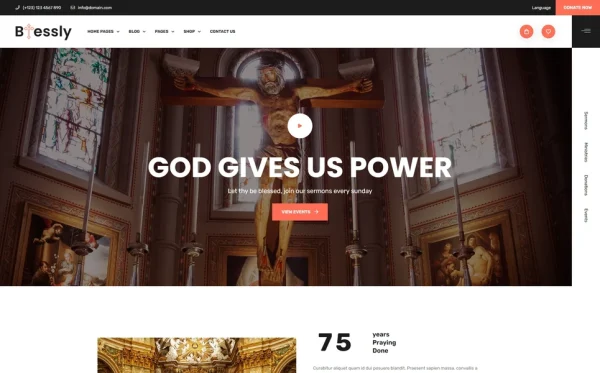
1. Blessly (20 Pages)
Blessly provides a solid, well-structured foundation for any faith community that wants a professional website without an overwhelming setup process. Its 20-page architecture covers the core needs shared across religious traditions: 2 homepage variants, a teaching/sermon archive with detail pages, an event calendar with individual event pages, a donation system with campaign-level detail pages, ministry or program pages in multiple layout styles, leadership and team profiles, a blog, and a shop with cart, checkout, and wishlist functionality.
While Blessly uses church-oriented language and imagery in its default design, the underlying structure is denomination-agnostic. The “sermon” archive functions equally well as a dharma talk library, a khutbah collection, or a lecture archive. The “ministry” pages work as program pages for any type of community group. The donation pages, event system, and team profiles require nothing more than a content swap to serve a mosque, temple, gurdwara, or synagogue. The two homepage layouts offer different visual approaches. One opens with a full-width video hero and statistical counters. The other emphasizes imagery and prominent calls to action. Both include testimonial sections, event listings, and social media integration.
For smaller faith communities or organizations launching their first website, Blessly’s focused page count is an advantage. Twenty pages is enough to cover every essential function without creating a maintenance burden. Every page has a clear purpose, and the clean Bootstrap 5 codebase makes customization straightforward for developers of any skill level.
Best for: Small to mid-sized faith communities of any tradition that need a focused, professional website with teaching archives, event management, and online giving. View Live Demo
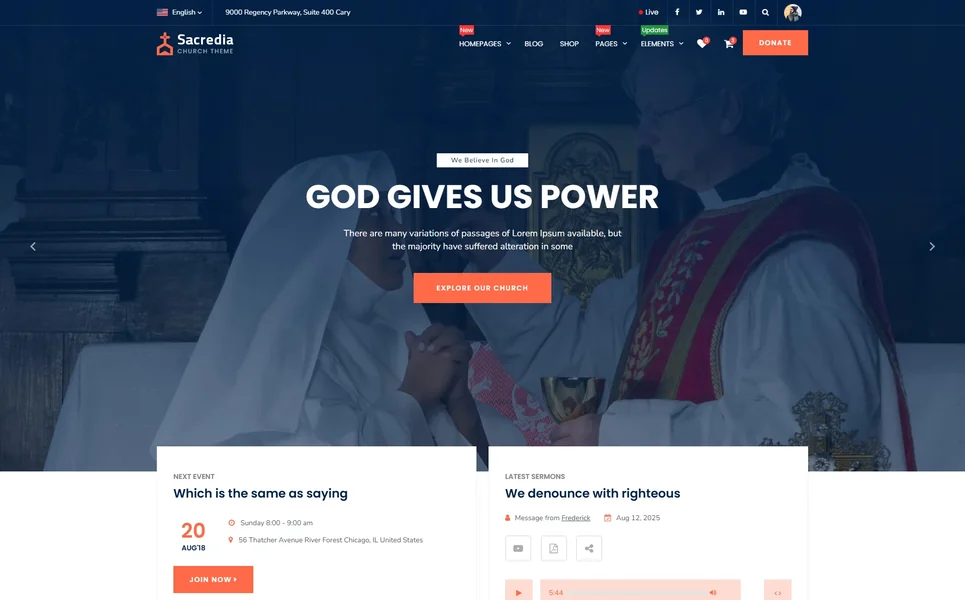
2. Sacredia (31 Pages, 10 Homepage Layouts)
Sacredia is the most versatile religious website template on the market, and its 10 homepage layouts are the reason. These are not minor color variations. Each layout is architecturally distinct, built to serve a specific type of faith organization: Catholic, Protestant, Eastern Orthodox, charity, NGO, non-profit, event-centered, ministry-focused, and donation-driven designs. This range makes Sacredia uniquely suited for multi-faith contexts. A Catholic parish, an Orthodox cathedral, a Protestant community church, and a faith-based charity can all start from the same template and arrive at dramatically different websites by selecting the appropriate homepage and customizing the content.
The adaptability extends beyond Christianity. Sacredia’s charity, NGO, and non-profit homepage variants use neutral, community-focused design language that translates naturally to Hindu service organizations, Buddhist meditation centers, Islamic charitable foundations, and interfaith community groups. The event-centered layout works for any organization whose primary function is gathering people, whether for worship, study, meditation, or community service. The donation-driven layout prioritizes fundraising, making it ideal for faith-based relief organizations, building campaigns, or community development initiatives.
At 31 pages, Sacredia’s feature library is extensive. A prayer wall supports community intercession and prayer request sharing. The sermon archive includes speaker profiles and video playback. A full event scheduling system provides countdown timers and location details. The shop handles merchandise, books, and devotional items. A live broadcast section supports online streaming for organizations offering virtual worship. Multi-language support in English, French, and German serves multilingual congregations and international organizations. A member dashboard provides profile management and personalized access to community resources.
Sacredia is the right choice for larger faith organizations, multi-campus operations, denominational headquarters, or any religious community that anticipates significant growth in its online presence. The 31-page architecture provides room to expand without outgrowing the template.
Best for: Larger faith organizations, multi-denomination communities, faith-based charities, and religious groups that need maximum design flexibility with denomination-specific homepage layouts. View Live Demo
Essential Features for Religious Websites
Regardless of your faith tradition, these features form the foundation of an effective religious website in 2026.
- Secure online donation page. A prominent, dedicated giving page with support for one-time and recurring contributions. Accessible from every page on the site through a persistent header or footer link.
- Teaching and sermon archive. A searchable, filterable library of recorded teachings with speaker names, dates, topics, and embedded audio or video playback.
- Event calendar with detail pages. Individual event pages displaying dates, times, locations, descriptions, and registration or RSVP options. Support for recurring events and holiday schedules.
- Mobile-responsive design. Built on a framework like Bootstrap 5 that adapts automatically to smartphones, tablets, and desktops. Over 60% of your visitors will access your site from a mobile device.
- Leadership and team profiles. Photos, bios, and roles for your spiritual leaders, staff, and key volunteers. Newcomers want to know who leads the community before attending.
- Community and program pages. Dedicated pages for each ministry, program, study group, or service initiative with descriptions, schedules, and contact information.
- Blog or news section. Regular content updates improve search visibility and keep your community informed. Share reflections, event recaps, volunteer spotlights, and organizational news.
- Contact page with map and service times. Your physical address, phone number, email, worship schedule, and an embedded map should be findable within one click from any page.
Start Building Your Faith Community Website
The people your faith community is meant to serve are already online, searching for a spiritual home. They are typing “church near me,” “mosque in Brooklyn,” “Buddhist temple weekend services,” and “synagogue open to newcomers” into Google right now. Whether they find your organization depends entirely on whether you have a professional, functional website that answers their questions and invites them in.
Blessly offers a focused 20-page foundation that works across traditions with minimal customization. Sacredia delivers 31 pages and 10 homepage layouts designed for specific denominations and faith-based organizations, providing the flexibility to match your community’s unique identity. Both templates are built on Bootstrap 5 with responsive layouts, clean source code, and complete documentation. Pick the one that fits your community’s size and goals, customize it with your branding and content, and go live. The people searching for what you offer should not have to scroll past you. Browse All Religious Website Templates