
Launching a startup is an exercise in prioritization. With limited resources, limited time, and unlimited ambition, every decision matters. You need to build a product, find customers, manage finances, and build a team, often simultaneously. In the middle of all this, your website might seem like a secondary concern. Something you will get around to eventually. Something that can wait.
That thinking is a mistake. Your website is not a nice-to-have. It is the front door of your business. It is where potential customers form their first impression, where investors evaluate your credibility, where partners assess your legitimacy, and where job candidates decide whether they want to work with you. In the startup world, where trust is scarce and competition is fierce, your website can be the difference between getting that meeting and getting ignored.
Why Your Startup Website Is Your Most Important Asset
Consider the journey of a potential customer who hears about your startup for the first time. Maybe a friend mentioned it. Maybe they saw a social media post. Maybe they came across your product in a search result. In nearly every scenario, the next step is the same: they visit your website. That visit is your one chance to convert curiosity into interest and interest into action.
The data supports this reality. Research shows that visitors form an opinion about a website within fifty milliseconds, and that opinion is predominantly based on visual design. If your website looks amateurish, outdated, or confusing, visitors assume your product is too. If it looks polished, clear, and professional, they give you the benefit of the doubt and keep reading.
For startups seeking investment, the website is equally critical. Investors routinely check company websites before taking a meeting. A well-designed site that clearly communicates your value proposition, shows traction, and presents your team does not guarantee funding, but a poor website can certainly prevent it. Investors want to see founders who understand their market and can present their vision compellingly. Your website is that presentation, available around the clock.
Anatomy of a High-Converting Startup Landing Page
The best startup websites follow a proven structure that guides visitors from curiosity to conversion. This structure has been refined through thousands of A/B tests and millions of data points across the startup ecosystem. Here is what works.
The Hero Section
Your hero section has one job: communicate what you do and why it matters in five seconds or less. This is the first thing visitors see, and it determines whether they scroll further or leave. An effective hero section includes a headline that states the primary benefit (not the feature), a subheadline that provides context and specificity, a clear call-to-action button with action-oriented text, and a visual element that reinforces the message, whether that is a product screenshot, an illustration, or a short demo video.
The headline deserves particular attention. Research shows that headline optimization alone can lift conversion rates by two hundred fifty to three hundred percent. Focus on the outcome your customer achieves, not the technology you built. Instead of saying what your software does, say what your customer accomplishes by using it.
Social Proof Section
After the hero section captures attention, social proof builds confidence. This section typically includes logos of notable customers or partners, testimonials with specific, quantified results, user count or growth metrics, press mentions or awards, and security or compliance certifications if applicable.
The most effective testimonials include concrete numbers. Telling potential customers that someone increased their conversion rate by a specific percentage using your product tells visitors exactly what they can expect. Vague praise is forgettable. Specific results are compelling.
Feature Showcase
This section explains how your product works and what it does, but always framed through the lens of customer benefit. For each feature, explain the problem it solves, not just what it does. Use screenshots, short videos, or animated illustrations to make abstract concepts tangible. Organize features logically, leading with the most impactful ones that align with your primary value proposition.
Pricing Section
If your startup has a product available for purchase or subscription, transparent pricing builds trust. Display your pricing tiers clearly with the most popular plan highlighted. Include a free tier or trial option to lower the barrier to entry. If your pricing is custom or enterprise-level, provide enough context for visitors to self-qualify, so they know whether your solution is in their budget range before reaching out.
Call-to-Action Strategy
A single, consistent call-to-action should appear multiple times throughout your page: prominently in the hero section, after building desire in the feature section, and near the bottom after addressing objections. The wording of your CTA matters more than most founders realize. Studies show that changing a button from one phrase to another can dramatically impact conversion rates. Words that imply low commitment and easy reversal outperform those that suggest obligation.
The Psychology of Startup Website Conversion
Understanding why people convert (or do not) helps you make smarter design and content decisions. Several psychological principles are particularly relevant for startup websites.
Cognitive Load Theory
Every element on your page requires mental processing from your visitor. Too many options, messages, or visual stimuli create cognitive overload, which leads to decision paralysis and abandonment. The most effective startup pages are ruthlessly focused. One primary message. One primary action. Everything else supports those two things. If a section, image, or paragraph does not directly contribute to your conversion goal, remove it.
Loss Aversion
People are more motivated by the fear of losing something than the prospect of gaining something equivalent. Frame your messaging to highlight what visitors risk by not adopting your solution. What inefficiency will continue? What competitor advantage will they miss? What opportunity will pass them by? This is not about fear-mongering. It is about making the cost of inaction tangible.
The Paradox of Choice
Offering too many options reduces conversion rates. This applies to everything from pricing tiers to navigation menu items. Keep your pricing to three tiers maximum. Limit your navigation to the essential pages. Use a single CTA rather than offering multiple actions at the same point. Simplicity converts.
Performance Optimization for Startups
Page speed is not just a technical metric. It is a business metric. Every second of load time costs approximately seven percent in conversions. For a startup generating one hundred thousand dollars in monthly revenue, reducing load time from five seconds to two seconds could add thousands in monthly revenue. These are not hypothetical numbers. They are documented across multiple studies and industries.
The fundamentals of fast-loading websites include optimized images using modern formats like WebP, minimal JavaScript that loads asynchronously, efficient CSS without bloated frameworks, content delivery network integration for global reach, and browser caching for returning visitors. HTML templates built on lightweight frameworks like Bootstrap have a natural advantage here because they do not carry the overhead of page builders, dynamic rendering engines, or unnecessary plugin scripts.
Mobile-First Design for Startups
Mobile devices now account for over eighty percent of web traffic, but there is a persistent gap between mobile traffic and mobile conversions. Desktop conversion rates average around five percent compared to mobile’s roughly two and a half percent. This gap represents an enormous opportunity for startups that optimize their mobile experience beyond basic responsiveness.
Mobile-first design means designing for the smallest screen first and scaling up, rather than the reverse. It forces you to prioritize ruthlessly. What content is truly essential? What can be collapsed, deferred, or removed entirely? The constraints of mobile design often produce better desktop experiences too, because the exercise of simplification benefits all users.
Critical mobile optimizations for startups include sticky CTAs that remain visible as users scroll, form fields large enough for comfortable thumb input, tap targets at minimum forty-four pixels square for accessibility, streamlined signup flows that minimize typing, and social login options that eliminate the need for manual account creation.
Building Your Startup Website: Template vs. Custom vs. No-Code
Startups have three primary paths to a website, each with distinct advantages. The right choice depends on your stage, budget, and technical resources.
| Approach | Cost | Speed | Flexibility | Best For |
|---|---|---|---|---|
| Professional HTML template | $15-$69 | Days | High (code access) | Technical founders, MVPs |
| No-code builder (Framer, Webflow) | $0-$50/month | Days to weeks | Medium | Non-technical founders |
| WordPress with starter theme | $50-$300 | 1-2 weeks | High | Content-heavy startups |
| Custom development | $5,000-$30,000+ | 2-4 months | Unlimited | Funded startups with specific needs |
| Full-stack SaaS template | $199-$499 | 1-2 weeks | Very high | SaaS products needing auth + billing |
For most early-stage startups, a professional HTML template offers the best value proposition. You get a proven, conversion-optimized design at minimal cost, with the flexibility to customize every element as your brand evolves. The money and time you save can be invested in product development, customer acquisition, and the activities that actually determine whether your startup succeeds.
The key insight is that your website can (and should) evolve as your startup grows. Starting with a template does not mean staying with a template forever. It means launching quickly with a professional foundation while you learn what actually resonates with your audience, then iterating based on real data rather than assumptions.
SEO Strategy for Early-Stage Startups
Search engine optimization is a long-term investment that compounds over time. The sooner you start building your organic search presence, the greater the advantage you accumulate. For startups, SEO strategy should focus on several key areas.
Technical SEO fundamentals include proper meta tags on every page, structured data markup for your business and FAQ content, a clean URL structure, fast page load times, and mobile-friendly design. These are the table stakes that every template should provide out of the box.
Content strategy for startups should target problem-aware keywords that your potential customers are searching for. If you are building a project management tool, write about project management challenges and best practices. If you are building a fintech product, create content about the financial problems you solve. This informational content attracts potential customers during their research phase and establishes your brand as a knowledgeable authority.

Product-led content, such as use case pages, comparison pages, and integration documentation, targets users closer to a purchase decision and often converts at higher rates than informational content.
Making Your Startup Website Investor-Ready
If fundraising is on your roadmap, your website needs to speak to investors as well as customers. This does not mean creating a separate investor section (though some startups do). It means ensuring that key signals of credibility and traction are visible throughout your site.
Investors want to see a clearly articulated problem and solution, evidence of market traction (user counts, growth metrics, notable customers), a strong founding team with relevant experience, a professional, polished presentation that suggests operational competence, and press coverage or industry recognition if available. Your team page is particularly important for investor audiences. Include professional photos, relevant backgrounds, and LinkedIn links. Investors invest in people, and your team page is where they evaluate yours.
How Baboo Powers Your Startup Launch
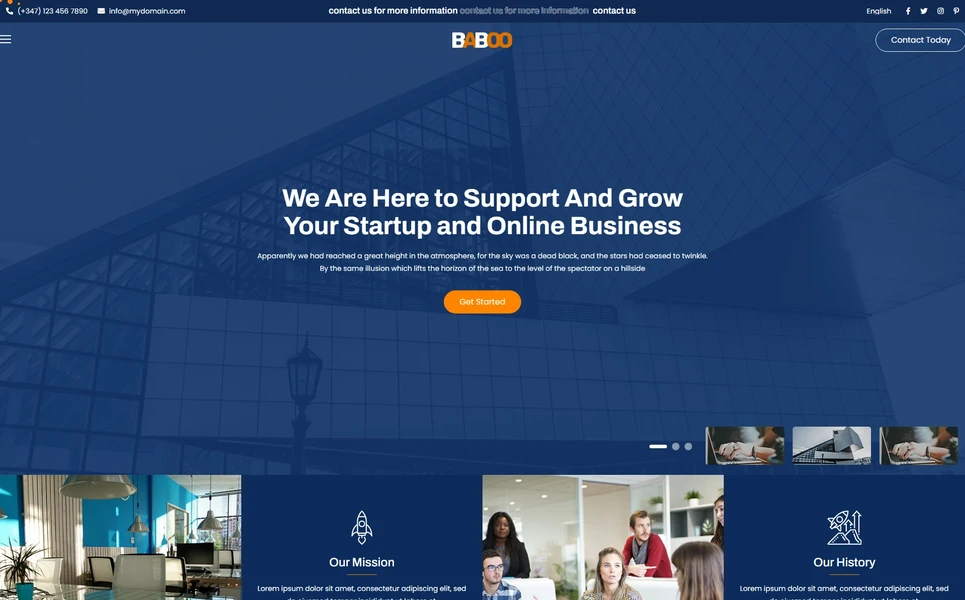
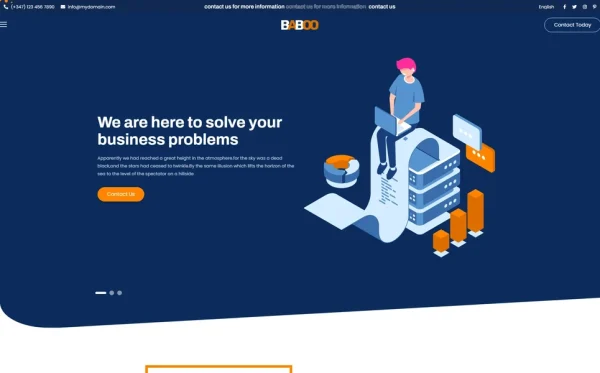
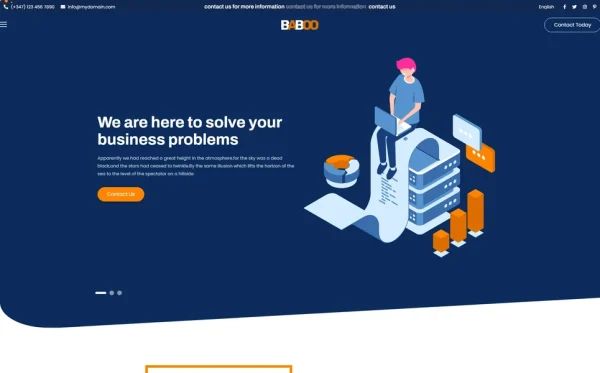
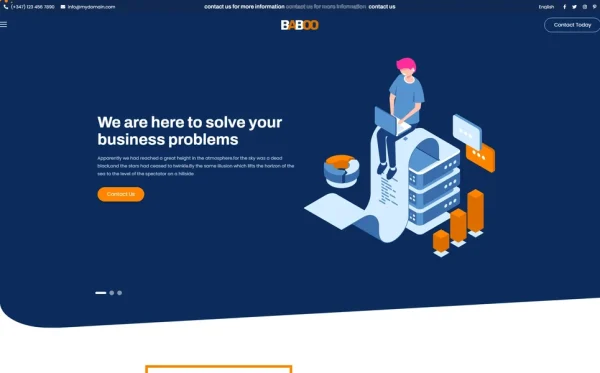
For founders who need a website that looks funded before they are, Baboo is a startup website template engineered for exactly this purpose. Built on Bootstrap 5, Baboo delivers the polished, conversion-focused design that startups need to compete credibly from day one.
The template includes every section covered in this guide: a compelling hero area designed for maximum impact, social proof sections for customer logos and testimonials, feature showcases with multiple layout options, pricing tables, team profiles, FAQ sections, and strategically placed call-to-action elements throughout. The design is clean, modern, and deliberately aligned with the aesthetic that tech-savvy audiences and investors expect.
Baboo is lightweight and fast-loading by design, addressing the performance requirements that directly impact conversion rates. The code is clean, well-documented, and easy to customize, meaning your first iteration can go live in days while leaving room for continuous improvement as you learn what resonates with your audience.
See Baboo in action at demo.metropolitanhost.com/baboo/ and experience the difference a purpose-built startup template makes.
Frequently Asked Questions
When should a startup build its website?
As early as possible. Even before your product is ready, a landing page validates your idea, captures early interest, and begins building your online presence. Many successful startups launch a simple landing page with a value proposition and email signup form during the idea stage, then expand the site as the product develops. Waiting until your product is perfect means missing months of organic search indexing, brand awareness building, and lead generation.
How much should a startup spend on its website?
For pre-seed and bootstrapped startups, spending fifteen to one hundred dollars on a quality template plus five to fifteen dollars per month on hosting is the sweet spot. This gives you a professional foundation without diverting precious capital from product development and customer acquisition. Funded startups with specific design requirements might budget two to ten thousand dollars for a custom build, but should still consider starting with a template for their initial launch and iterating based on real user data before investing in custom development.
What is a good conversion rate for a startup landing page?
The average landing page conversion rate across all industries is around six and a half percent. For startups, a conversion rate of ten percent or higher is considered strong, and top performers in targeted campaigns can reach fifteen to twenty percent. However, the right benchmark depends on what you are measuring. Email signups convert at higher rates than paid signups, which convert higher than demo requests. Focus on improving your conversion rate incrementally through testing rather than chasing an absolute number.
Should my startup website have a blog from day one?
Not necessarily on day one, but sooner than most startups think. A blog builds organic search traffic that compounds over time. The content you publish today continues driving visitors months and years later. Start with three to five foundational articles that target your core keywords and address the primary problems your product solves. Then commit to publishing at least one or two articles per month. Consistency matters more than volume. A dormant blog with one post from six months ago is worse than no blog at all.
How do I make my startup website stand out from competitors?
Differentiation comes from specificity, not complexity. Instead of trying to look different with unusual animations or unconventional layouts, focus on communicating your unique value proposition more clearly than anyone else. Use specific language instead of generic startup jargon. Show real product screenshots instead of abstract illustrations. Include real customer testimonials with verifiable details instead of anonymous praise. The startups that stand out online are the ones that communicate with clarity and authenticity, not the ones with the fanciest animations.
What pages should a startup website have besides the landing page?
Beyond your main landing page, consider these essential pages: an About page that tells your founding story and introduces your team, a Pricing page with transparent tier comparison, individual feature or use case pages that target specific customer segments, a Contact page with multiple ways to reach you, legal pages including Terms of Service and Privacy Policy, and a Blog or Resources section for content marketing. As you grow, add Customer Stories, Integration pages, API documentation, and a Careers page. Start lean and add pages as your needs evolve.
How often should I update my startup website?
Your website should evolve continuously. At minimum, update your landing page whenever you ship a major feature, hit a significant milestone, or gain a notable customer. Social proof elements like testimonials and customer logos should be refreshed quarterly. Blog content should be published consistently, at least one to two times per month. Full redesigns are rarely necessary if you are making incremental improvements. The most successful startup websites are never done; they are continuously optimized based on analytics, user feedback, and A/B testing results.
Analytics and Data-Driven Iteration
One of the greatest advantages of a startup website over traditional marketing is measurability. Every visitor interaction generates data that can inform your decisions. Setting up analytics correctly from day one creates a foundation for data-driven growth that compounds over time.
At minimum, install a web analytics platform and configure it to track page views and traffic sources, time on page and scroll depth, button clicks and form submissions, funnel completion rates from landing to signup, and device and browser breakdowns. Beyond basic analytics, consider implementing heatmap tools that show exactly where visitors click, scroll, and spend time. These visual representations often reveal insights that numerical data alone misses. You might discover that visitors consistently click on an image expecting it to be interactive, or that a critical CTA is positioned below where most visitors stop scrolling.
A/B testing is the gold standard for optimizing startup websites. Test one element at a time, headlines, CTA copy, hero images, form field count, and let the data determine the winner. Even small improvements compound dramatically over time. A five percent improvement in conversion rate this month, followed by another five percent next month, creates exponential growth in your customer acquisition efficiency.
The most important principle is to treat your website as a hypothesis, not a finished product. Every design choice, every piece of copy, every layout decision is a bet about what will resonate with your audience. Data tells you which bets are paying off and which need to change. Startups that embrace this mindset iterate faster and outperform those who treat their website as a set-and-forget project.
Security and Trust Signals for Startups
For startups asking visitors to share their email address, create an account, or enter payment information, trust is paramount. A security breach or even the perception of poor security can be fatal for an early-stage company that has not yet established brand recognition.
HTTPS is non-negotiable. Every page of your website should load over a secure connection, signaled by the padlock icon in the browser address bar. Most hosting providers include free SSL certificates through services like Let’s Encrypt, so there is no cost barrier. Search engines also penalize HTTP sites in rankings, making HTTPS a combined security and SEO requirement.
Display trust badges and security certifications in your footer and on any page that collects personal information. Payment processor logos like Stripe or PayPal signal that transactions are handled by established, secure platforms. If your startup has achieved compliance certifications like SOC 2, GDPR compliance, or HIPAA compliance, display these prominently. For early-stage startups that do not yet have formal certifications, a clearly written privacy policy and terms of service demonstrate professionalism and respect for user data.
Your website’s technical performance also signals trustworthiness. A slow, buggy website suggests a slow, buggy product. Broken links, typos, and layout issues on your marketing site make visitors question the quality of your engineering. Every detail matters when you are asking strangers to trust you with their time, data, or money.
Building a Content Engine for Sustainable Growth
Paid advertising delivers immediate traffic but stops the moment you stop paying. Content marketing builds an asset that delivers traffic indefinitely. For startups with limited marketing budgets, building a content engine early creates sustainable growth that reduces your dependence on paid channels over time.
Start by identifying the questions your target customers ask before they realize they need your product. These problem-aware queries are the foundation of your content strategy. Create comprehensive, genuinely helpful articles that address these questions thoroughly. Do not gate your best content behind forms. Free, ungated content builds goodwill and search engine authority faster than gated lead magnets that frustrate visitors.
As your content library grows, create pillar pages that organize related articles into comprehensive resource hubs. These pillar pages target competitive head keywords while linking to supporting articles that target long-tail variations. This topic cluster approach signals topical authority to search engines and provides visitors with a structured learning path through your content.
Repurpose your written content across channels. A blog post can become a Twitter thread, a LinkedIn article, a podcast episode, or a short video. This multiplier effect maximizes the return on your content investment and reaches audiences who prefer different content formats. The key is adapting the content to fit each channel naturally rather than simply cross-posting identical content everywhere.
The Role of Design Systems in Startup Growth
As your startup grows beyond the initial landing page, maintaining visual consistency becomes a challenge. A design system, even a simple one, ensures that every new page, feature announcement, and marketing campaign feels cohesive. Start with the basics: your primary and secondary colors, heading and body font styles, button styles and sizes, spacing and padding conventions, and icon style. Document these in a lightweight style guide that anyone on your team can reference. The template you choose establishes these foundations, and extending them consistently as you add content preserves the professional impression that builds trust with customers and investors alike.
Launch Fast, Iterate Faster
The startup world moves at a pace that does not wait for perfection. The founders who succeed are not the ones with the best initial website. They are the ones who launch quickly with a solid foundation, learn from real-world data, and improve relentlessly. Your website is a living product, just like the product you are building.
Start with a template that gives you a professional, conversion-optimized foundation. Fill it with your authentic story, your real product, and your genuine value proposition. Launch it, share it, measure the results, and improve it. Repeat. The perfect website does not exist, but a continuously improving one that serves your customers and your business goals is entirely within reach, starting today.