The automotive aftermarket is a massive industry with hundreds of billions in annual revenue, yet a staggering number of auto parts retailers still operate without a professional website. Some rely entirely on eBay and Amazon marketplace listings. Others have a basic website that looks like it was designed in 2010 and never updated. A few still depend exclusively on walk-in traffic and phone orders from a customer base that is literally aging out of the market.
Meanwhile, the buyers who are spending the most money on auto parts — enthusiasts building project cars, professional mechanics running independent shops, fleet managers maintaining commercial vehicles, and weekend warriors tackling their own repairs — have shifted their research and purchasing behavior almost entirely online. They compare parts across multiple retailers, check specifications against OEM numbers, read reviews from other buyers, and expect the same browsing and filtering experience they get from major ecommerce platforms.
This guide covers everything auto parts retailers need to know about building a professional online presence in 2026: the features that automotive buyers demand, the costs at every budget level, the design principles that communicate reliability and expertise, and how to choose a template that serves the automotive aftermarket without requiring a six-figure development investment.

Why Auto Parts Retailers Cannot Survive Without a Website
The auto parts buying process has fundamentally shifted. A decade ago, a mechanic or car enthusiast would call their local parts store, describe what they needed, and either pick it up or have it delivered. Today, that same buyer searches online first — checking part numbers, comparing prices, reading fitment information, and verifying compatibility before ever contacting a supplier. If your business does not appear in that search, you do not exist in their buying process.
The stakes are particularly high in the automotive aftermarket because parts purchases are rarely one-time events. A mechanic who finds a reliable online parts source will return repeatedly — for every vehicle they service, for every repair they perform. Losing that first impression means losing not one sale but potentially hundreds of repeat purchases over years. An enthusiast building a project car might spend thousands over the course of a build, all from a single trusted source.
Marketplace dependence is the other critical risk. Retailers who sell exclusively through Amazon, eBay, or other platforms have no control over their brand presentation, pay substantial commission fees on every sale, and build zero customer loyalty — because the customer relationship belongs to the marketplace, not to the retailer. A professional website gives you direct customer relationships, eliminates per-sale commissions, and builds a brand that customers remember and return to.
Beyond direct sales, a website serves as a 24-hour parts catalog and technical resource. Detailed product pages with specifications, fitment information, and installation guides reduce phone calls and emails asking basic questions. A blog publishing maintenance tips, installation walkthroughs, and vehicle-specific guides drives organic search traffic that brings new customers at zero acquisition cost.
The 10 Must-Have Features for Auto Parts Websites
Auto parts ecommerce has specific requirements that generic shop templates cannot address. Here are the features that separate a professional auto parts website from a generic online store.
1. Multiple Shop Archive Layouts
Auto parts catalogs contain thousands of items spanning wildly different categories — from small fasteners and gaskets to complete engine assemblies and body panels. A single product display layout cannot serve this range. Templates offering multiple shop archive layouts let you present different categories in the format that best showcases each. Grid layouts work for browse-heavy categories like accessories and appearance parts. List layouts with more specification space suit technical components where fitment details matter more than aesthetics.
2. Price Range Filtering
Auto parts pricing spans an enormous range — from two-dollar O-rings to five-thousand-dollar turbo kits. Buyers almost always have a budget in mind, and price range sliders let them instantly narrow the catalog to their price bracket. This is especially important for categories where multiple quality tiers exist — economy, OEM-equivalent, and performance — each at different price points for the same application.
3. Detailed Product Pages With Specification Space
Auto parts buyers need technical information that goes far beyond basic product descriptions. Part numbers, OEM cross-references, dimensions, material specifications, fitment information by year/make/model, torque specifications, and installation notes are all expected on a professional auto parts product page. Templates with multiple product detail page styles let you create comprehensive specification sections alongside high-quality product imagery.
4. Wishlist for Project Planning
Car builds and restoration projects involve planning parts purchases across weeks or months. A wishlist lets customers compile their parts list, share it with fellow enthusiasts or shop partners for review, and purchase in stages as budget allows. For professional mechanics, wishlists serve as job-specific parts lists that can be assembled, priced, and ordered efficiently.
5. Countdown Timer for Promotions
Auto parts retailers depend heavily on promotional events — Black Friday sales, seasonal clearances, manufacturer rebate programs, and flash sales on closeout inventory. Countdown timers create the urgency that converts browsers into buyers during these events. A timer showing that a brake kit sale ends in 48 hours pushes the customer who was planning to buy next month to buy today.
6. Category and Brand Filtering
Auto parts buyers often search by brand — Bosch, Denso, Moog, Monroe, ACDelco — as well as by category. Isotope grid filtering that lets visitors dynamically filter products by category, brand, vehicle type, or application creates the refined search experience that auto parts buyers expect. Without effective filtering, visitors drown in irrelevant results and leave for a competitor with better catalog organization.
7. Full-Screen Product Image Display
Auto parts buyers need to verify visual details — connector types, mounting hole patterns, finish quality, included hardware. Magnific Popup or equivalent lightbox functionality that allows full-screen image viewing with zoom capability is essential. Multiple product angles — front, back, mounting surface, included components — help buyers confirm they are ordering the correct part.
8. Blog for Technical Content
Auto parts retailers have a massive content marketing opportunity. Installation guides, troubleshooting articles, maintenance schedules, vehicle-specific upgrade paths, and product comparison posts all drive organic search traffic from buyers actively looking for parts. A blog module with multiple layout options supports this content strategy and positions your store as a technical authority, not just another parts vendor.
9. Complete Cart and Checkout
Auto parts orders often include multiple line items — a brake job requires pads, rotors, hardware, and possibly calipers and fluid. The cart needs to handle multi-item orders clearly, with itemized pricing and the ability to adjust quantities. The checkout flow should support both consumer and wholesale buyers, with space for vehicle information and special instructions.
10. Mobile-Responsive Design
Mechanics frequently look up parts on their phones while standing in front of the vehicle they are working on. Enthusiasts browse parts forums on tablets and follow links to retailer websites. Your auto parts website must display product specifications, images, and pricing correctly on every screen size. Slow-loading mobile pages cost auto parts retailers sales every single day.
How Much Does an Auto Parts Website Cost?
The cost of building a professional auto parts website depends on the complexity of your catalog, the features you need, and whether you build custom or use a template-based approach.
Marketplace-Only Presence: $0 to $50 Per Month
Selling exclusively through eBay, Amazon, or dedicated auto parts marketplaces requires no website investment but costs 10 to 15 percent in commissions per sale, offers zero brand building, and leaves you vulnerable to marketplace policy changes. A retailer doing $500,000 annually through marketplaces pays $50,000 to $75,000 in commissions — money that would fund a professional website many times over.
Basic eCommerce Platform: $30 to $300 Per Month
Shopify, BigCommerce, or WooCommerce with an auto parts theme provides basic ecommerce functionality. Monthly costs accumulate — a store paying $79 per month spends nearly $5,000 over five years. Most platform themes lack auto-parts-specific features like advanced fitment filtering, and customization requires additional paid apps or plugins.
Custom Auto Parts Platform: $25,000 to $150,000+
Enterprise auto parts websites with year-make-model fitment search, ACES/PIES data integration, real-time inventory synchronization with distributors, and advanced product configurators. These solutions serve large-scale retailers with thousands of SKUs and complex fulfillment operations. Annual maintenance runs $5,000 to $25,000.
Premium HTML Templates: $14 to $59 One-Time
A single purchase delivers a complete multi-page auto parts website with multiple shop layouts, product detail pages, price filtering, cart, checkout, wishlist, blog, and all supporting pages. No recurring fees. Full code ownership. The most cost-effective foundation for auto parts retailers who want professional design and can handle backend integration separately. Combined with hosting and domain registration, you can launch a professional auto parts storefront for under $200.
Design Principles for Auto Parts Websites
Auto parts website design must communicate three things instantly: technical competence, product breadth, and reliability. The design choices that work for fashion boutiques and lifestyle brands will undermine an auto parts retailer’s credibility.
Use Bold, Technical Aesthetics
Auto parts buyers respond to design that feels engineered rather than designed. Dark color schemes with high-contrast accent colors, strong typography, structured grid layouts, and sharp product photography communicate the precision and reliability that automotive buyers expect. Avoid soft pastels, script fonts, and decorative elements that feel out of place in a technical context.
Prioritize Information Density
Auto parts buyers want information, not whitespace. Product pages should display specifications, fitment data, part numbers, and pricing without excessive scrolling. Shop archive pages should show enough detail in each product card — part number, key specs, price, and compatibility notes — to let buyers evaluate quickly without clicking into every individual page.
Build Around Search and Filter
No auto parts buyer wants to browse your entire catalog sequentially. Your navigation must be structured around how automotive buyers think — by vehicle application, by part category, by brand, and by price. The filtering system is not a nice-to-have feature; it is the primary way customers will interact with your catalog.
Show Products in Application Context
When possible, show parts installed on vehicles — not just sitting on a white background. An exhaust system photographed under a vehicle communicates fitment and quality more effectively than the same system photographed on a workbench. Lifestyle imagery of vehicles using the parts you sell creates aspirational context that drives purchases, especially for performance and appearance modifications.
Auto Parts Content Marketing Strategy
Auto parts retailers sit on a content goldmine that most completely ignore. Every part you sell connects to a repair procedure, a maintenance schedule, a performance upgrade, or a troubleshooting scenario — and people search for all of these topics in massive volumes.
Installation guides. Step-by-step installation articles for common repairs and upgrades drive traffic from buyers who are already committed to the repair and just need the parts. An article about how to replace brake pads on a specific vehicle naturally links to the exact pads, rotors, and hardware needed — creating a direct path from content to purchase.
Maintenance schedules. Vehicle-specific or general maintenance articles — when to replace timing belts, how often to change transmission fluid, seasonal maintenance checklists — attract owners who are planning maintenance purchases. Each maintenance item mentioned is a product you can link to in your shop.
Product comparisons. Budget versus premium brake pads, ceramic versus semi-metallic, OEM versus aftermarket — these comparison articles help buyers make informed decisions and position your store as a knowledgeable resource rather than just another parts vendor. Buyers trust retailers who help them choose the right product, not just the most expensive one.
Troubleshooting content. “Why is my car pulling to the right after a brake job?” “What causes a squealing belt?” These search queries represent buyers who need parts right now. Troubleshooting content that diagnoses the problem and recommends the solution — with links to the relevant parts — captures buyers at the highest-intent moment in their purchasing journey.
Common Mistakes Auto Parts Retailers Make Online
The auto parts industry has been slower than most retail sectors to adopt professional ecommerce practices. These common mistakes continue to cost retailers sales and credibility.
Relying solely on marketplace listings. Selling only through eBay or Amazon means paying commissions on every sale, competing on price alone, and building zero brand equity. Marketplace listings should complement your own website, not replace it. Direct sales through your website are more profitable, build customer loyalty, and give you control over the buying experience.
Using a generic ecommerce template. A template designed for fashion or food will not work for auto parts. Automotive buyers expect technical aesthetics, specification-heavy product pages, and robust filtering by category and brand. A generic template forces you to compromise on the features and presentation that auto parts buyers consider essential.
Inadequate product information. Listing a brake rotor without dimensions, vehicle fitment, finish type, or vane count is asking the buyer to gamble. In auto parts, incorrect purchases create return headaches and destroy trust. Every product listing should include enough specification data for the buyer to confirm compatibility before ordering.
Ignoring content marketing. Auto parts retailers who only have product pages miss the massive organic search traffic available through how-to guides, maintenance articles, and troubleshooting content. Your competitors who publish this content are capturing buyers you never even see.
Poor mobile experience. Mechanics look up parts on their phones while standing in the shop bay. If your product pages do not display specifications and images properly on mobile, you are losing the customers who need parts most urgently — and urgent buyers convert at the highest rates.
Building Customer Loyalty in Auto Parts Retail
Auto parts retail has one of the highest repeat purchase rates of any industry. Vehicles need continuous maintenance, repairs create ongoing parts demand, and enthusiast builds generate sustained purchasing over months or years. Building loyalty pays outsized dividends in this market.
Accurate product information builds trust. Nothing destroys an auto parts customer relationship faster than receiving the wrong part. Detailed product pages with accurate specifications, fitment data, and clear photographs prevent ordering errors and the frustration of returns. Customers who receive the right part every time become repeat buyers.
Technical content establishes expertise. A blog that helps customers diagnose problems, choose the right parts, and perform installations positions your store as a technical partner rather than just a vendor. This expertise-based trust is the foundation of long-term customer loyalty in the automotive aftermarket.
Professional presentation signals reliability. A polished, well-organized website communicates that you take your business seriously. In an industry plagued by fly-by-night sellers offering counterfeit parts and no support, a professional web presence distinguishes legitimate retailers from unreliable operators.
Wishlist and account features enable relationship continuity. When customers create accounts and save wishlists, they invest in the relationship with your store. This investment creates switching costs and encourages repeat purchases — especially for project builds where parts lists evolve over time.
Why Digivaz Fits the Auto Parts Market
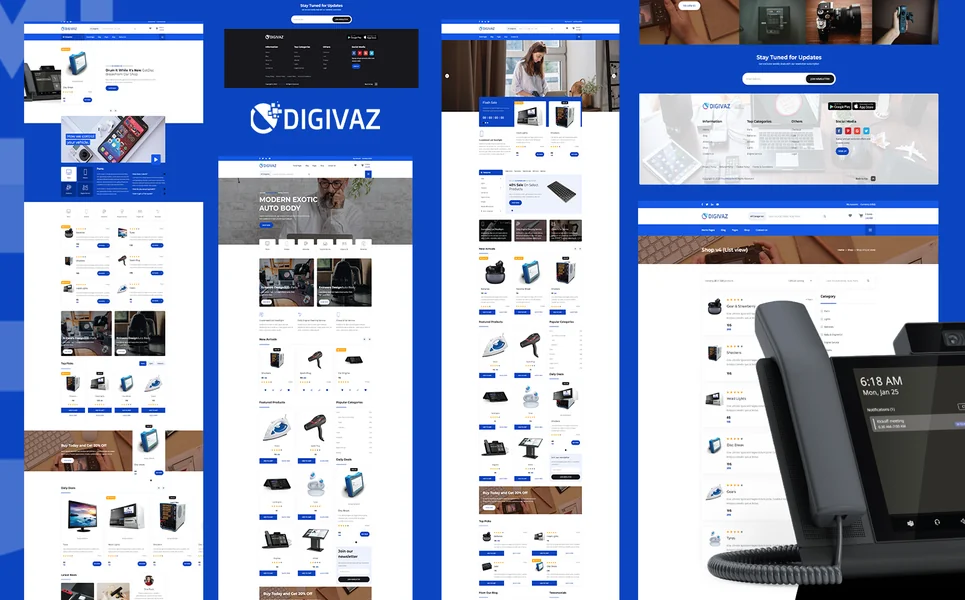
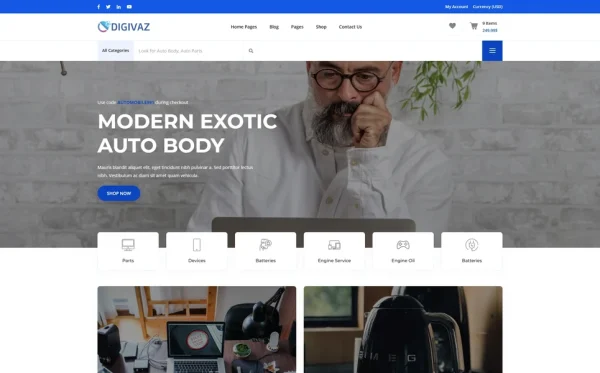
Digivaz is a professionally designed HTML5 template that ships with 23 fully crafted HTML pages built specifically for automotive parts and electronics retail. The template includes three unique home layouts that accommodate different business focuses — a hero-driven layout for retailers emphasizing flagship products, a category-grid layout for shops with broad product catalogs, and a promotional layout for retailers running active sales campaigns.
The four distinct shop archive layouts are essential for auto parts catalogs that span diverse product categories. Engine components, brake parts, electrical accessories, and appearance upgrades each benefit from different display treatments. Two product detail page styles provide the specification-heavy, image-rich presentation that automotive buyers demand — with space for part numbers, fitment data, technical specifications, and multiple product angles.
The price range slider powered by ion.rangeSlider addresses the enormous price spectrum in auto parts retail, letting customers filter from budget gaskets to premium turbo kits instantly. The countdown timer drives urgency during promotional events, clearance sales, and manufacturer rebate deadlines. The wishlist page supports the project-planning workflow that car builders and professional mechanics rely on.
The blog module in grid, list, and masonry formats supports the technical content strategy that distinguishes successful auto parts retailers — installation guides, maintenance articles, product comparisons, and troubleshooting content that drives organic search traffic. The complete cart and checkout flow handles multi-item orders typical of auto parts purchases.
Built on Bootstrap 5 with Slick carousels for featured product promotion, Isotope grid filtering for category and brand navigation, and Magnific Popup lightbox for detailed product image inspection, Digivaz delivers a production-ready auto parts ecommerce website at a fraction of the cost of custom development.
Frequently Asked Questions
What features should an auto parts website include?
An auto parts website should include multiple shop archive layouts for different product categories, price range filtering for the wide automotive price spectrum, detailed product pages with specification space for part numbers and fitment data, wishlist functionality for project planning, countdown timers for promotional events, category and brand filtering, full-screen product image viewing, a blog for technical content, complete cart and checkout, and responsive mobile design for mechanics browsing from the shop floor.
How much does an auto parts website cost?
Costs range widely. Marketplace-only selling costs $0 upfront but 10 to 15 percent commissions per sale. Basic ecommerce platforms run $30 to $300 per month with limited automotive features. Custom auto parts platforms with fitment search and inventory integration cost $25,000 to $150,000 or more. Premium HTML templates offer the most cost-effective foundation at $14 to $59 one-time, providing complete professional design with shop, filtering, cart, checkout, blog, and all supporting pages.
Why should auto parts retailers have their own website instead of just selling on marketplaces?
Marketplace-only selling costs 10 to 15 percent in commissions on every sale, builds zero brand loyalty, and leaves your business vulnerable to platform policy changes. A retailer doing $500,000 annually through marketplaces pays $50,000 to $75,000 in commissions that would fund a professional website many times over. Your own website enables direct customer relationships, eliminates per-sale commissions, supports content marketing for organic traffic, and builds a brand that customers remember and return to for repeat purchases.
How do I drive traffic to my auto parts website?
Technical content marketing is the most effective strategy for auto parts retailers. Publish installation guides, maintenance schedules, product comparisons, and troubleshooting articles that capture organic search traffic from buyers actively looking for parts. Each article naturally links to products in your shop. Combine content marketing with Google Shopping listings, social media presence in automotive communities, and email marketing to repeat customers for the strongest traffic mix.
What makes auto parts website design different from other ecommerce?
Auto parts design requires bold, technical aesthetics with dark color schemes and high-contrast accents rather than soft retail aesthetics. Product pages need significantly more specification space for part numbers, fitment data, dimensions, and technical details. Filtering must support browsing by category, brand, and application. Information density should be higher than typical ecommerce because automotive buyers prioritize specifications over visual styling. And mobile design is critical because mechanics frequently search for parts on their phones from the shop floor.
Can I integrate payment processing with an HTML auto parts template?
HTML templates provide the complete front-end design — shop pages, product detail pages, cart, checkout, and all visual elements. To process actual payments and manage real inventory, you need to integrate a payment gateway like Stripe or PayPal through backend development or by converting the template to a platform like WordPress with WooCommerce. The template provides the professional design foundation that establishes credibility with automotive buyers; payment and inventory management require additional backend integration.
How important is product photography for auto parts?
Product photography is critical in auto parts because buyers need to visually verify part details — connector types, mounting hole patterns, finish quality, included hardware, and overall condition. Multiple angles are essential. When possible, show parts in application context on vehicles, not just on white backgrounds. Clear, detailed photography reduces return rates by helping customers confirm compatibility before ordering, and it builds the trust that distinguishes professional retailers from unreliable sellers.
The automotive aftermarket rewards retailers who combine deep product knowledge with professional presentation. The parts store that provides accurate specifications, helpful content, and a polished buying experience earns the repeat business that sustains long-term growth. A professional website is not a marketing expense — it is the foundation of a modern auto parts business that builds customer relationships, reduces marketplace dependency, and captures the growing share of automotive purchases that happen online.
Final Verdict
Auto parts retailers face a clear choice: build a professional online presence that captures the expanding digital automotive market, or watch marketplace commissions eat into margins while competitors with better websites capture the customers who used to walk through your door. The investment in a purpose-built auto parts template with multiple shop layouts, specification-ready product pages, price filtering, and content marketing capability is trivial compared to the revenue it protects and the growth it enables. Every month without a professional website is a month of lost direct sales, lost customer relationships, and lost competitive ground.