What Is a Delivery Service Website Template?
A delivery service website template is a pre-designed, fully coded website built specifically for local delivery companies, courier services, package delivery businesses, last-mile delivery providers, same-day delivery startups, food delivery operations, and regional parcel services. It includes every page a delivery business needs — homepage with service overview and delivery capability highlights, detailed service pages with individual delivery type breakdowns, portfolio showcasing completed projects and client case studies, team profiles presenting drivers and operations staff, blog for delivery tips and logistics updates, FAQ for shipping questions and service policies, and contact page with quote request forms — all designed, responsive, and ready for your brand.
For delivery service providers that need a professional web presence without paying $5,000 to $15,000 for a custom build or $100 to $300 per month for a managed logistics platform, a template delivers the most practical path to a client-generating online presence. But delivery service websites face a unique trust challenge: customers are handing over valuable packages and trusting that they arrive intact, on time, and at the promised location. Unlike browsing an online store, choosing a delivery service requires confidence in reliability, professionalism, and accountability. Your website must instantly communicate operational competence and build the trust needed for customers to entrust their packages to your service. This guide covers what delivery customers expect from your website, what technical features drive bookings, and how to choose the right template for your delivery business.
Local Delivery vs Global Logistics: Different Businesses, Different Websites
Global logistics companies manage freight forwarding, container shipping, customs brokerage, and international supply chains — complex operations requiring enterprise software and multi-modal tracking systems. Local delivery services operate differently: they serve defined geographic areas with same-day, next-day, or scheduled delivery for packages, food, documents, medical supplies, and specialty items. Your website must reflect this local, accessible, and responsive positioning — not the corporate industrial aesthetic of global freight companies. The service pages should describe delivery types your customers actually need: same-day courier, scheduled regular pickups, fragile item handling, medical specimen transport, legal document delivery, and food and grocery delivery.
Template vs Logistics Platform vs Custom Build
| Factor | Logistics Platform (Onfleet, Track-POD) | Delivery Service Website Template | Custom Website Build |
|---|---|---|---|
| Upfront Cost | $0–200 | $29–69 | $5,000–15,000 |
| Monthly Cost | $149–599/month | $3–10/month (hosting only) | $50–200/month |
| 3-Year Total Cost | $5,364–21,764 | $137–429 | $6,800–22,200 |
| Code Ownership | No — you rent it | Yes — you own it forever | Yes — you own it |
| Client-Facing Website | Basic branded portal | Full professional website | Fully custom |
| Service Detail Pages | None or basic | Dedicated module with detail pages | Any format |
| Portfolio/Case Studies | None | 4-style portfolio with case studies | Any format |
| SEO Capabilities | Limited or platform-controlled | Full SEO control | Full SEO control |
| Vendor Lock-in | High — workflow dependent | None | None |
Logistics platforms like Onfleet and Track-POD focus on dispatch, routing, and proof-of-delivery functionality — essential operational tools but not client-facing websites. They cost $149 to $599 per month for fleet management features, but provide only basic branded portals for customer interactions. A template provides the professional client-facing website that generates new business, explains your services, showcases reliability through case studies, and establishes your brand — while logistics platforms handle the operational backend. The two work together: your template-based website attracts clients, and your logistics platform manages deliveries.
What Delivery Customers Expect From Your Website
Delivery service customers — both individual consumers and business clients — evaluate reliability and professionalism within seconds of visiting your website. Here is what they look for when choosing a local delivery service:
Clear Service Type Descriptions
The most common frustration among delivery service customers is unclear service offerings. “We deliver packages” tells a potential customer nothing about whether you handle fragile items, offer same-day service, accept scheduled recurring pickups, or deliver food and perishables. Each delivery service type deserves its own detailed page explaining what the service covers, typical use cases, pricing structure, delivery timeframes, geographic coverage area, package size and weight limits, and special handling capabilities. Individual service detail pages pre-qualify inquiries — a customer who reads your same-day courier page and then requests a quote already understands your service parameters and is ready to book.
Common service categories that need individual pages include: same-day courier service, scheduled business deliveries, medical and pharmaceutical transport, legal document delivery, food and grocery delivery, fragile and specialty item handling, bulk and pallet delivery, and e-commerce fulfilment partnerships. Each category attracts different customer segments with different needs and budget expectations.
Proof of Reliability Through Case Studies
Delivery customers need evidence that you deliver on your promises — literally. Portfolio case studies showing completed delivery partnerships, operational statistics, and client outcomes provide the proof that marketing claims cannot. A case study documenting how your service handles 200 daily deliveries for a local e-commerce company with 99.2% on-time delivery rate communicates reliability more effectively than any tagline. Case studies for different service types — a restaurant delivery partnership, a medical courier contract, a legal document delivery arrangement — demonstrate versatility and build trust across customer segments.
Four distinct portfolio layout styles allow you to present case studies in the format that best showcases each delivery partnership — image-heavy layouts for branded vehicle and warehouse projects, data-focused layouts for operational performance metrics, narrative layouts for partnership stories, and grid layouts for quick-scan overviews of your delivery portfolio.
Operational Capability Indicators
Animated skill charts and capability indicators — showing on-time delivery rates, geographic coverage percentages, fleet capacity, and years of operation — provide instant credibility signals that visitors absorb in seconds. EasyPieChart animated circular progress indicators displaying “99.2% on-time delivery,” “500+ deliveries per day,” “15 years in service,” and “98% customer satisfaction” communicate operational competence faster than paragraphs of text. These visual metrics serve both individual customers evaluating service quality and business clients conducting due diligence before committing to delivery partnerships.
Team Profiles for Trust Building
Delivery involves trusting strangers with your packages, documents, or food. Team pages presenting operations managers, dispatchers, and senior drivers with their experience, certifications, and professional backgrounds humanise the delivery service and build confidence. For business clients evaluating a long-term delivery partnership, knowing the management team’s logistics experience, safety training credentials, and industry background provides the assurance needed to commit. Team profiles are particularly important for delivery services handling sensitive items — medical specimens, legal documents, high-value goods — where client trust is paramount.
FAQ for Service Policies and Coverage
Delivery service customers ask specific questions before booking: What is your coverage area? What are your delivery timeframes? How do you handle fragile items? What happens if a delivery fails? Do you provide proof of delivery? What are your insurance policies? Can I schedule recurring pickups? What payment methods do you accept? A comprehensive FAQ page that answers these questions proactively reduces support call volume, sets service expectations, and builds confidence in your operational professionalism. The FAQ also serves as valuable SEO content, capturing search queries from potential customers researching delivery services.
Blog for Industry Authority
Blog content for delivery services serves both consumer education and B2B client acquisition. Articles covering packaging best practices for fragile items, delivery cost comparison guides, tips for scheduling efficient recurring deliveries, food delivery temperature management, and e-commerce fulfilment strategy articles attract organic search traffic from two audiences: individual consumers researching delivery options and business owners evaluating delivery partnerships. Grid, sidebar, and detail blog formats accommodate quick tips, detailed guides, and comprehensive industry analysis, providing editorial flexibility for a consistent content strategy.
Mobile-First Quote Requests
A significant portion of delivery service inquiries originate from mobile devices — business owners searching for courier services while at their office desk, individuals needing an urgent same-day delivery while on the go, and restaurant managers looking for delivery partnerships during peak service hours. Your website must make requesting a quote or booking a delivery as frictionless as possible on a smartphone. Click-to-call phone numbers, mobile-optimised quote request forms with minimal required fields, and prominent contact information visible without scrolling capture the time-sensitive inquiries that delivery clients frequently make. A responsive mobile-first framework ensures that service pages, portfolio case studies, capability metrics, and contact information present cleanly on every screen size.
Geographic Coverage Communication
Local delivery customers need to know immediately whether your service covers their area. Your website must communicate geographic coverage clearly — not buried in a FAQ entry but prominently displayed on the homepage and every service detail page. Whether your coverage area is a single city, a metropolitan region, or a multi-county territory, visual coverage maps, zip code lists, or clear boundary descriptions eliminate the most common disqualification reason before it becomes a wasted phone call. Service detail pages that specify coverage areas per delivery type — same-day available within 15 miles, scheduled delivery within 50 miles — respect the geographic specificity that delivery customers require.
Competitive Positioning Through Content
The local delivery market is increasingly competitive, with national carriers, gig economy platforms, and other local operators all vying for the same customers. Your blog is where you differentiate. Articles comparing local delivery services versus national carriers on speed, reliability, and personal service build the case for choosing a local provider. Packaging guides, delivery preparation checklists, and industry trend analyses demonstrate expertise that commodity delivery services cannot match. Blog content also captures organic search traffic from queries like “best same-day delivery service near me” and “local courier vs FedEx for small business” — exactly the searches that potential customers make when evaluating delivery options.
Essential Features for a Delivery Service Website
Services Module With Individual Detail Pages
A services module with an overview page listing all delivery services — plus individual detail pages for each service type — is the foundation of an effective delivery website. The overview page lets visitors scan all offerings at a glance, while detail pages provide the specificity that converts browsers into customers. Each detail page should include service description, geographic coverage, timeframes, pricing structure, handling procedures, and a quote request CTA.
Four-Style Portfolio for Case Studies
Four portfolio layout variants — optimised for different case study types — provide the flexibility to present delivery partnerships in the format that best showcases each relationship. Image-heavy layouts for branded delivery vehicle projects, metric-focused layouts for operational performance data, narrative layouts for long-term partnership stories, and grid layouts for portfolio overviews create a comprehensive case study archive that demonstrates both versatility and reliability.
EasyPieChart Animated Capability Metrics
Animated circular progress charts displaying on-time rates, capacity utilisation, satisfaction scores, and operational reach provide the visual credibility signals that delivery customers process instantly. These animated metrics engage visitors during scrolling and communicate competence through data rather than claims — a critical distinction for an industry where reliability is the primary purchasing criterion.
Branded Utility Pages
Coming soon and 404 branded pages extend your professional identity to every visitor touchpoint. A delivery service launching a new coverage area can use the coming soon page with countdown timer to build anticipation. A branded 404 page with navigation options prevents lost visitors from bouncing to competitors when they encounter a broken link or mistyped URL. These utility pages demonstrate the operational thoroughness that delivery customers associate with reliable service.
How Much Does a Delivery Service Website Cost?
| Cost Component | Template Approach | Custom Build |
|---|---|---|
| Website Template / Design | $29–69 (one-time) | $5,000–15,000 |
| Domain Name (.com) | $10–15/year | $10–15/year |
| Web Hosting | $3–10/month | $20–80/month |
| SSL Certificate | Free (Let’s Encrypt) | Free–$200/year |
| Professional Email | $6/user/month | $6/user/month |
| Quote Request Forms | Free (Contact Form 7, Formspree) | Built into project |
| Fleet Photography | $0–300 (smartphone DIY) | $500–2,000 |
| Year 1 Total | $200–1,200 | $6,500–20,000 |
| Annual Maintenance (Year 2+) | $150–400 | $1,000–4,000 |
Common Mistakes in Delivery Service Web Design
Using a Generic Business Template
Generic business templates with a homepage, about page, and contact form cannot serve delivery services effectively. Without dedicated service detail pages, portfolio case studies, capability metrics, and a comprehensive FAQ, your website is a brochure that provides no competitive advantage. Delivery customers comparing three websites will choose the one that clearly explains services, demonstrates reliability through case studies, and answers their specific questions through a detailed FAQ.
Listing Services Without Detail Pages
Many delivery websites list all services on a single page with icons and one-paragraph descriptions. This approach fails both customers and search engines. Customers cannot evaluate whether your same-day courier service handles their specific package size, weight, or fragility requirements from a single paragraph. Search engines cannot rank a summary page for specific queries like “same-day medical courier service” or “scheduled restaurant delivery partner.” Individual service detail pages solve both problems — customer education and SEO visibility — simultaneously.
Hiding Operational Proof
Delivery services that make reliability claims without supporting evidence lose credibility. Stating “99% on-time delivery” without case studies, animated metrics, or client testimonials to back it up reads as marketing puffery. EasyPieChart capability indicators, portfolio case studies with real performance data, and client testimonials with specific delivery outcomes transform unsubstantiated claims into persuasive proof.
Neglecting Mobile Users
A significant portion of delivery service inquiries come from mobile devices — business owners looking up courier services from their office phone, individuals needing a same-day delivery while on the move, and restaurant owners searching for delivery partners during busy shifts. A responsive mobile-first framework ensures service pages, quote request forms, contact information, and FAQ are fully accessible on smartphones. Click-to-call phone numbers and mobile-optimised forms capture the time-sensitive inquiries that delivery service clients frequently make.
How to Evaluate a Delivery Service Template
Service Module Architecture
Does the template include a services module with both an overview page and individual detail pages? A template without individual service detail pages cannot adequately present the range of delivery services that customers need to evaluate. Each delivery type — same-day, scheduled, fragile, medical, document, food — requires its own page with full descriptions, coverage areas, and pricing information.
Portfolio Variety
Does the template offer multiple portfolio layout styles? Delivery case studies vary significantly — some are data-heavy operational partnerships, others are visual brand collaboration stories. Four layout variants ensure each case study is presented in the format that best communicates its value proposition.
Credibility Features
Does the template include animated capability metrics, team profiles, and FAQ infrastructure? Delivery service websites without credibility indicators rely entirely on marketing copy — which prospective clients are trained to distrust. Animated EasyPieChart metrics, real team profiles, and comprehensive FAQ content build the trust layer that converts sceptical visitors into delivery clients.
Delco: A Delivery Service Website Template Built for Local Operations
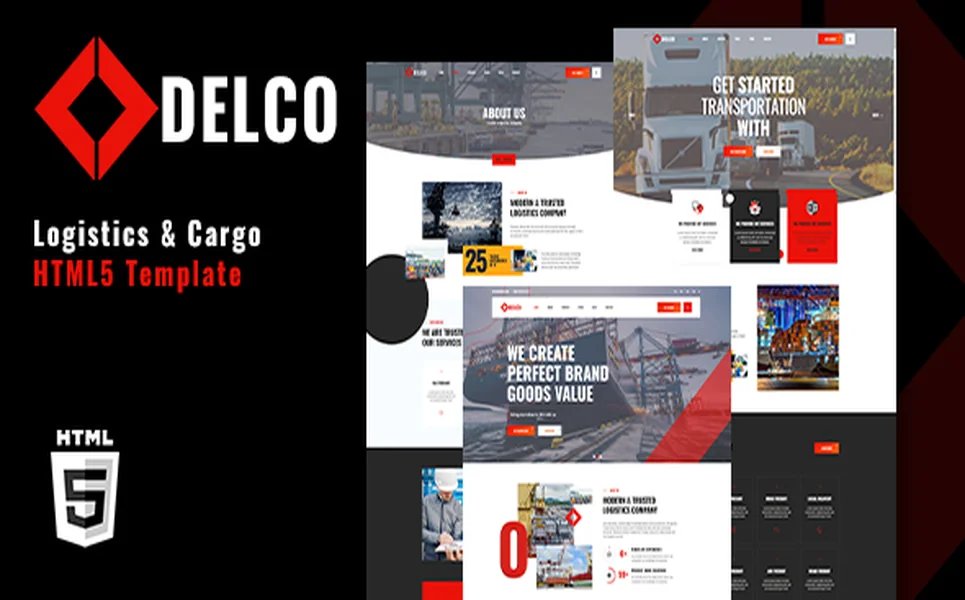
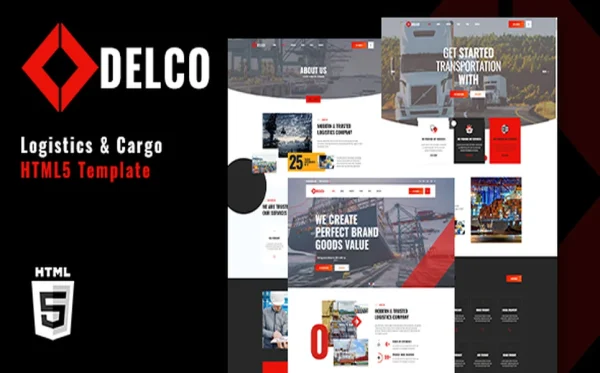
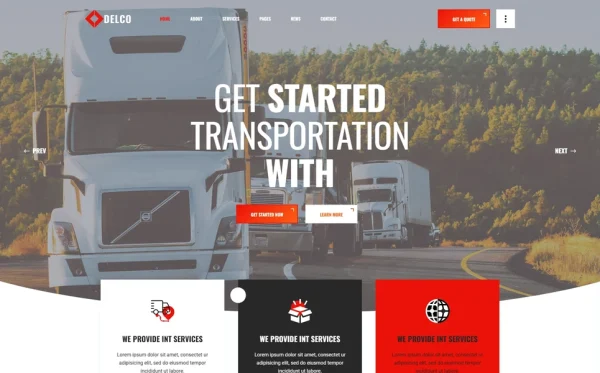
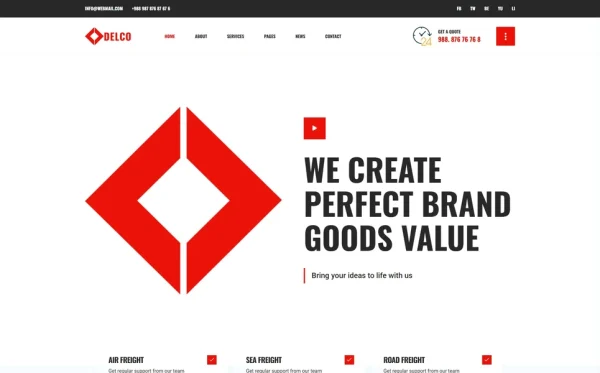
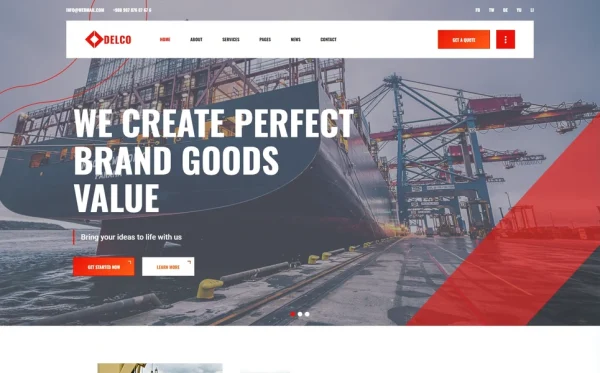
Delco is a 19-page HTML5 template designed for local delivery companies, courier services, package delivery businesses, same-day delivery providers, and regional parcel operations. Built on Bootstrap 5 with Slick carousels, Isotope grid filtering, EasyPieChart animated progress charts, MeanMenu mobile navigation, and Magnific Popup lightbox, Delco provides a professional foundation purpose-built for delivery service client acquisition.
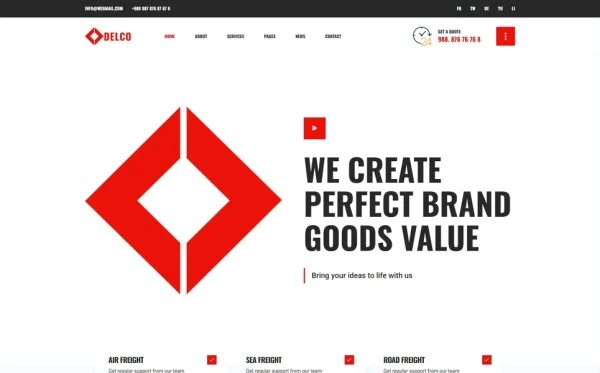
The template centres on a services module with overview and individual service detail pages — presenting each delivery type (same-day courier, scheduled business pickups, fragile handling, document delivery, food and grocery transport) with the depth that customers need to evaluate and book. A four-style portfolio module showcases delivery partnerships and completed projects in the layout format that best communicates each case study’s value — from data-driven operational metrics to visual brand collaboration stories.
EasyPieChart animated capability metrics display on-time delivery rates, fleet capacity, geographic coverage, and customer satisfaction scores — providing instant visual credibility that converts sceptical visitors. Team profiles present operations managers, dispatchers, and senior drivers with their professional backgrounds and logistics credentials. Three blog formats, a comprehensive FAQ page, and branded coming soon and 404 pages round out a complete delivery service web presence.
- 19 HTML pages across services, portfolio, team, blog, and utility pages
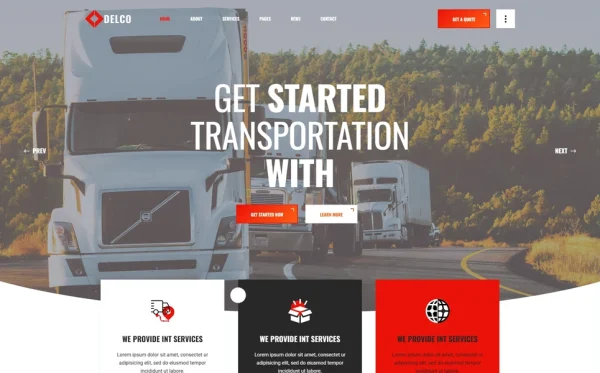
- 3 unique homepage layouts with distinct delivery service showcase arrangements
- Services module — overview + individual service detail pages
- Portfolio in 4 distinct layout styles for delivery case studies
- EasyPieChart animated circular progress charts for capability metrics
- Team profiles for operations staff, dispatchers, and drivers
- Blog in 3 formats: grid, sidebar, and full article detail
- FAQ page for delivery policies, coverage, and service questions
- Isotope grid filtering for portfolio and content categories
- MeanMenu accessible responsive mobile navigation
- Slick Carousel for client testimonials and featured content
- Magnific Popup lightbox for full-screen imagery
- Branded coming soon + 404 utility pages
- Bootstrap 5 responsive mobile-first framework
- Cross-browser compatible: Chrome, Firefox, Safari, Edge, Opera
How Delco Serves Different Delivery Businesses
Same-Day Courier Services
Same-day courier companies use Delco’s service detail pages to present each delivery tier — express (1–2 hour), standard same-day (4–6 hour), and scheduled same-day — with clear pricing, coverage maps, and package limitations. Portfolio case studies showcase high-volume client partnerships with on-time statistics. EasyPieChart metrics highlight “99.5% same-day success rate” and “average 47-minute delivery time.” The FAQ addresses urgent questions about cutoff times, weekend availability, and insurance coverage that same-day customers need answered immediately.
Food and Grocery Delivery Operations
Food delivery services use service detail pages to describe temperature-controlled transport, packaging requirements, delivery radius, order minimum thresholds, and restaurant partnership terms. Portfolio case studies document restaurant partnerships with delivery volume metrics and customer satisfaction data. The blog publishes food packaging best practices, temperature management guides, and restaurant delivery partnership case studies. EasyPieChart metrics display “15-minute average delivery time,” “500+ daily food deliveries,” and “99.8% condition compliance.”
Medical and Pharmaceutical Couriers
Medical delivery services use service detail pages to document chain-of-custody procedures, temperature monitoring capabilities, compliance certifications, and handling protocols for specimens, pharmaceuticals, and medical equipment. Team profiles emphasise HIPAA training, hazmat certifications, and medical courier experience. Portfolio case studies present hospital and clinic partnerships with compliance metrics. The FAQ addresses regulatory questions, insurance requirements, and emergency delivery protocols that medical clients evaluate during vendor selection.
E-Commerce Fulfilment Partners
Local e-commerce fulfilment services use service detail pages to explain partnership models — per-delivery pricing, monthly contract rates, peak season capacity, return handling, and integration with e-commerce platforms. Portfolio case studies showcase online retailer partnerships with delivery volume growth, customer satisfaction trends, and cost-per-delivery metrics. The blog publishes e-commerce logistics strategy articles that attract online retailers evaluating local delivery alternatives to national carriers.
Frequently Asked Questions
Need Help Launching Your Delivery Service Website?
MetropolitanHost provides professional web development services for HTML template deployments. Our team understands service industry website requirements and delivers professional, trust-building implementations.
- Template Installation — live in under 24 hours
- Full Website Package — complete front-to-back deployment
- Colour Customisation — match your delivery brand across all pages
- Website Speed Optimisation — Core Web Vitals improvements
- Accessibility Compliance — WCAG audit and remediation