
The travel industry has always been built on trust. When someone hands over their hard-earned vacation budget to a tour agency, they are trusting that agency with their most precious commodity: their time off. In a world where travelers have endless options at their fingertips, the first place they evaluate that trust is your website. It is your storefront, your brochure, your sales team, and your customer service desk, all rolled into one digital experience.
Tour agencies face a unique challenge in the digital age. Unlike products that can be photographed and shipped, you are selling experiences. You are selling the promise of adventure, relaxation, discovery, and memories. Your website needs to communicate that promise convincingly while also handling the practical mechanics of bookings, itineraries, and payments. Getting this balance right is what separates thriving agencies from those struggling to compete.
Why Your Tour Agency Needs a Professional Website
The days when a tour agency could rely solely on walk-in customers and word-of-mouth referrals are long gone. Today, over ninety percent of travel planning begins online. Potential customers are searching for destinations, comparing tour packages, reading reviews, and making booking decisions from their phones and laptops. If your agency does not have a compelling online presence, you are invisible to the vast majority of potential customers.
A professional website does more than establish your existence. It actively generates leads and converts them into bookings. Research shows that a well-designed travel website can boost bookings by forty-two percent compared to relying on third-party listing platforms alone. When customers book directly through your website, you avoid the commission fees charged by online travel agencies, keeping more revenue in your pocket.
Your website also serves as the foundation for all your digital marketing efforts. Search engine optimization, social media campaigns, email marketing, and paid advertising all drive traffic back to your site. Without a professional, conversion-optimized website to receive that traffic, your marketing investment is largely wasted.
Understanding the Modern Travel Consumer
Building an effective tour agency website starts with understanding how today’s travelers make decisions. The modern booking journey is not linear. It is a complex, multi-device, multi-session process that can span days or even weeks.
The journey typically begins with inspiration. A traveler sees a stunning photo on social media, watches a travel documentary, or hears a friend rave about a trip. This sparks interest in a destination or type of experience. Next comes research. The traveler searches for information about the destination, reads blog posts, watches videos, and compares different tour options. They may visit your website multiple times during this phase, each time gathering more information.
The comparison phase follows, where the traveler narrows their options and evaluates agencies based on reputation, pricing, inclusions, and the overall quality of their web presence. Finally, the decision and booking phase arrives, often triggered by a sense of urgency, a limited-time offer, or simply reaching the point of confidence where they are ready to commit.
Your website needs to support every stage of this journey. Inspirational imagery for the discovery phase. Detailed, informative content for the research phase. Clear value propositions and trust signals for the comparison phase. And a smooth, frictionless booking process for the decision phase.
Essential Features for a Tour Agency Website
Not every travel website needs to be a full-scale online travel agency with real-time inventory and dynamic pricing. But regardless of your agency’s size, certain features are essential for credibility and conversion.
Destination Showcases
Dedicated destination pages with stunning photography, key highlights, and curated tour packages give visitors a reason to stay on your site and explore. Each destination page should include enough information to educate the traveler while leaving enough mystery to entice them to book. Think of it as a trailer for the experience, not the full movie.
Tour Package Listings
Clear, well-organized tour package pages are the backbone of your website. Each listing should include the tour name and a compelling description, duration and itinerary overview, pricing with clear indication of what is included and excluded, departure dates and availability, high-quality photos from the actual tour, and a prominent call-to-action button for booking or inquiry.
Booking and Inquiry Forms
The booking process should be as simple as possible. For agencies that handle bookings manually, a well-designed inquiry form that captures the traveler’s name, contact information, preferred dates, group size, and any special requirements is sufficient. For agencies with automated booking systems, integration with platforms like Bookly, Checkfront, or FareHarbor enables real-time availability checking and instant confirmation.
Itinerary Presentations
Day-by-day itineraries help travelers visualize the experience and justify the investment. Present itineraries in a clean, scannable format with icons for different activity types, map pins for locations, and expandable details for each day. The best itinerary presentations balance enough detail to inform without overwhelming the reader.
Customer Reviews and Testimonials
Social proof is particularly powerful in the travel industry because experiences are intangible until they happen. Display authentic customer reviews prominently throughout your site. Include the reviewer’s name, their trip details, and ideally their own photos from the tour. Video testimonials are even more impactful, providing an emotional connection that text alone cannot achieve.
Blog and Travel Guides
A regularly updated blog serves multiple purposes. It improves your search engine rankings by creating fresh, keyword-rich content. It establishes your agency as a knowledgeable authority on the destinations you serve. And it gives potential customers valuable content that builds goodwill and keeps them returning to your site even before they are ready to book.
The Cost of Building a Tour Agency Website
Your website is an investment, and like any investment, understanding the cost versus return helps you make an informed decision. The range of options is broad, and the right choice depends on your agency’s size, budget, and growth ambitions.
| Approach | Cost | Timeline | Best For |
|---|---|---|---|
| Free website builder (Wix, Google Sites) | $0-$20/month | 1-3 days | Solo operators testing the market |
| Professional HTML template | $15-$69 one-time + $5-$10/mo hosting | 1-2 weeks | Small to mid-size agencies |
| WordPress with booking plugin | $100-$500 setup + $10-$30/mo hosting | 2-4 weeks | Agencies wanting CMS flexibility |
| Custom development | $5,000-$20,000+ | 2-6 months | Large agencies with complex needs |
| Full OTA platform build | $70,000+ | 6-12 months | Enterprise-level operations |
Most travel agencies see the best return by starting with a professional template or WordPress-based solution. The Travel Marketing Institute reports that agencies typically see full return on their website investment within six to eight months through increased direct bookings and reduced commission payments to third-party platforms. Starting lean and iterating based on actual customer behavior is far more effective than overinvesting in a complex build before you understand what your customers truly need.
Designing for the Travel Mindset
Travel website design is fundamentally about emotion. You are not selling specifications or features. You are selling the feeling of standing on a mountaintop, the taste of street food in a Bangkok market, the thrill of spotting wildlife on an African safari. Your design choices should amplify these emotions at every opportunity.
Photography as the Primary Design Element
In travel web design, photography is not decoration. It is the content. Full-bleed hero images, immersive gallery sections, and background videos transport visitors to the destination before they read a single word. Invest in authentic, high-quality images that capture the genuine experience of your tours. Stock photos that look generic or staged will undermine your credibility instantly.
Color Psychology in Travel Design
Blues evoke trust and serenity, perfect for ocean and cruise-related tours. Greens suggest adventure and nature, ideal for eco-tourism and hiking agencies. Warm oranges and golds convey energy and excitement, fitting for cultural and food-focused experiences. Choose a color palette that aligns with the type of travel experience your agency specializes in, and use it consistently across your website and marketing materials.
White Space and Visual Breathing Room
Travel websites often make the mistake of cramming too many destinations, tours, and calls-to-action onto a single page. This creates visual chaos that overwhelms visitors and actually reduces engagement. Generous white space allows your photography to shine, your content to be readable, and your calls-to-action to stand out. Less is more when the “less” is beautifully presented.
Search Engine Optimization for Tour Agencies
Organic search traffic is the lifeblood of most tour agency websites. When someone searches for “cultural tours in Morocco” or “best hiking trips in Patagonia,” you want your website to appear on the first page of results. Achieving this requires a deliberate SEO strategy tailored to the travel industry.
Destination pages should target specific long-tail keywords that match how travelers actually search. Create unique, substantial content for each destination you serve, not just a few paragraphs and some photos, but comprehensive guides that cover the best time to visit, cultural highlights, practical tips, and why your agency offers the best way to experience it.
Local SEO matters even for agencies that serve international destinations. Claim your Google Business Profile, build local citations, and ensure your name, address, and phone number are consistent across all online directories. When someone nearby searches for “tour agency near me,” you want to be the first result they see.
Schema markup for travel businesses helps search engines understand your content and display rich results. Implement structured data for your business information, tour packages with pricing, customer reviews, and FAQ content. These rich snippets increase your visibility and click-through rates in search results.
Integrating Booking Systems into Your Website
The booking system is where your website transitions from marketing tool to revenue generator. The right booking integration depends on your agency’s operational workflow and the complexity of your tour offerings.
For agencies that prefer to handle bookings personally, a simple contact form or inquiry widget is often sufficient. The form captures the lead, and your team follows up via email or phone to finalize the booking. This approach works well for custom, high-value tours where personalized communication is part of the service.
For agencies with standardized tour packages and fixed departure dates, automated booking systems streamline the process. Platforms like Checkfront, FareHarbor, and Rezdy offer embeddable booking widgets that display real-time availability, process payments, send confirmation emails, and sync with your calendar. These integrations can be added to most website templates through simple embed codes or API connections.
Regardless of the system you choose, the key principles remain the same. Make booking visible and accessible from every page. Minimize the number of steps from decision to confirmation. Display pricing transparently with no hidden fees. And provide instant confirmation to reduce the anxiety that comes with committing to a significant purchase.
Mobile Optimization for Travel Websites
Travel planning is one of the most mobile-heavy activities online. People research destinations during commutes, compare tours during lunch breaks, and make booking decisions from their couches in the evening. Your website must deliver a flawless experience on smartphones and tablets.
Mobile optimization for travel goes beyond responsive layout. It includes thumb-friendly navigation with easily tappable menu items and buttons, image optimization that balances quality with fast loading on mobile data connections, simplified booking flows that work well on smaller screens, click-to-call functionality for visitors who prefer to speak with an agent, and maps that integrate with the device’s native navigation app.
Test your website on actual mobile devices, not just browser simulators. The physical experience of scrolling through your tour listings, tapping through an itinerary, and completing a booking form on a five-inch screen reveals issues that desktop testing misses.
How Goldentour Serves the Modern Tour Agency
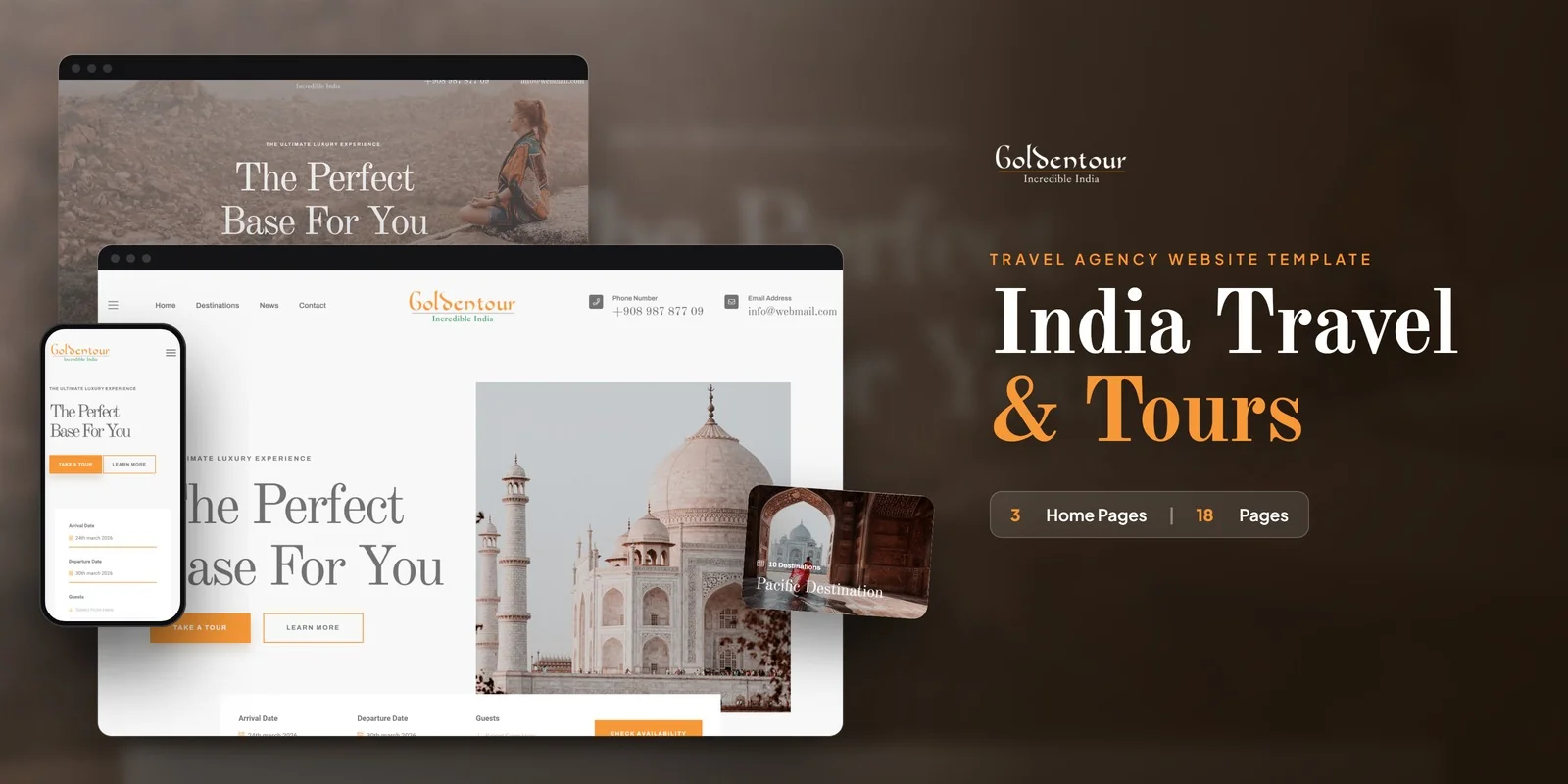
For tour agencies looking for a website template that understands the travel business, Goldentour delivers a complete, purpose-built solution. Designed specifically for tour operators, travel agencies, and adventure companies, Goldentour provides every section and feature discussed in this guide, ready to customize with your content and branding.
Built on Bootstrap 5, Goldentour is fully responsive across all devices and screen sizes. The template features immersive destination showcases with full-width photography, detailed tour package layouts with itinerary timelines, booking inquiry forms, customer testimonial sections, team profiles, and a blog layout for your travel content marketing.
The design philosophy behind Goldentour prioritizes the visual storytelling that travel marketing demands. Hero sections span the full viewport to create an immersive first impression. Tour cards use hover effects and subtle animations to invite exploration. The color scheme and typography are carefully chosen to convey both professionalism and the excitement of travel.
See every section and interaction by visiting the live demo at demo.metropolitanhost.com/goldentour/.
Frequently Asked Questions
Using a professional template, you can have a fully functional tour agency website live within one to two weeks. This includes customizing the design with your branding, adding your tour listings and destination content, configuring your booking or inquiry forms, and testing across devices. A custom-built website typically takes two to six months, depending on complexity and the development team’s availability.
Not necessarily. Many successful tour agencies use simple inquiry forms that capture lead information and handle bookings through personal follow-up. This is especially effective for custom or high-value tours where personalized communication adds value. Automated booking systems become worthwhile when you offer standardized packages with fixed dates and want to reduce administrative overhead. Start with an inquiry form and upgrade to automated booking as your volume grows.
Most agencies see return on their website investment within six to eight months. The primary ROI drivers are increased direct bookings (eliminating commission fees paid to OTA platforms), improved lead generation through organic search traffic, enhanced credibility that converts more inquiries into bookings, and reduced customer support overhead through self-service information on the website. Even a modestly performing website that generates three to five additional direct bookings per month can cover its costs many times over.
You do not compete with OTAs on scale; you compete on specialization, expertise, and personal service. Your website should emphasize what makes your agency unique: deep destination knowledge, curated itineraries, exclusive local partnerships, and the personal attention that large platforms cannot provide. Long-tail SEO targeting specific niches, destinations, and experience types helps you rank for searches where OTAs are less dominant. Focus on being the undeniable expert in your specific area rather than trying to offer everything.
Essential content includes detailed destination guides for every location you serve, comprehensive tour package descriptions with itineraries and pricing, an about page that tells your agency’s story and introduces your team, customer testimonials and reviews with photos, a regularly updated blog with travel tips and destination insights, clear contact information and booking forms, and an FAQ section addressing common questions about your tours, payment policies, and cancellation terms.
Both options are valid, and the choice depends on how you plan to manage content. WordPress is ideal if you want to frequently update tour listings, publish blog posts, and manage content without touching code. A static HTML template is better if you prioritize speed, security, and simplicity, and if your tour offerings do not change frequently. HTML templates load faster, have fewer security vulnerabilities, and require less maintenance. Many agencies start with HTML and migrate to WordPress as their content management needs grow.
For multi-currency pricing, display your primary currency alongside a note that prices can be converted at the current exchange rate. More advanced solutions include currency toggle switches that use real-time exchange rate APIs. For multilingual support, consider creating separate language versions of your key pages rather than relying on automatic translation, which often produces awkward results for marketing content. Focus on the languages spoken by your primary target markets first and expand as demand warrants.
Building Trust Through Content and Storytelling
Travel is fundamentally about stories. The stories of places, cultures, and personal transformation. Your website should harness the power of storytelling to differentiate your agency from the countless options travelers encounter online. While competitors may list the same destinations and similar itineraries, your stories are uniquely yours.
Invest in creating destination narratives that go beyond surface-level descriptions. Instead of simply stating that you offer tours to Kyoto, tell the story of a morning spent at Fushimi Inari before the crowds arrive, the silence broken only by birdsong echoing through thousands of vermillion torii gates. This kind of evocative writing transports the reader and creates emotional investment that generic descriptions never achieve.
Behind-the-scenes content humanizes your agency and builds connection. Share the story of how you discovered a hidden restaurant that became a highlight of your culinary tour. Introduce the local guides who bring each destination to life. Explain the process of designing a new itinerary, the research, the scouting trips, the partnerships with local operators. This transparency builds trust by showing the expertise and care behind every tour you offer.
Video content is particularly powerful for travel marketing. Even short clips of destinations, tours in action, and traveler reactions convey the energy and emotion of an experience far more effectively than static images and text. Consider creating a YouTube channel or embedding video content throughout your website to bring your destinations to life. Video also keeps visitors on your site longer, which is a positive signal for search engine rankings.
Social Media Integration and Multi-Channel Marketing
Your website does not exist in isolation. It is the hub of a multi-channel marketing ecosystem that includes social media, email, search, and potentially paid advertising. The most effective tour agencies create a seamless experience across all channels, with each one driving traffic and engagement back to the website where conversions happen.
Instagram is the natural social media home for travel brands. The visual nature of the platform aligns perfectly with the aspirational imagery that drives travel decisions. Embed your Instagram feed on your website to create a constantly refreshing gallery of destination content. Use Instagram Stories and Reels to share real-time moments from tours in progress, giving followers a window into the experiences you create.
Email marketing remains one of the highest-converting channels for travel businesses. Build your email list through website signup forms that offer genuine value, perhaps a downloadable destination guide, a packing checklist, or early access to new tour announcements. Segment your list by travel interests and past bookings to deliver personalized content that feels relevant rather than generic.
Google Business Profile is essential for agencies that serve a local market. A well-optimized profile with current photos, reviews, and accurate business information helps you appear in local search results and Google Maps, capturing nearby travelers who are searching for agencies in their area. Encourage satisfied customers to leave Google reviews, as these ratings significantly influence the decision-making of prospective clients who discover you through search.
Handling Seasonality and Promotional Campaigns
Travel is inherently seasonal, and your website should reflect this reality. A static website that shows the same content year-round misses the opportunity to capitalize on seasonal demand patterns and create urgency that drives bookings.
Update your homepage hero section and featured tours to align with upcoming travel seasons. Promote winter sun destinations as the cold months approach. Highlight European summer itineraries in early spring when travelers are planning ahead. Feature fall foliage tours or harvest season experiences at the appropriate time. This seasonal rotation keeps your website feeling current and relevant while matching the content to what travelers are actively searching for.
Limited-time promotions and early-booking discounts create urgency that accelerates decision-making. Your website should support these campaigns with dedicated landing pages, countdown timers, and prominent banner placements. When a visitor sees that an early-bird discount expires in seven days, the psychological pressure to act increases significantly compared to an open-ended offer with no deadline.
Safety Information and Travel Advisories
Responsible tour agencies provide clear safety information and travel advisory updates on their websites. This content serves both practical and trust-building purposes. Include dedicated sections for health and vaccination requirements by destination, travel insurance recommendations and partner providers, emergency contact protocols during tours, local customs and cultural etiquette guides, and links to official government travel advisory pages.
Post-pandemic travelers are particularly attuned to health and safety protocols. Clearly communicating your hygiene standards, group size limitations, and flexible cancellation policies addresses these concerns directly and differentiates your agency from operators who treat safety as an afterthought. This transparency builds the kind of trust that converts cautious researchers into confident bookers.
For adventure and activity-focused tour operators, safety credentials are especially important. Display your guide certifications, safety equipment standards, and incident response procedures. Families evaluating adventure tours for their children will specifically seek this information, and providing it proactively positions your agency as thorough and trustworthy.
Your Next Step
The travel industry rewards agencies that invest in their digital presence. Every day without a professional website is a day of missed bookings, lost leads, and revenue flowing to competitors who made the investment. The good news is that you do not need a massive budget or months of development time to get started.
A well-chosen template, filled with compelling content, authentic photography, and clear calls-to-action, can transform your agency’s online presence in weeks rather than months. From there, continuous improvement based on real visitor behavior and booking data ensures your website evolves alongside your business.
Start by evaluating your current online presence honestly. If it is not generating leads and bookings, it is time for a change. Explore your options, test template demos on multiple devices, and choose a foundation that positions your agency for the growth ahead.