
There is something about the open water that has captivated humanity for millennia. Whether it is the quiet discipline of competitive sailing, the social traditions of a yacht club gathering, or the pure freedom of a charter cruise along a sun-drenched coastline, the maritime world holds a unique place in our culture. And yet, despite this deep emotional resonance, many yacht clubs, marinas, and charter companies are represented online by websites that look like they were built in another era.
The disconnect between the premium experience these organizations offer and the dated digital presence they maintain is striking. Members pay significant annual dues. Charter clients spend thousands per trip. Marine businesses operate in a world of luxury, precision, and prestige. Their websites should reflect that same standard, but too often they do not.
Why the Marine Industry Needs Better Websites
The marine and yachting sector has been slower to embrace digital transformation than many other industries. There are understandable reasons for this. Yacht clubs are tradition-oriented institutions. Charter operations often rely on brokers and word-of-mouth. Marinas have historically filled slips through local reputation rather than online marketing.
But the demographics of the industry are shifting. A new generation of members, charter clients, and boating enthusiasts expects the same seamless digital experience from their yacht club that they get from every other aspect of their lives. They want to check regatta schedules on their phones. They want to book a charter with a few clicks. They want to browse a fleet gallery that does justice to the vessels they are considering.
More importantly, the competitive landscape is changing. Online platforms for boat rentals and charter bookings are growing rapidly, and they are capturing market share from traditional operators who lack a compelling digital presence. For yacht clubs competing for new members, a modern website is often the first impression that determines whether a prospective member schedules a tour or moves on to the next option.
Understanding Your Maritime Audience
Effective website design starts with understanding who you are designing for. The maritime world serves several distinct audiences, each with different needs and expectations.
Yacht Club Members and Prospects
Current members need a website that functions as a practical tool: event calendars, regatta schedules, committee information, member directories, and dock assignments. Prospective members are evaluating the club’s prestige, community, facilities, and culture. They want to see the clubhouse, the marina, the social events, and the sailing program before they commit to an application. Your website must serve both audiences without sacrificing one for the other.
Charter Clients
People considering a yacht charter are often making one of the larger leisure purchases of their year. They are detail-oriented, comparison-shopping across multiple operators, and heavily influenced by visual presentation. Your fleet gallery, pricing transparency, and the overall quality of your website directly impact their confidence in your operation. A poorly designed website suggests a poorly run charter business, even if the reality is the opposite.
Marina Tenants and Visitors
Boat owners evaluating marina options care about facilities, pricing, availability, and convenience. Transient boaters need information about guest slips, fuel, pump-out stations, and nearby amenities. A marina website should provide all of this information clearly and accessibly, with an emphasis on practical details that help boaters make decisions.
Essential Features for Yacht and Marine Websites
Marine websites have unique requirements that distinguish them from general business websites. Here are the features that your audience expects and that drive meaningful engagement.
Fleet Gallery
For charter companies and yacht clubs with a racing fleet, the vessel gallery is the centerpiece of the website. Each vessel should have its own dedicated page or card with professional photography, key specifications (length, beam, draft, capacity), available amenities, and booking or inquiry options. High-resolution images shot in natural light on the water are worth every dollar of the photography investment.
Event Calendar and Regatta Schedule
Yacht clubs live and breathe by their event calendar. Racing schedules, social gatherings, sailing clinics, junior programs, and holiday celebrations all need to be communicated clearly. A well-designed calendar that distinguishes between event types, shows upcoming events prominently, and integrates with members’ personal calendars keeps the community informed and engaged.
Membership Information and Application
Make the path from interest to application clear and inviting. Include information about membership tiers, benefits, dues, and the application process. An online application form or inquiry submission simplifies what is often a cumbersome paper-based process. Highlight testimonials from current members to provide social proof and help prospects envision themselves as part of the community.
Booking and Reservation System
Whether it is charter bookings, sailing lesson registrations, or slip reservations for transient boaters, online booking functionality saves time for both your team and your customers. Integration with platforms like Dockwa for slip management or custom booking forms for charter inquiries streamlines operations and captures leads that might otherwise be lost to competitors who make booking easier.
Weather and Marine Conditions
Real-time weather widgets, tide charts, and wind forecasts add practical value that brings members back to your website regularly. This kind of utility-driven content transforms your site from a marketing brochure into a daily-use tool, significantly increasing return visits and engagement.
Photo and Video Galleries
Racing photos, social event albums, aerial marina views, and sailing videos showcase the vibrancy of your organization. These galleries serve double duty: they delight existing members who want to relive experiences and they persuade prospective members by showing the active, engaged community they could join.
Design Principles for Nautical Websites
The visual language of a maritime website should evoke the ocean without resorting to cliches. Here is how to achieve a design that is authentically nautical while remaining modern and professional.
Color Palette
Deep navy blues, crisp whites, and warm wood tones form the classic nautical palette, and for good reason. These colors evoke the ocean, sails, and teak decking that define the maritime experience. Accent colors might include brass gold for a traditional club feel or aqua tones for a more contemporary coastal vibe. The key is restraint. A sophisticated nautical palette uses color intentionally rather than saturating every element with blue and white stripes.
Typography
Avoid novelty fonts that try to look “nautical” with rope textures or anchor decorations. These undermine the professional image you are trying to convey. Instead, use clean serif fonts for headings to communicate tradition and authority, paired with modern sans-serif body text for readability. The contrast between a classic serif headline and clean body copy creates a refined feel that suits the maritime context perfectly.
Imagery Standards
Photography makes or breaks a nautical website. Golden-hour shots of sailboats, aerial views of your marina, action shots from regattas, and candid moments from social events create an emotional connection that no amount of text can match. Avoid dark, grainy images taken with phone cameras. Professional maritime photography is an investment that pays dividends across your website, social media, print materials, and advertising.
The Cost of a Professional Marine Website
| Solution | Cost | Timeline | Best For |
|---|---|---|---|
| Free website builder | $0-$25/month | 1-3 days | Small boat rental operations |
| Professional HTML template | $15-$69 one-time + hosting | 1-3 weeks | Charter companies, yacht clubs |
| WordPress with marina plugins | $200-$1,000 setup + hosting | 3-6 weeks | Marinas with complex needs |
| Custom website with management system | $10,000-$50,000+ | 3-6 months | Large yacht clubs, multi-marina operations |
| Specialized marine platform (ClubSpot, etc.) | $200-$500/month | 4-8 weeks | Clubs wanting all-in-one management |
For most yacht clubs and charter companies, a professional template provides the best balance of quality, cost, and speed to launch. You get a design that conveys the premium positioning your brand demands, the flexibility to customize it to your specific needs, and the ability to launch in weeks rather than months. The savings compared to custom development can be redirected to professional photography, marketing, or facility improvements that directly benefit your members and clients.
Marketing Your Marine Business Online
A beautiful website is the foundation, but driving the right traffic to it requires a targeted digital marketing strategy. The marine industry has unique marketing channels and opportunities that differ from mainstream consumer marketing.
Search engine optimization for marine businesses should target both broad terms like “yacht charter” and location-specific long-tail keywords like “sailboat charter San Diego Bay” or “yacht club membership Long Island Sound.” Creating content around sailing tips, destination guides, regatta recaps, and boat maintenance advice builds authority and captures organic search traffic from boating enthusiasts.
Social media marketing in the marine space leans heavily on visual platforms. Instagram and YouTube are natural fits for showcasing the beauty of the waterfront lifestyle. Drone footage of your marina, time-lapse videos of regattas, and behind-the-scenes looks at boat maintenance create engaging content that builds your brand and attracts new audiences.
Email marketing remains one of the most effective channels for member retention and charter upselling. Monthly newsletters with upcoming events, member spotlights, seasonal promotions, and sailing tips keep your audience engaged between visits. Your website’s email capture forms feed this critical marketing channel.
Member Portal and Private Areas
Yacht clubs often need a dual-purpose website: a public-facing marketing site to attract new members and visitors, and a private member area for internal communications, documents, and resources. The member portal might include meeting minutes and committee documents, member directory with contact information, race results and standings, online payment for dues and event registrations, and private photo albums from member-only events.
While a full member management system requires backend development beyond what a static template provides, many clubs successfully implement basic member areas using password-protected pages, third-party member management integrations, or dedicated club management platforms that complement their main website.
How Yachtchu Creates the Perfect Maritime Web Presence
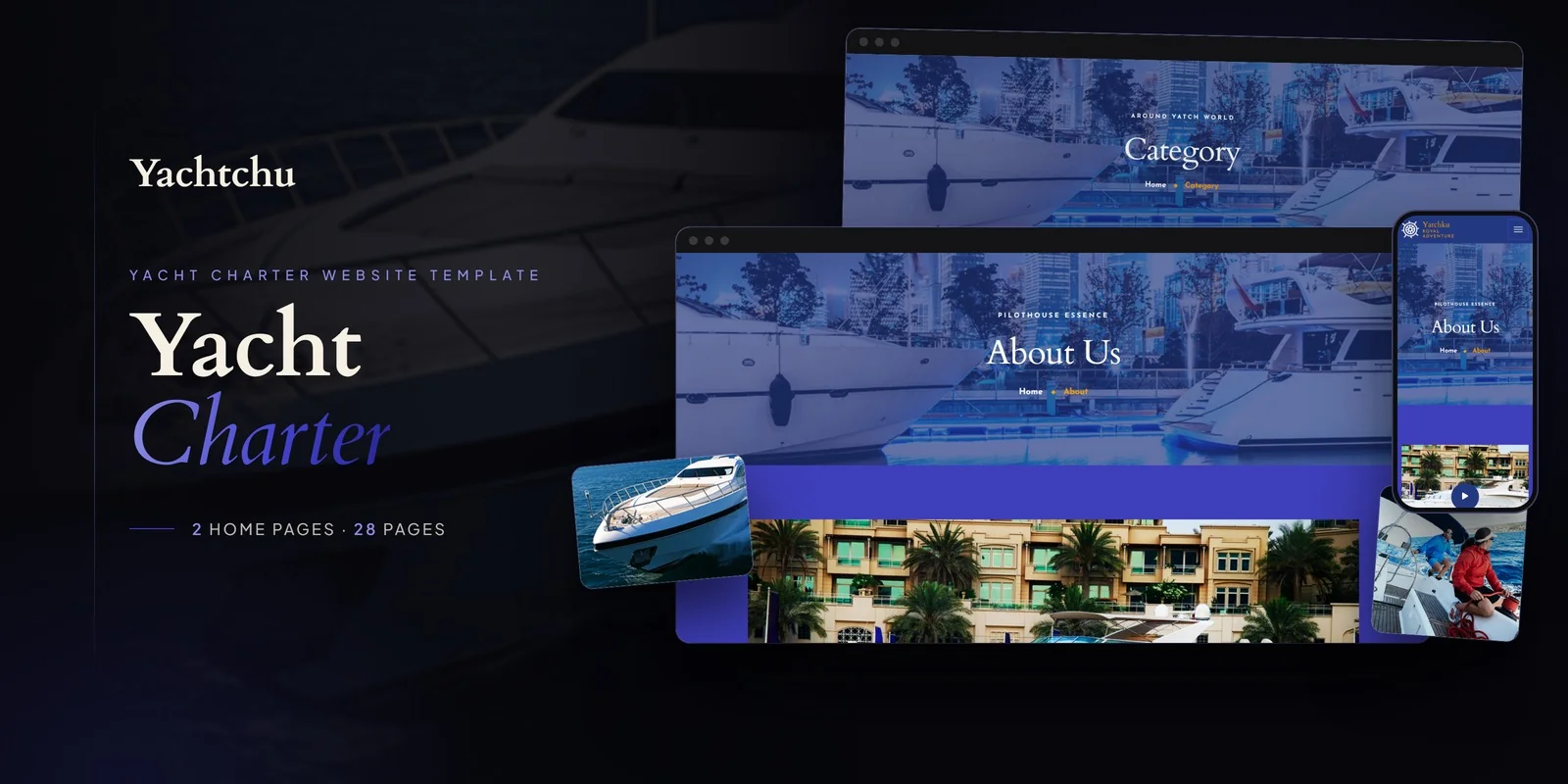
For yacht clubs, charter companies, and marine businesses that demand a website matching the quality of their on-water experience, Yachtchu delivers exactly that. Purpose-built for the nautical industry, Yachtchu is a comprehensive website template that understands the unique requirements of maritime organizations.
Built on Bootstrap 5 for flawless performance across all devices, Yachtchu features a commanding hero section designed for dramatic nautical photography, a sophisticated fleet gallery with vessel detail cards, event and regatta scheduling sections, membership information layouts, booking inquiry forms, and elegantly designed content areas for your organization’s story and services.
The visual design draws from authentic nautical aesthetics without falling into cliched territory. The color palette, typography, and layout create a premium impression that resonates with the expectations of yacht club members, charter clients, and marine enthusiasts. Every section is thoughtfully designed to serve the dual purpose of attracting new audiences while providing value to existing members.
Experience the complete template at demo.metropolitanhost.com/yachtchu/ to see how Yachtchu brings maritime elegance to the web.
Frequently Asked Questions
Yacht club websites serve dual audiences: prospective members evaluating the club and current members who need practical tools. This requires a public-facing section with marketing content, galleries, and membership information alongside member-focused features like event calendars, race results, and committee resources. The design must convey prestige and tradition while remaining functional and modern. Standard business templates rarely address these specific needs.
Extremely important, and for reasons specific to the marine industry. Boaters frequently access marina websites from their phones while on the water or in transit. They need to quickly find slip availability, fuel dock hours, contact numbers, and navigation coordinates. A website that is difficult to use on a smartphone fails this audience at the moment they need it most. Responsive design, click-to-call functionality, and integration with marine navigation apps are essential.
Focus on three areas: visual presentation, trust building, and booking friction. Invest in professional photography that showcases your vessels and the charter experience. Display customer reviews, safety certifications, and captain credentials prominently. And make the inquiry or booking process as simple as possible, ideally a prominent form on every page that captures contact information and preferred dates. Follow up on every inquiry within hours, not days. Speed of response is a major differentiator in the charter industry.
It depends on your club’s size and complexity. Small clubs with fewer than a hundred members can often manage with password-protected web pages, a shared calendar, and email communications. Larger clubs with complex dues structures, multiple membership tiers, racing programs, and extensive event calendars benefit from dedicated club management platforms like ClubSpot or ClubSoft that integrate with your website. Your public website handles marketing and information, while the management platform handles operations and member services.
Plan for several categories of photography: fleet shots of each vessel in your lineup (on water, ideally at golden hour), aerial or drone footage of your marina showing the full scope of your facility, lifestyle images of people enjoying the sailing and social experience, action shots from racing events, interior photos of clubhouse facilities, and candid moments from social events. Schedule photography during optimal conditions: calm water, good light, and active marina traffic. A professional marine photographer understands these conditions and will deliver images that elevate every page of your website.
Younger prospective members evaluate clubs through their digital presence first. A modern, mobile-friendly website with dynamic content signals that your club is evolving, not stuck in the past. Feature your junior sailing programs, social events, and young adult membership options prominently. Use video content and social media integration to show the community in action. Consider a dedicated landing page for young adults that addresses their specific interests and concerns, including affordability, social scene, and learning opportunities. The website itself is a statement about your club’s direction.
The most effective nautical color schemes use deep navy blue as the primary color, conveying trust, authority, and oceanic depth. Pair it with crisp white for contrast and readability, and add warm accents in gold, brass, or teak brown for a classic yacht club feel. Aqua or teal accents work well for charter and marina businesses targeting a more contemporary, coastal aesthetic. Avoid bright primary colors or overly saturated blues that look artificial. The goal is to evoke the real colors of the maritime environment: ocean, sky, canvas, wood, and brass.
Seasonal Content and Event Promotion
The yachting and marina world revolves around seasons. Spring commissioning, summer racing series, fall haul-outs, and winter social programming each bring distinct website content needs. A static website that looks the same in January as it does in July fails to capitalize on the natural rhythms that drive engagement and bookings in the marine industry.
Update your homepage hero imagery and featured content to reflect the current season. During racing season, highlight upcoming regattas and results from recent events. During the social season, promote holiday parties, summer cookouts, and themed gatherings. In the off-season, feature boat maintenance workshops, sailing education programs, and early-bird membership renewal incentives. This seasonal rotation keeps your website feeling alive and gives members a reason to return regularly.
Event promotion deserves particular attention. For yacht clubs, events are the primary driver of community engagement and member satisfaction. Each major event, whether it is your annual regatta, a guest speaker series, or a holiday gala, should have a dedicated page on your website with event details, registration functionality, sponsor recognition, and post-event photo galleries. Over time, these event pages build a rich archive that demonstrates the vibrancy of your club’s programming.
For charter companies, seasonal pricing and availability should be clearly communicated. Peak season rates, shoulder season discounts, and special holiday packages all influence booking decisions. A well-organized pricing calendar helps clients understand your rate structure and often encourages them to book during shoulder seasons for better value, which helps you fill capacity during otherwise slower periods.
Safety, Certifications, and Regulatory Compliance
The marine industry operates under strict safety regulations, and your website is the right place to communicate your commitment to safety and compliance. For charter operations, display your US Coast Guard certifications, captain licensing information, vessel inspection status, and safety equipment inventory. These details may seem administrative, but they build confidence with safety-conscious clients who are trusting you with their well-being on the water.
For yacht clubs, safety information might include your safety boat coverage during racing, man-overboard procedures, weather cancellation policies, and junior sailing program safety protocols. Parents evaluating your junior sailing program will specifically look for this information before enrolling their children. Making it easily accessible demonstrates professionalism and care.
Insurance information, while not typically detailed on a website, can be referenced to reassure clients. A simple statement that your vessels are fully insured and your operations carry comprehensive liability coverage provides peace of mind without getting into policy specifics.
Accessibility and Inclusive Design for Marine Websites
Yacht clubs and marine businesses serve increasingly diverse communities, and your website should be accessible to all visitors, including those with disabilities. Web accessibility is not just an ethical responsibility; in many jurisdictions, it is a legal requirement under the Americans with Disabilities Act and similar legislation globally.
Practical accessibility measures include providing alt text for all images so screen readers can describe your fleet and facilities to visually impaired visitors, ensuring sufficient color contrast between text and backgrounds, making all interactive elements keyboard-navigable for users who cannot use a mouse, and providing captions for video content. These improvements benefit all users, not just those with disabilities. Improved color contrast makes your site more readable in bright sunlight, which is particularly relevant for boaters checking your site dockside.
Beyond digital accessibility, consider highlighting the physical accessibility of your facilities. If your clubhouse is wheelchair accessible, if you offer adaptive sailing programs, or if your charter vessels can accommodate guests with mobility challenges, feature this information prominently. These inclusive offerings differentiate your organization and expand your potential audience.
Measuring Website Performance and Continuous Improvement
Launching your website is the beginning, not the end. The most successful marine businesses treat their website as a living asset that is continuously improved based on data and feedback. Setting up analytics from day one gives you the insights needed to make informed decisions about content, design, and marketing investments.
Track key metrics including total visitors and traffic sources (organic search, social media, direct, referral), most visited pages and how long visitors spend on each, conversion actions such as inquiry form submissions, event registrations, and membership applications, bounce rate (the percentage of visitors who leave after viewing only one page), and mobile versus desktop usage patterns.
These metrics tell a story about how your audience interacts with your website. High traffic to your fleet gallery but low inquiry form submissions might indicate that your call-to-action is not prominent enough or that your pricing information creates uncertainty. Strong blog traffic but low navigation to service pages might suggest that your internal linking strategy needs improvement. Each insight creates an opportunity for targeted improvement that makes your website more effective over time.
Schedule quarterly website reviews where you assess analytics, update seasonal content, refresh photography, and test all interactive elements. Annual audits should include checking for broken links, updating copyright dates, reviewing SEO performance, and evaluating whether any design elements feel dated. This disciplined approach to website maintenance ensures your digital presence remains a strong asset for your marine business.
Community Building Through Your Website
A yacht club is more than a facility. It is a community. Your website should reflect and reinforce the sense of belonging that keeps members engaged and attracts new ones. Feature member spotlights that introduce interesting personalities within your club, from the longtime commodore to the junior sailor who just earned their first certification. These human stories transform your website from an institutional brochure into a living reflection of your community.
Consider incorporating a news or announcements section that keeps members informed about club developments, from facility improvements and new boat acquisitions to committee updates and policy changes. This section does not need to be a full blog. Even brief, regularly updated posts demonstrate that your club is active, evolving, and invested in keeping members in the loop.
For clubs with active racing programs, a results and standings page adds competitive value that brings racing members back to the website regularly. Post results promptly after each race day, maintain season standings, and archive historical results for reference. This competitive data is often the most frequently visited content on yacht club websites, and keeping it current signals organizational commitment to the racing program.
Alumni and legacy content can also strengthen community bonds. If your club has a notable history, a heritage section with historical photos, founding stories, and milestone celebrations creates emotional connection to the institution. New members gain appreciation for the tradition they are joining, and longstanding members feel their history is valued and preserved.
Setting Sail with the Right Website
The maritime industry deserves websites that match the beauty and prestige of the waterfront experience. Whether you operate a yacht club with a century of tradition, a modern charter fleet, or a full-service marina, your website is the gateway through which new members, clients, and visitors discover what you offer.
Investing in a professional, purpose-built website template gives you the design quality and functionality your audience expects, without the timeline and budget of a custom build. Combined with professional photography, compelling content, and ongoing updates, it creates a digital presence that attracts new business while serving your existing community.
Evaluate your current website against the standards discussed in this guide. If it falls short, the opportunity cost of waiting grows every day. The right template, customized with your brand’s story and imagery, can transform your maritime organization’s online presence and drive meaningful results for years to come.