Why Every Church Needs an Online Giving Strategy in 2026
The way congregations support their churches has changed permanently. Fewer people carry cash. Younger members grew up with digital payments. And families who miss a Sunday service often mean to catch up financially but forget by the following week.
Churches that offer online giving consistently report higher total donations than those relying solely on the offering plate. The reason is straightforward: digital giving removes friction. A member sitting in the pew can give during the sermon through their phone. A college student attending remotely can tithe from another state. A family on vacation doesn’t have to remember an envelope when they return.
But online giving only works when the church website makes it easy. A buried donation link, a confusing form, or a page that looks untrustworthy on a phone screen will quietly suppress generosity week after week.
This guide walks through everything a church, ministry, or faith-based nonprofit needs in a website template that supports online donations — from the donation page itself to the surrounding features like event management, sermon archives, and community engagement tools that keep members connected between Sundays.
What a Church Donation Page Actually Needs
Not all donation pages are created equal. A generic “Contact Us” form with a PayPal link tucked underneath is technically online giving, but it signals to donors that the church hasn’t invested in the experience. Here is what a well-designed church donation page should include:
Clear giving amounts with a custom option. Pre-set buttons ($25, $50, $100, $250) reduce decision fatigue, but a custom field lets generous donors give exactly what they feel called to give. The best designs highlight one suggested amount — often the congregation’s average gift size — while keeping all options equally accessible.
Fund designation. Members want to know where their money goes. A dropdown or button set that lets donors choose between the general fund, building fund, missions, benevolence, or a specific campaign builds trust and increases giving. Churches running capital campaigns see significantly higher participation when donors can earmark contributions.
Recurring giving toggle. One-time gifts sustain a church through good Sundays. Recurring gifts sustain a church through every Sunday. A simple toggle that lets donors set up weekly, biweekly, or monthly giving transforms unpredictable income into stable, plannable revenue. Churches that prominently feature recurring giving options build financial resilience that survives seasonal attendance dips.
Mobile-first design. More than half of church website traffic comes from phones. If the donation page requires pinching, zooming, or horizontal scrolling on a mobile screen, the church is losing gifts. The donation form should render cleanly on every screen size with large, tappable buttons and minimal text input.
Trust signals. Donors need to feel safe. An SSL certificate badge, a brief privacy statement, and a clean, professional design all communicate that the church takes financial stewardship seriously. A donation page that looks like it was built in 2012 creates unconscious hesitation even among committed members.
Donation Cause Pages: Running Multiple Campaigns at Once
Beyond the general donation page, growing churches and nonprofits frequently need to run several fundraising campaigns simultaneously. A building renovation, a missions trip to Central America, a community food pantry expansion, and a youth camp scholarship fund might all be active at the same time.
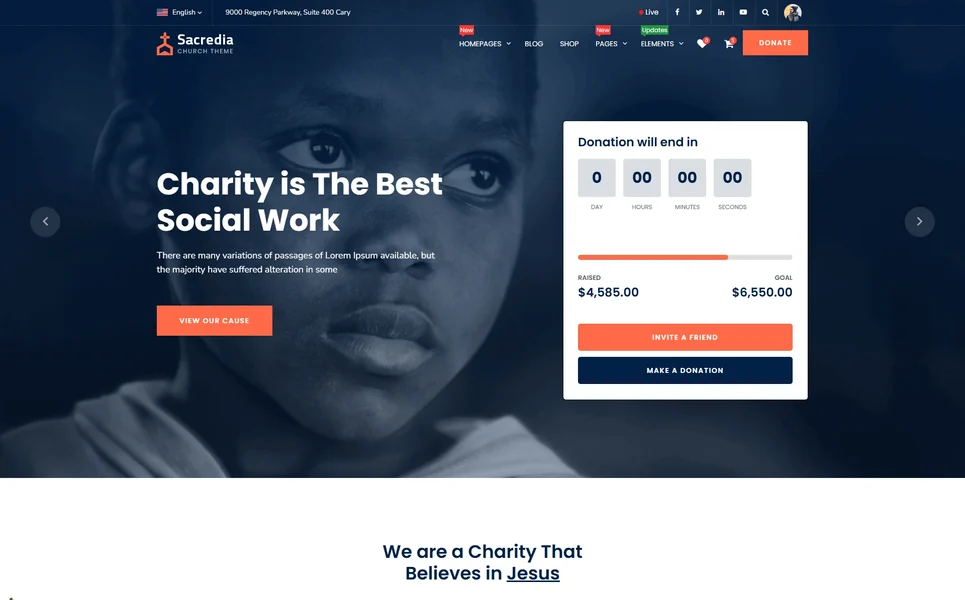
Donation cause pages solve this by giving each campaign its own dedicated URL, story, goal, and giving call to action. When a member shares a cause page link on social media or in a group chat, the recipient lands on a focused page that explains exactly what their gift supports — not a generic donation form where they have to guess which fund to select.
Effective cause pages include:
- A compelling narrative explaining the need and the impact
- A visual progress indicator showing how close the campaign is to its goal
- Specific giving tiers tied to tangible outcomes (“$50 feeds a family for a week”)
- Social sharing buttons so supporters can amplify the campaign
- A direct donate button that pre-selects the correct fund
Churches that use dedicated cause pages for specific campaigns consistently outperform those that funnel all giving through a single donation form. The psychology is simple: specificity increases generosity. Donors give more when they can see exactly what their contribution accomplishes.
Event Management: Keeping Your Congregation Connected
A church website without event management is like a bulletin board that never gets updated. Events are the heartbeat of church life — worship services, bible studies, youth group meetings, community outreach days, holiday celebrations, baptism classes, marriage retreats, and mission trips all need a home on the website.
A strong event system on a church website should provide:
Event listings with filtering. Members should be able to browse upcoming events by category (worship, youth, outreach, education) or by date. A cluttered list of every event from every ministry overwhelms visitors. Organized listings help members find what matters to them.
Individual event detail pages. Each event deserves its own page with the date, time, location, description, and any registration or RSVP information. These detail pages also serve as shareable links — a youth pastor can text the retreat page directly to parents rather than retyping all the details.
Event schedules and calendars. For multi-day events like conferences, retreats, or vacation bible school, a schedule view that breaks down sessions, speakers, and activities by time slot helps attendees plan their participation.
Extended event views. Major events like annual conferences or community festivals benefit from extended pages that include speaker bios, session descriptions, venue maps, and logistical information like parking and childcare.
Event pages also serve an outreach function. When someone in the community searches for local events — a holiday service, a free community meal, a grief support group — the church website should surface those events with enough detail to make a newcomer feel welcome and informed.
Sermon Archives: Extending Your Reach Beyond Sunday Morning
For many churches, the sermon is the most valuable content produced each week. Yet most church websites either don’t archive sermons at all or bury them in a disorganized page that members have to scroll through endlessly.
A well-designed sermon archive transforms a single Sunday morning message into a persistent resource that serves the congregation all week:
Sermon listing pages present messages in reverse chronological order with the title, speaker, date, series name, and a brief description. Members can browse by series, speaker, or topic to find the message they want to revisit.
Sermon detail pages give each message its own URL with the full description, embedded audio or video, downloadable notes, and related scripture references. These pages are individually shareable — a member can send a specific sermon to a friend who is going through a difficult season rather than saying “go to our website and look for the one from three weeks ago.”
Sermon archives also have significant SEO value. Each sermon detail page, properly titled and described, becomes a unique piece of content that search engines can index. A church that preaches a sermon series on grief recovery now has pages that can surface when someone in the community searches for resources on dealing with loss.
For churches that livestream services, the sermon archive becomes the permanent home for recorded services, allowing members who missed the live broadcast to watch at their convenience.
The Prayer Wall: Digital Community Building for Faith Organizations
One feature that separates church-specific website templates from generic nonprofit designs is the prayer wall. This interactive page allows congregation members to submit prayer requests and the wider community to view, support, and respond to those requests.
The prayer wall serves several purposes:
Pastoral awareness. When members submit prayer requests through the website, the pastoral staff gains visibility into the needs of the congregation without relying solely on in-person conversations. A single mother struggling financially, an elderly member facing surgery, a teenager dealing with anxiety — these needs surface through the prayer wall and enable targeted pastoral care.
Community connection. Members who see prayer requests from fellow congregants develop deeper empathy and connection. The prayer wall transforms a website from an information portal into a genuine community space where people feel seen and supported.
Outreach opportunity. Visitors exploring the church website can see the prayer wall and immediately understand that this is a community that cares about its members. For someone searching for a new church home, that kind of visible compassion can be the deciding factor.
Midweek engagement. The prayer wall gives members a reason to visit the church website between Sundays. Regular engagement with the website increases the likelihood that members will also interact with event pages, sermon archives, and donation opportunities during the week.
Not every church template includes a prayer wall. Most generic nonprofit or charity templates skip this feature entirely because it is specific to faith communities. When evaluating a church website template, the presence of a prayer wall signals that the designers understood the unique relational dynamics of a congregation.
Choosing the Right Design for Your Denomination
One of the most overlooked aspects of church website design is denomination-appropriate visual language. A Catholic parish expects a different aesthetic than a contemporary Protestant megachurch, which looks nothing like an Eastern Orthodox cathedral’s online presence.
Catholic parishes tend toward traditional design elements: rich colors, formal typography, imagery of saints and sacraments, and a layout that communicates the weight of liturgical tradition. The website should feel like an extension of the physical sanctuary — reverent, orderly, and beautiful.
Protestant churches span an enormous design range. A traditional Baptist church may want warm, welcoming colors with family imagery, while a modern nondenominational church might prefer bold typography, cinematic photography, and a design that feels more like a startup landing page than a traditional church bulletin.
Eastern Orthodox congregations have distinct visual expectations rooted in iconographic tradition. Gold accents, traditional imagery, and layouts that respect the visual hierarchy of Orthodox worship create an authentic online presence for these communities.
Charities, NGOs, and faith-based nonprofits need designs that lead with impact rather than worship. Statistics, program areas, volunteer calls to action, and donor-facing content should be prominent, with faith elements present but not dominant.
A church website template that offers only one design approach forces organizations to either compromise their visual identity or spend significant time and money customizing. Templates that provide multiple homepage variants for different denomination types save weeks of design work and deliver denomination-appropriate results out of the box.


What to Look for in a Church Website Template with Donation System
Before evaluating specific templates, here is a practical checklist of features that a church or nonprofit should prioritize:
Donation infrastructure:
- Dedicated donation page with clear giving flow
- Donation cause pages for individual campaigns
- Mobile-responsive donation forms
- Integration-ready design for Stripe, PayPal, or church-specific processors
Content management:
- Sermon listing and detail pages
- Blog system for devotionals, news, and community updates
- About Us page for mission, vision, and leadership
- Pastor or staff profile pages
Community engagement:
- Event listing, detail, and schedule pages
- Prayer wall or prayer request system
- Contact page with location, service times, and map
- History or timeline page for organization milestones
E-commerce capability:
- Shop pages for books, merchandise, and ministry resources
- Cart and checkout flow
- Member account pages
Technical foundations:
- Responsive design across all devices
- Clean, semantic HTML5 markup for SEO
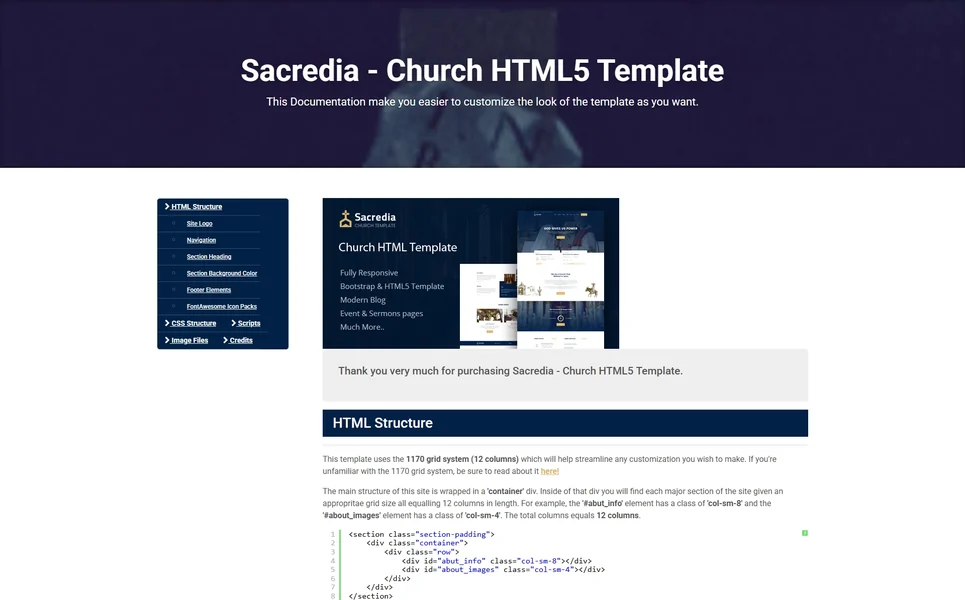
- Bootstrap or equivalent framework for maintainability
- Cross-browser compatibility
- Well-documented, organized code
- Fast loading performance
Sacredia: A Church Website Template Built Around Online Giving
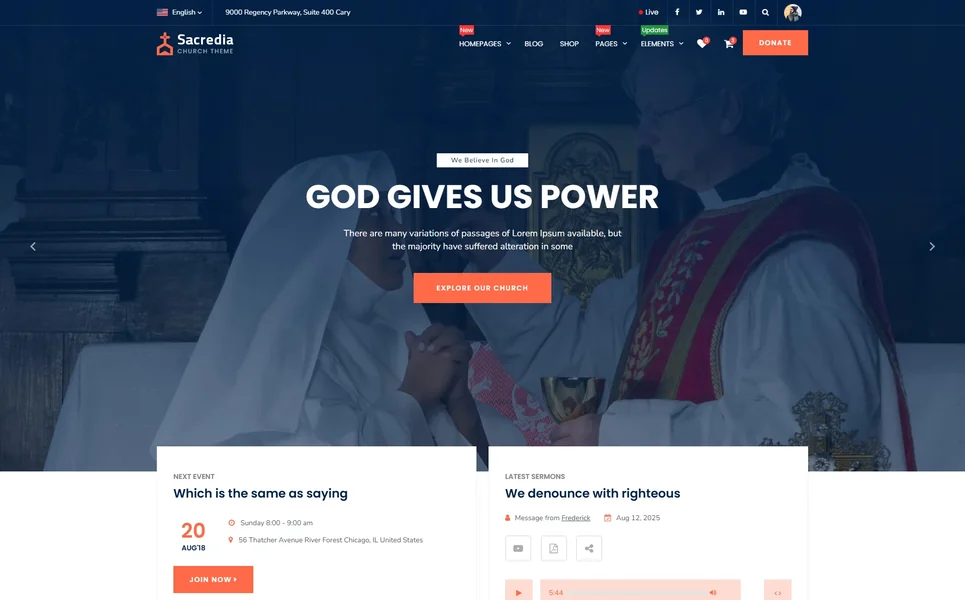
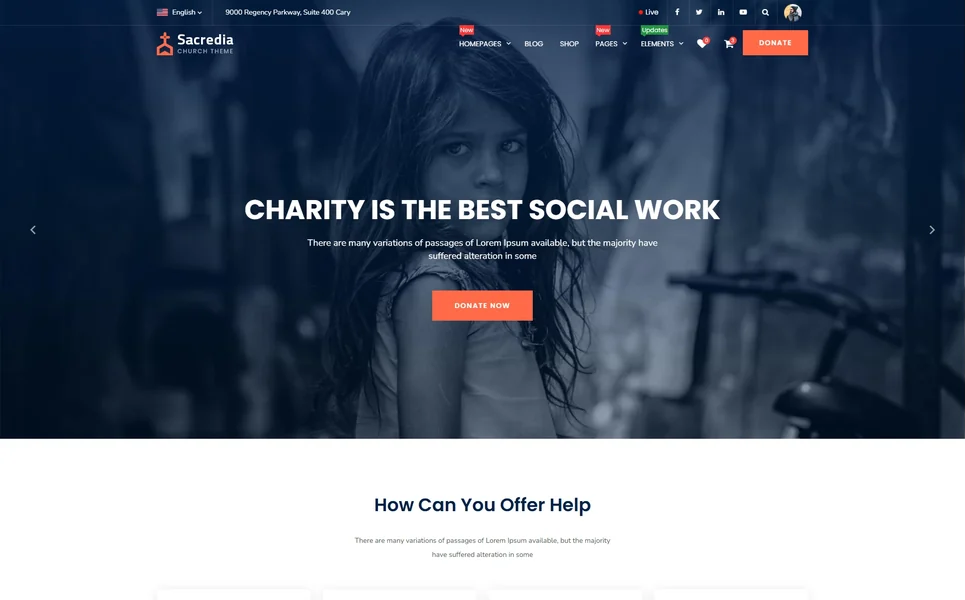
Sacredia is an HTML5 template designed specifically for churches, ministries, and faith-based nonprofits that need a professional web presence with a fully realized donation system. Built on Bootstrap and jQuery, the template spans 31 pages across 11 unique homepage variations — covering Catholic, Protestant, Eastern Orthodox, Charity, NGO, Non-Profit, Ministry, Donation-focused, and Event-driven organizations.
What sets Sacredia apart from generic church templates is the depth of its donation infrastructure. Rather than offering a single donation page and calling it sufficient, Sacredia includes both a general donation page and individual donation cause pages. This means a church can run its regular tithing and offering collection through the main donation page while simultaneously running targeted campaigns — a building fund, a missions trip, a community outreach project — each with its own dedicated URL, narrative, goal progress, and giving call to action.
The template addresses every major category of church website content:
Sermons: A sermon listing page and sermon detail page provide the front-end framework for building a searchable sermon archive. Each sermon gets its own URL for sharing, with space for audio, video, descriptions, and scripture references.
Events: Four event-related pages cover event listings, event details, extended event views for conferences and retreats, and event schedules with session-by-session breakdowns.
Prayer wall: A dedicated interactive page where congregation members can submit prayer requests and the community can view and support them.
eCommerce: A complete shop section with product detail pages, shopping cart, checkout flow, and member account pages for selling books, devotional materials, branded merchandise, or event tickets.
Blog: Blog listing and detail pages for devotionals, community news, ministry updates, and outreach stories.
Community pages: About Us, pastor profile, church location with map integration, history slider with organizational milestones, and a contact page with service times.
The 11 homepage variants deserve specific attention. Most church templates offer two or three layout options at best. Sacredia provides dedicated homepage designs for:
- Catholic parishes
- Protestant churches
- Eastern Orthodox congregations
- Charity organizations
- NGOs
- Non-profit organizations
- Ministries
- Donation-focused organizations
- Event-driven organizations
- A general index layout
- A default home layout
Each variant uses design language appropriate to its target audience — liturgical formality for Catholic and Orthodox, warm community imagery for Protestant, impact-driven layouts for charities and NGOs. A church administrator can select the variant closest to their denomination and customize from there, rather than starting from a blank canvas or forcing a design meant for a different tradition.
Cost Comparison: Template vs. SaaS Platform vs. Custom Development
One of the most important decisions a church makes about its website is the delivery model. There are three primary approaches, each with different cost structures, capabilities, and trade-offs.
HTML template (like Sacredia): $49 one-time
The template provides all the front-end design and page structure. The church (or its volunteer developer) hosts the site on any web hosting service, connects a payment processor like Stripe or PayPal for donations, and maintains the content directly. There are no monthly platform fees and no transaction fees beyond what the payment processor charges (typically 2.9% + $0.30 per transaction for credit cards).
Over three years, the total cost of ownership is the template price ($49) plus basic hosting (~$5–10/month, or $180–360 over three years). Total: roughly $229–$409.
SaaS church platform (Tithe.ly Sites, ChurchTrac, etc.): $19–119/month
Platforms like Tithe.ly Sites offer drag-and-drop website builders with built-in donation processing, sermon hosting, and church management features. The convenience is real — everything is integrated, and no technical knowledge is required. However, the costs accumulate:
- Tithe.ly Sites: $19/month ($684 over three years) + 2.9% + $0.30 per donation transaction
- Tithe.ly All Access (website + giving + ChMS + app): $119/month ($4,284 over three years) + transaction fees
- ChurchTrac: $5–100/month depending on church size, plus extra for custom website development
These platforms also create vendor dependency. If the church decides to switch platforms, the website, donation history, and member data may not transfer easily.
Custom development: $1,000–$10,000+ upfront
Hiring a web developer or agency to build a custom church website delivers a unique design tailored to the church’s exact needs. However, the upfront investment is significant, and ongoing maintenance, security updates, and content changes often require continued developer involvement at hourly rates.
For most small to mid-sized churches, the template approach offers the best balance of professional design, feature completeness, and financial stewardship. The $49 one-time investment in Sacredia delivers 31 pages of production-ready design that would cost thousands to commission from scratch.
Integrating a Payment Processor with Your Church Template
A common question from pastors and church administrators is how a static HTML template handles actual payment processing. The answer is straightforward: the template provides the beautifully designed front-end — the donation page layout, the cause page structure, the giving buttons and forms — while a third-party payment processor handles the actual financial transaction.
Here is how the integration typically works:
Step 1: Choose a payment processor. Popular options for churches include Stripe (most widely supported), PayPal (familiar to donors), Square (if the church also accepts in-person payments), or church-specific platforms like Tithe.ly or Pushpay for their embeddable giving forms.
Step 2: Create your account. Sign up with the processor, provide your church’s bank account details and tax ID (EIN), and complete identity verification. Most processors approve churches within 1–2 business days.
Step 3: Generate your payment form or embed code. Stripe, PayPal, and most processors provide embed codes, hosted payment pages, or JavaScript widgets that you paste into your template’s donation page HTML. The form inherits the page’s styling for a seamless look.
Step 4: Configure fund designations. Set up your giving funds (general fund, building fund, missions, etc.) in the processor’s dashboard. Map these to the fund selection options on your donation page.
Step 5: Test with a small transaction. Process a $1 donation through each fund to verify the entire flow works — from the donation page click to the confirmation email to the bank deposit.
The entire process typically takes an afternoon for someone with basic HTML familiarity. For churches that want hands-off setup, professional web deployment services can handle the integration for a one-time fee that is still far less than ongoing SaaS platform subscriptions.
Sacredia vs. Sacreva: Which Church Template Fits Your Organization?
MetropolitanHost offers two church website templates, and choosing the right one depends on your organization’s specific needs.
Sacreva ($14, 55+ pages) focuses on three denomination-specific layouts — Classic, Baptist, and Catholic — with an admin dashboard, RTL support, and the largest page library. Choose Sacreva if your church fits squarely into one of those three denomination styles and you want the deepest page count at the lowest price.
Sacredia ($49, 31 pages) focuses on breadth of organization types with 11 homepage variants spanning Catholic, Protestant, Eastern Orthodox, Charity, NGO, Non-Profit, Ministry, Donation, and Event layouts. Choose Sacredia if your organization spans multiple faith traditions, operates as a nonprofit or NGO, or needs specialized features like the prayer wall, donation cause pages, and full event management.
Neither template is objectively better — they serve different needs. A Baptist church with a straightforward web presence saves money with Sacreva. An interfaith nonprofit running multiple fundraising campaigns with event schedules and a prayer community needs Sacredia’s architectural breadth and donation infrastructure.
Frequently Asked Questions
Need Help Launching Your Church or Nonprofit Website?
MetropolitanHost provides professional web development services for HTML template deployments. Our team understands church and nonprofit platform requirements and delivers clean, well-structured implementations.
- Full Website Package — complete front-to-back deployment
- Colour Customisation — match your church or nonprofit branding
- Website Speed Optimisation — Core Web Vitals improvements
- Accessibility Compliance — WCAG audit and remediation