Walk into any successful spa and you will notice something immediately: every detail has been considered. The lighting is calibrated to relax. The scent is intentional. The music is curated. The reception area flows naturally toward treatment rooms. The entire physical environment has been designed to make you feel calm, cared for, and confident that you are in professional hands. Now visit that same spa’s website. In most cases, the experience is the polar opposite — cluttered layouts, stock photos from a generic business template, no information about specific treatments, no therapist profiles, and a contact form that feels like an afterthought.
The disconnect is damaging, and it is costing spa owners clients they never know they lost. A potential client who searches for spa services in their area, finds your website, and encounters a generic or unprofessional design does not call to complain. They simply close the tab and book with the competitor whose website made them feel what your physical space would make them feel — relaxed, confident, and valued. In the wellness industry, where trust and comfort are prerequisites for the purchase decision, your website is not a brochure. It is the first treatment experience.
This guide covers everything spa and wellness business owners need to know about building a professional web presence in 2026: the specific pages and features that wellness clients expect, the costs at every investment level, the design principles that create the right emotional response, and how to choose a template that captures the serenity and professionalism of your space without requiring a luxury-level development budget.
Why Spa Websites Require a Different Approach
Spa and wellness services are experience purchases — clients are buying a feeling, not a product. This fundamentally changes what a website needs to accomplish compared to most business categories. A plumbing company’s website needs to communicate competence and availability. A law firm’s website needs to communicate expertise and credibility. A spa’s website needs to communicate all of that while simultaneously creating an emotional response: calm, anticipation, trust, and the desire to experience the physical space.
The decision to book a spa treatment is deeply personal. Clients are choosing to be physically vulnerable — lying on a table in a dimly lit room while a stranger touches them. This requires a level of trust that goes beyond what most service businesses need to establish. Your website must build that trust through therapist credentials, treatment descriptions, facility imagery, and an overall aesthetic that signals professionalism, cleanliness, and expertise.
Spa clients also research extensively before booking. They read treatment descriptions to understand what each service involves. They look at therapist profiles to choose the right practitioner. They browse gallery images to evaluate the facility environment. They check pricing to ensure the investment fits their budget. A spa website that fails to provide this information pushes potential clients toward competitors who do — because in the absence of information, anxiety wins and the booking does not happen.
The local competition factor amplifies the importance of web presence. Spa services are inherently local — clients want convenient locations and will compare multiple options within their area. When three spas appear in a local search, the one with the most professional and informative website consistently captures the largest share of bookings. The website is the tiebreaker between otherwise comparable options.
The 10 Essential Features for Spa Websites
Spa and wellness websites have specific requirements that generic business templates cannot satisfy. Here are the features that create the online experience wellness clients expect.
1. Services Module With Treatment Detail Pages
This is the most critical feature for spa websites. A services overview page listing all treatment categories — massage, facials, body treatments, wellness therapies, packages — should link to individual treatment detail pages that describe each service in depth. Every treatment page should include a description of the experience, duration, pricing, what to expect during and after the session, and who the treatment is ideal for. This depth answers the questions that create booking anxiety and removes the friction between interest and action.
2. Therapist and Practitioner Profiles
Clients want to know who will be treating them. A team section with professional photos, credentials, specializations, certifications, and brief personal bios humanizes your spa and builds the trust that booking requires. Clients who can review a therapist’s qualifications and choose the practitioner that resonates with them book with more confidence and return more frequently. Team profiles also differentiate your spa from competitors by showcasing the expertise behind the treatments.
3. Portfolio and Treatment Showcase
Visual evidence of results builds credibility that text descriptions cannot match. A portfolio section with Isotope grid filtering lets you organize treatment results, before-and-after images, and case studies by treatment type or wellness category. This feature is especially valuable for medical spas and aesthetics studios where visible results are the primary purchase driver. The ability to filter by treatment category lets potential clients quickly find results relevant to the services they are considering.
4. Gallery Showcasing Facility and Atmosphere
The physical environment is a core part of the spa value proposition. A dedicated gallery page with full-screen lightbox viewing lets potential clients virtually experience your treatment rooms, relaxation areas, reception, and overall atmosphere before visiting. High-quality facility photography that captures lighting, decor, and ambiance communicates the care and attention to detail that clients associate with premium spa experiences.
5. Animated Achievement Statistics
CounterUp or equivalent animated statistics that display treatments performed, satisfied clients, years of experience, and certified therapists provide immediate credibility signals. These metrics are especially important for newer spas establishing their reputation and for established spas communicating the scale of their experience. Quantifiable evidence of track record builds the confidence that drives first-time bookings.
6. Blog for Wellness Content
A blog module positions your spa as a wellness authority, not just a service provider. Articles about skincare routines, stress management, seasonal wellness tips, treatment explanations, and self-care practices drive organic search traffic from people actively interested in wellness — your ideal potential clients. Multiple blog formats let you publish different content types effectively — quick tips in grid format, in-depth wellness guides in full-width layout, and curated collections by wellness category.
7. Multiple Homepage Options
Different spa concepts benefit from different homepage approaches. A luxury day spa might lead with a full-screen hero image of its most elegant treatment room. A medical aesthetics studio might lead with treatment results and credentials. A wellness centre might lead with a service overview and testimonials. Multiple homepage layouts let you choose the approach that best represents your brand and resonates with your target clientele.
8. Testimonial and Review Display
Social proof is exceptionally powerful in the spa industry because services are experience-based and inherently personal. Client testimonials displayed through carousel sliders or dedicated sections provide the reassurance that first-time visitors need. Testimonials that mention specific treatments, therapists, or aspects of the experience are more persuasive than generic positive comments.
9. Contact With Location Information
Spa clients need practical information to complete the booking decision — address with map, parking details, hours of operation, phone number, and an easy-to-use contact form. Since spa services are inherently local, prominent location information with embedded maps helps clients evaluate convenience and plan their visit. Some spas also benefit from displaying arrival instructions and preparation guidelines on the contact page.
10. Responsive Mobile Design
A significant portion of spa bookings originate from mobile searches — someone feeling stressed during their workday, looking up spa services during a lunch break, or researching treatment options while commuting. Your website must deliver the same serene, professional experience on a phone screen as it does on a desktop monitor. Treatment descriptions, gallery images, therapist profiles, and contact information must all be easily accessible and beautifully presented on mobile devices.
How Much Does a Spa Website Cost?
Spa owners face the same budgeting challenge as other small business owners — balancing the need for professional presentation against the realities of business expenses. Here is what each investment level delivers.
Basic Website Builders: $10 to $40 Per Month
Wix, Squarespace, and similar platforms offer spa-adjacent templates with basic page structures. Monthly costs accumulate — $30 per month totals $1,800 over five years. These platforms offer limited customization, standardized layouts shared with thousands of other businesses, and no individual treatment detail pages. The result often looks more like a placeholder than a professional spa website.
Custom Spa Website Design: $8,000 to $30,000
Hiring a designer to build a custom spa website delivers a unique result that reflects your brand identity. This range typically includes custom design, professional photography direction, booking system integration, and CMS setup. Professional spa photography — essential for communicating atmosphere and quality — adds $2,000 to $8,000. Annual maintenance and updates run $1,500 to $5,000.
Enterprise Wellness Platform: $30,000 to $100,000+
Multi-location spa chains and luxury wellness resorts invest at this level for custom booking engines, client management portals, membership systems, gift card platforms, and integration with spa management software. Annual maintenance typically runs 15 to 20 percent of the build cost.
Premium HTML Templates: $14 to $59 One-Time
A single purchase delivers a complete spa website with homepage layouts, services overview and detail pages, therapist profiles, portfolio showcase, gallery, blog, achievement statistics, and contact page. No recurring fees. Full code ownership. The most cost-effective path for independent spas and wellness centres that want professional design without custom development budgets. Combined with professional photography and hosting, you can launch a premium spa web presence for under $500 total.
Design Principles for Spa Websites
Spa website design has a singular objective: make the visitor feel what they would feel walking into your spa. Every design choice should serve this emotional goal.
Create Calm Through Visual Restraint
Less is more in spa design — on the website just as in the treatment room. Soft, muted color palettes with natural tones — sage, sand, cream, soft blue, warm gray — create visual calm. Generous whitespace gives content room to breathe. Elegant typography at comfortable sizes communicates refinement without shouting. The website should lower the visitor’s heart rate, not raise it.
Use Photography That Communicates Experience
Spa photography should capture atmosphere, not just spaces. Warm lighting, soft textures, natural elements, and the quiet elegance of treatment rooms communicate the experience that awaits. Include detail shots — folded towels, essential oil bottles, stone arrangements, candle displays — that suggest the sensory richness of the spa environment. Avoid harsh lighting, cluttered compositions, and generic stock imagery that could belong to any spa anywhere.
Structure Around the Client Journey
Design your navigation around how clients think: What treatments do you offer? Who are your therapists? What does the space look like? What do other clients say? How do I book? Each of these questions should be answerable in one or two clicks from any page. The client should never feel lost or frustrated navigating your website — those feelings are antithetical to the calm you are selling.
Ensure Consistency Between Physical and Digital
Your website’s visual identity should match your physical space. If your spa uses earth tones and natural materials, your website should reflect that palette. If your brand is modern and minimalist, the website should mirror that aesthetic. A disconnect between the online and offline experience creates cognitive dissonance that undermines trust. Clients who visit your spa expecting the experience your website promised — and find something different — lose confidence immediately.
Spa Content Marketing Strategy
Spa owners have a natural content advantage that most fail to leverage. Wellness content has enormous search volume and directly correlates with service demand. Here is how to build a content strategy that drives bookings.
Treatment education articles. “What to Expect During Your First Deep Tissue Massage,” “Benefits of Regular Facial Treatments,” “How Hot Stone Therapy Reduces Chronic Pain” — these articles capture search traffic from people actively considering spa services. Each article naturally ends with an invitation to book the treatment described, creating a direct path from education to conversion.
Seasonal wellness guides. Winter skin care routines, summer body treatment recommendations, holiday stress relief guides, and spring detox programs align your content with seasonal demand patterns. Published four to six weeks before each season, these guides capture the early planners who represent the most reliable booking audience.
Self-care and wellness tips. Articles about at-home skincare routines, stress management techniques, and wellness practices establish your spa as a wellness authority and attract a broader audience. While not every reader will book a treatment, the brand awareness and search authority these articles build contribute to long-term growth.
Behind-the-scenes content. Introducing new therapists, showcasing new treatment rooms, explaining product selections, and sharing your spa’s wellness philosophy create transparency that builds trust. This content is especially effective on social media, driving followers to your website where they can explore services and book treatments.
Common Mistakes Spa Owners Make With Their Websites
Spa websites suffer from a consistent set of mistakes that undermine booking rates and brand perception. Avoiding these common pitfalls gives you an immediate competitive advantage.
Using a generic business template. A template designed for an accounting firm or a tech startup cannot convey the sensory, emotional experience that spa clients are purchasing. Spa websites need specific features — treatment detail pages, therapist profiles, atmospheric galleries, achievement statistics — that generic templates do not include. Forcing spa content into an inappropriate template framework undermines the brand you have built in your physical space.
No individual treatment pages. Listing all treatments on a single page with one-line descriptions is the website equivalent of handing a client a handwritten price list instead of a printed menu. Each treatment deserves its own page with detailed description, duration, pricing, benefits, and what to expect. Treatment detail pages also rank individually in search engines, capturing traffic for specific service searches.
Stock photos instead of authentic imagery. Generic spa stock photos — the woman with cucumber slices, the pile of hot stones, the generic massage table — appear on thousands of spa websites. They tell the visitor nothing about your specific spa. Authentic photography of your actual treatment rooms, products, therapists, and facility creates the trust and differentiation that stock images cannot provide.
Missing therapist information. A spa website without therapist profiles is like a medical practice without doctor bios. Clients want to know who will be treating them — their qualifications, specializations, and personality. This information builds the trust required for someone to book a treatment that involves physical vulnerability.
No content strategy. Spa owners who treat their website as a static brochure miss the ongoing organic traffic that wellness content generates. Regular publishing of treatment education, wellness tips, and seasonal guides keeps the website fresh, builds search engine authority, and brings potential clients to your site at every stage of their wellness journey.
Why Dolistic Fits the Spa and Wellness Niche
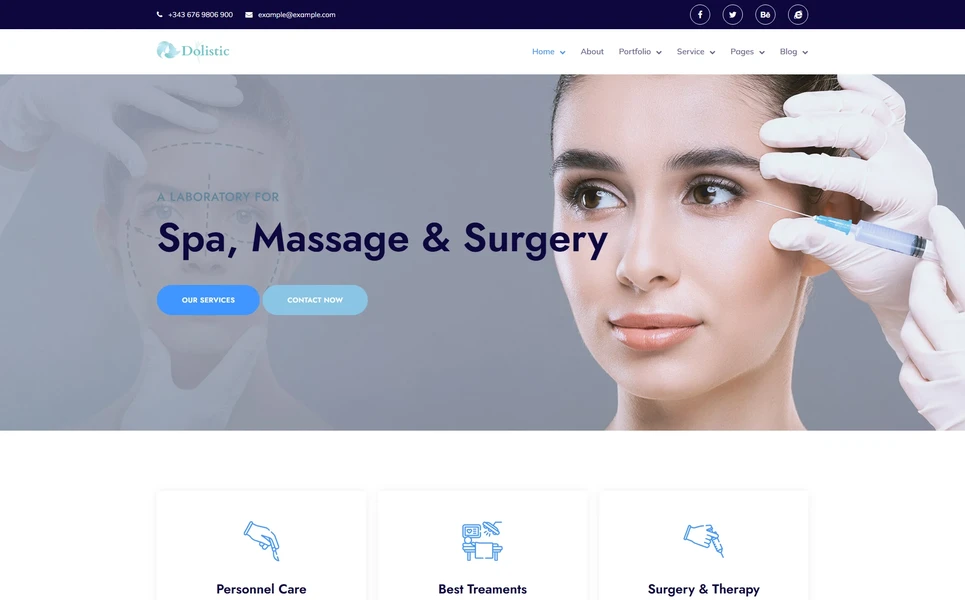
Dolistic is a professionally designed HTML5 template that ships with 15 carefully crafted HTML pages built specifically for spas, wellness centres, beauty clinics, and holistic health businesses. The template includes two unique home layouts — a serene, image-driven approach for luxury day spas and a service-forward layout for wellness centres and medical spas that want to lead with treatment capabilities.
The services module with overview and individual treatment detail pages provides exactly the structure spa websites need. Each treatment gets its own page with space for detailed descriptions, duration, pricing, benefits, and expectations — eliminating the single-page treatment list that undermines client confidence and search visibility. This structure also improves SEO by giving each treatment its own rankable page.
The team section showcases therapists and practitioners with professional profiles, credentials, and specializations — building the trust that spa clients need before booking treatments that involve physical vulnerability. The portfolio showcase with Isotope filtering displays treatment results and case studies organized by category, providing the visual evidence of quality that drives bookings for aesthetics and results-oriented services.
The gallery page with Magnific Popup lightbox lets potential clients virtually experience your facility — treatment rooms, relaxation areas, reception, and overall atmosphere — with full-screen imagery that communicates the care and attention to detail your physical space embodies. CounterUp animated statistics display treatments performed, satisfied clients, and years of expertise with visual impact.
The blog module in grid, sidebar, and detail formats supports the wellness content strategy that drives organic search traffic. Built on Bootstrap 4 with Owl Carousel for testimonial and featured treatment display, Isotope grid filtering for portfolio organization, and responsive design across all devices, Dolistic delivers a production-ready spa website that communicates the same calm professionalism your physical space provides.
Frequently Asked Questions
What pages should a spa website include?
A spa website should include a calming homepage with treatment highlights, a services overview page linking to individual treatment detail pages, a team section with therapist profiles and credentials, a portfolio or results showcase with filtering by treatment type, a gallery displaying the spa facility and atmosphere, a blog for wellness content and treatment education, animated achievement statistics, testimonials, a contact page with location map and booking information, and responsive mobile design.
How much does a spa website cost?
Costs range widely. Basic website builders run $10 to $40 per month with limited customization and standardized designs. Custom spa website design costs $8,000 to $30,000 plus photography. Enterprise wellness platforms exceed $30,000. Premium HTML templates offer the most cost-effective option at $14 to $59 one-time, delivering complete spa websites with services modules, therapist profiles, portfolio, gallery, blog, and all supporting pages — no recurring fees and full code ownership.
Why do spa clients research online before booking?
Spa treatments are intimate, experience-based services that require significant trust. Clients research treatment descriptions to understand what each service involves, review therapist credentials to choose the right practitioner, browse facility photos to evaluate the environment, check pricing to confirm budget fit, and read reviews for social proof. A spa website that provides this information comprehensively removes booking anxiety and converts browsers into clients. Without this information, potential clients choose competitors who provide it.
What design elements work best for spa websites?
Spa websites should use soft, muted color palettes with natural tones — sage, sand, cream, soft blue, warm gray — that create visual calm. Generous whitespace gives content room to breathe. Elegant typography at comfortable sizes communicates refinement. Photography should capture atmosphere with warm lighting, soft textures, and natural elements. The overall design should lower the visitor’s heart rate rather than raise it — creating online the same feeling of calm that the physical spa provides.
How important are therapist profiles on a spa website?
Therapist profiles are among the most important elements on a spa website. Clients are choosing to be physically vulnerable during treatments, which requires significant trust in the practitioner. Professional photos, credentials, certifications, specializations, and brief personal bios build that trust before the first visit. Clients who can review and choose their therapist book with more confidence, return more frequently, and develop the practitioner loyalty that drives long-term retention.
Should spa websites have a blog?
Yes. Wellness content has enormous search volume and directly correlates with service demand. Treatment education articles capture search traffic from people actively considering spa services. Seasonal wellness guides align with demand patterns. Self-care tips establish authority and attract broader audiences. Each article creates a natural path from education to booking. Spas with active blogs consistently outrank competitors with static websites in local search results for treatment-related queries.
Can I add online booking to an HTML spa template?
HTML templates provide the complete front-end design — homepage, service pages, treatment detail pages, team profiles, gallery, and all visual elements. Online booking functionality requires integration with a booking system like Acuity Scheduling, Calendly, Square Appointments, or spa-specific software like Mindbody. The template provides the professional design foundation; booking functionality is added through embedded widgets or API integration. Many spa booking systems provide simple embed codes that work with any HTML template.
The wellness industry has reached a point where clients expect the same level of care and attention in the digital experience as they receive in the treatment room. A spa with beautiful interiors, skilled therapists, and premium products that presents itself through a generic website is leaving revenue on the table and reputation on the floor. The investment in a purpose-built spa template is negligible compared to a single month’s treatment product costs — yet the impact on client acquisition, trust building, and competitive positioning is substantial and ongoing.
Final Verdict
Spa and wellness businesses that invest in a dedicated website with treatment detail pages, therapist profiles, atmospheric gallery, portfolio showcase, and wellness content capability communicate the same professionalism and care online that they deliver in person. The alternative — a generic business template that fails to create the emotional response that drives spa bookings — pushes potential clients toward competitors whose websites made them feel what your spa would make them feel. In an industry built on experience and trust, your website is either your best marketing asset or your biggest liability. A purpose-built spa template ensures it is the former.