What Is a Cannabis Farm Website Template?
A cannabis farm website template is a pre-designed, fully coded website built specifically for cannabis cultivation businesses, hemp farms, indoor grow operations, and agricultural cannabis enterprises. Unlike dispensary or retail cannabis templates that focus on product sales and menus, a farm template addresses the unique needs of the cultivation side of the industry — showcasing growing methodologies, facility capabilities, investor relations, team expertise, and product lines grown on site. It delivers every page a cannabis cultivator needs to establish credibility with investors, retail partners, and regulatory bodies.
For cannabis farm operators who need a professional online presence without commissioning a $5,000 to $15,000 custom agency build — and who cannot afford to look amateur in an industry where credibility determines licensing outcomes and investor confidence — a purpose-built farm template provides the most practical path to a polished, agriculture-focused web presence. But cannabis cultivation websites have requirements that generic business templates simply cannot meet. Your growing process must be documented visually to build trust. Your investor relations page must communicate professionalism. Your compliance posture must be evident throughout the site. This guide covers everything cannabis farm operators need to know before choosing a template.
Farm Template vs Dispensary Template vs Custom Build
Cannabis business owners typically face three website options, but the choice depends heavily on which segment of the industry you operate in:
| Factor | Dispensary/Retail Template | Cannabis Farm Template | Custom Agency Build |
|---|---|---|---|
| Primary Focus | Product menus and online ordering | Cultivation process and investor relations | Fully custom to brief |
| Upfront Cost | $19–69 | $19–69 | $5,000–15,000 |
| Monthly Cost | $3–10/month (hosting) | $3–10/month (hosting) | $100–300/month |
| 3-Year Total | $127–429 | $127–429 | $8,600–25,800 |
| Investor-Ready Pages | Rarely included | Dedicated investor page | If specified |
| Cultivation Showcase | Not applicable | Process page with visual walkthrough | If specified |
| E-Commerce | Full menu/ordering system | Product shop for wholesale/direct | Any system |
| Time to Launch | 3–7 days | 3–7 days | 6–16 weeks |
| Code Ownership | Yes — you own it | Yes — you own it | Yes — you own it |
The critical distinction is purpose. Dispensary templates are designed around product menus, strain catalogues, and consumer-facing ordering systems. A cannabis farm template is designed around agricultural credibility, cultivation methodology, and business-to-business relationships. Using a dispensary template for a cultivation business forces you to work against the template’s structure — hiding retail features and improvising agricultural content into sections that were never designed for it.
Why Cannabis Farms Need Specialised Websites
Cannabis cultivation is not retail. The audiences visiting a cannabis farm website are fundamentally different from dispensary shoppers, and their expectations require a completely different website architecture.
Investors Evaluating Your Operation
Cannabis investors perform due diligence online before ever scheduling a meeting. Your website is the first touchpoint, and investors are looking for signals of professionalism, operational maturity, and business acumen. A dedicated investor relations page that presents your cultivation capacity, licensing status, expansion plans, and partnership opportunities communicates that you understand capital markets — not just agriculture. Without this page, investors move to the next opportunity in their pipeline.
The cannabis investment landscape is competitive. Global cannabis market projections show continued strong growth through 2030, which means investor interest remains high — but so does investor selectivity. Your website must demonstrate that your operation is investable, not just operational. Professional photography, clear financial positioning, team credentials, and a structured investor page separate serious cultivation businesses from hobby grows with a website.
Retail Partners and Distributors
Dispensary buyers and distribution partners evaluate potential suppliers through their web presence. A cultivation process page that documents your growing methodology — from seed selection and germination through vegetative growth, flowering, harvesting, curing, and quality testing — demonstrates the transparency and quality standards that retail partners require. These partners want to see that your operation follows documented processes, not ad-hoc growing practices.
Regulatory Bodies and Licensing Authorities
In many jurisdictions, your web presence is reviewed as part of licensing applications and renewals. A professional, well-structured website that clearly communicates your cultivation practices, team qualifications, facility standards, and compliance posture strengthens licensing applications. Conversely, a poorly built or generic website can raise concerns about operational seriousness during regulatory review.
Direct-to-Consumer Education
In states and countries permitting direct farm sales, consumer education is critical. Cannabis consumers increasingly care about how their product was grown — organic practices, sustainable cultivation, strain genetics, and testing results. A farm website with a cultivation process page, product descriptions with growing details, and a blog covering agricultural topics builds the transparency that quality-conscious consumers demand.
Essential Pages for a Cannabis Farm Website
Cannabis cultivation businesses need specific pages that no generic template includes by default. Here is what your farm website must contain:
Cultivation Process Page
This is the most important page on your farm website. It visually documents your growing methodology from seed to sale. Include photography or illustrations of each stage — seed selection, germination, vegetative growth, flowering, harvest, drying, curing, trimming, and quality testing. Each stage should include a brief explanation of your methods and standards. This page serves triple duty: it impresses investors with operational sophistication, reassures retail partners about quality control, and educates consumers about your growing practices.
Investor Relations Page
A dedicated page for investment inquiries signals business maturity. Include your cultivation capacity metrics, licensing status, growth trajectory, partnership structure, and a secure contact form specifically for investment discussions. This page should feel like a corporate investor page — clean, data-driven, and professional. Avoid cannabis-culture imagery here; investors respond to business credibility, not lifestyle branding.
Product Catalogue With Growing Details
Your product pages should go beyond strain name and THC percentage. Include growing conditions, cultivation method (indoor, outdoor, greenhouse), terpene profiles, intended effects, and available quantities. Wholesale buyers need to see that you can supply consistently and that your product information is thorough enough for their own retail marketing.
Team and Credentials Page
Cannabis cultivation expertise matters. Showcase your master growers, agricultural scientists, compliance officers, and business leadership. Include certifications, degrees, industry experience, and areas of specialisation. Investors and partners are investing in people as much as product — your team page is where that human capital value is communicated.
Cultivation Credibility: Cannabis farm websites with a dedicated cultivation process page and investor relations section convert business inquiries at dramatically higher rates than farms using generic business templates. When investors and retail partners can visually follow your growing methodology and see a structured investment page, they treat your operation as an investable business — not a grow operation with a website.
Technical Features That Matter for Farm Websites
Responsive Design for Field and Office
Cannabis farm operators access their own websites from the field — showing facility photos to visiting investors on a tablet, pulling up product information during distribution meetings on a phone, or presenting cultivation processes during licensing hearings on a laptop. Every page must work flawlessly across devices. A template built on Bootstrap ensures responsive behaviour across all screen sizes without additional development work.
E-Commerce for Direct and Wholesale Sales
A complete e-commerce flow — shop page, product details, cart, and checkout — enables both direct-to-consumer sales where legally permitted and wholesale ordering from retail partners. The shop should support product categorisation by strain type, cultivation method, product form, and quantity, with enough detail on each product page for informed purchasing decisions.
Blog for Thought Leadership
A blog transforms your website from a static brochure into an active platform that drives organic search traffic and establishes your farm as an authority in cannabis cultivation. Topics like growing technique comparisons, regulatory updates, sustainability practices, harvest reports, and strain development stories attract the exact audience your business serves — investors researching the market, retailers evaluating suppliers, and consumers seeking transparency.
Clean Navigation for Multiple Audiences
Your farm website serves investors, retail partners, consumers, and regulatory reviewers — each with different priorities. Navigation must be structured so each audience finds their destination within two clicks. Investors need immediate access to the investor page. Retailers need the product catalogue and cultivation process. Consumers need the shop and blog. Regulatory reviewers need the about page and team credentials. A well-structured navigation bar with clear labels serves all four audiences without confusion.
Cost Comparison: Cannabis Farm Web Presence
Understanding the full cost picture helps farm operators make informed decisions about their web presence investment:
| Cost Component | Cannabis Farm Template | Cannabis Agency Build | Generic DIY Builder |
|---|---|---|---|
| Template/Design | $19–49 (one-time) | $5,000–15,000 | $0–29/month |
| Hosting | $3–10/month | $20–50/month | Included |
| Domain | $12–15/year | $12–15/year | $12–15/year |
| SSL Certificate | Free (Let’s Encrypt) | Included | Included |
| Customisation | $0 (DIY) to $500 | Included | $0 (limited) |
| Year 1 Total | $67–289 | $5,252–15,615 | $12–363 |
| Year 2+ Annual | $48–135 | $252–615 | $12–363 |
| Investor-Ready | Yes — dedicated page | Yes — custom built | No — improvise |
| Cultivation Showcase | Yes — process page | Yes — custom built | No — generic layout |
How to Evaluate a Cannabis Farm Template
Check for Cultivation-Specific Pages
Open the template demo and look for a dedicated cultivation process or growing methodology page. This is the single most important differentiator between a template designed for cannabis farms and a generic template with cannabis imagery applied as a skin. If the template lacks a process or methodology page, it was not designed for cultivation businesses — it was designed for dispensaries or general cannabis brands.
Look for an Investor Relations Page
An investor page is rare in templates and immediately identifies a template designed for the business side of cannabis. Dispensary templates never include investor pages because retail shops attract customers, not investors. A cultivation template with a dedicated investor page was designed by someone who understands the capital-intensive nature of cannabis farming.
Evaluate the E-Commerce Flow
Cannabis farms that sell direct-to-consumer or handle wholesale orders need a complete shopping flow — product listing, product detail with comprehensive information, cart, and checkout. Check that the product pages support the level of detail cannabis products require: strain information, growing method, terpene profile, testing results, and quantity options.
Assess the Team Section Depth
Cannabis farm team pages should support detailed profiles with enough space for credentials, certifications, specialisations, and professional headshots. A master grower with 15 years of experience and a degree in plant science deserves more than a thumbnail and a one-line bio. The team section should communicate the human expertise behind the cultivation operation.
Cannafarm — A Template Built for Cannabis Cultivation Businesses
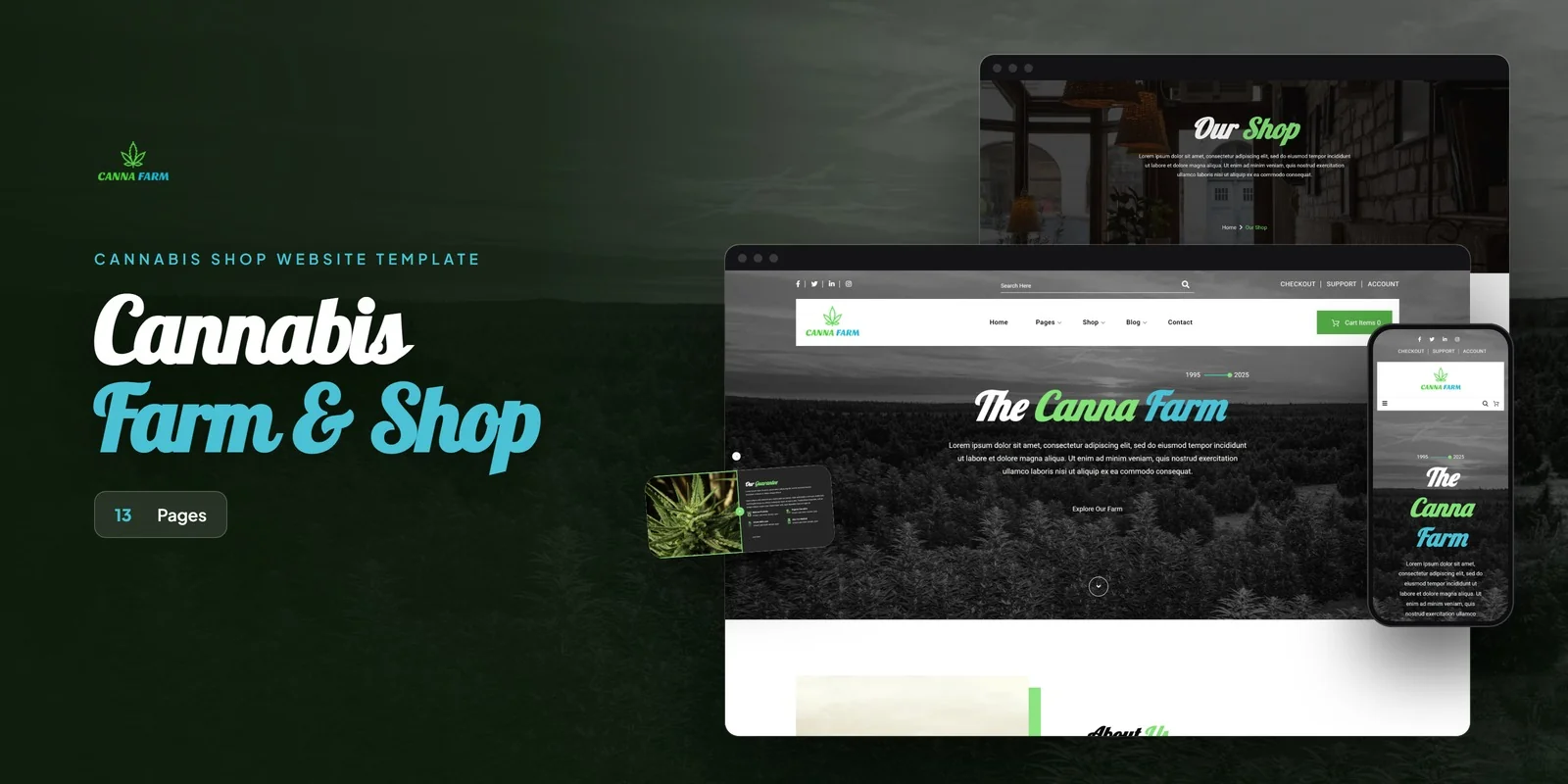
Cannafarm is a cannabis cultivation HTML5 template designed specifically for cannabis farms, hemp grow operations, and agricultural cannabis enterprises. With 13 focused pages built on Bootstrap and jQuery, it delivers exactly what cultivation businesses need without the retail-focused bloat of dispensary templates.
What Cannafarm Includes
- Investor Relations Page — dedicated page for attracting cannabis industry investors and partners, a rare inclusion that positions your farm for fundraising
- Cultivation Process Page — visual walkthrough of your growing methodology and standards from seed to sale
- Full E-Commerce Flow — shop, product details, shopping cart, and checkout pages for direct and wholesale sales
- Team Directory — showcase your cultivation experts, master growers, and leadership team with detailed profiles
- Blog System — blog listing and detail pages for farming insights, regulatory updates, and industry thought leadership
- User Authentication — login and signup pages for customer and wholesale partner account management
- Bootstrap 5 Responsive — mobile-first layout that works on every device from field tablets to boardroom screens
- Contact Page — professional inquiry form with map integration and facility location details
- 13 Focused Pages — every page serves a purpose without unnecessary complexity or retail-oriented filler
Why Cannafarm Fits the Cultivation Niche
Cannafarm stands apart from other cannabis templates because it was designed for the agricultural side of the industry. The investor relations page is the standout feature — most cannabis templates are built for dispensaries or CBD retail shops and never include investor-facing pages. Combined with the cultivation process page that walks visitors through your growing methodology, Cannafarm positions your farm as a credible, investable agricultural business rather than just another cannabis website.
The e-commerce flow supports both direct-to-consumer sales and wholesale ordering, while the blog system provides a platform for thought leadership content that drives organic search traffic. The team directory gives your master growers and agricultural experts the professional showcase they deserve. Every feature was chosen to serve cultivation businesses specifically.
Investor Page Advantage: Cannafarm is one of the only cannabis templates that includes a dedicated investor relations page. This single feature transforms your website from a marketing brochure into a business development tool. Cannabis investors perform online due diligence before scheduling meetings — an investor page with cultivation metrics, licensing details, and a secure inquiry form demonstrates the business maturity that attracts capital.
Customisation Roadmap for Cannabis Farm Operators
Week One — Content and Photography: Photograph your cultivation facility at each growth stage — propagation room, vegetative area, flowering room, drying and curing space, trimming station, and packaging area. Write your cultivation process descriptions for each stage. Prepare team bios with credentials and headshots. Gather investor-facing metrics: cultivation capacity, licensing status, product lines, and growth trajectory. Replace all placeholder content and adjust the colour palette to match your farm branding.
Week Two — Commerce and Launch: Configure the product shop with your actual product lines, including strain details, growing methods, terpene profiles, and available quantities. Set up the investor page with your pitch information and secure inquiry form. Populate the blog with two to three initial posts covering cultivation insights. Connect all forms to your email. Test on phones, tablets, and desktops. Deploy to your hosting environment and submit to search engines.
Frequently Asked Questions
Need Help Launching Your Cannabis Farm Website?
MetropolitanHost provides professional web development services for HTML template deployments. Our team understands cannabis industry website requirements and delivers clean, compliant implementations.
- Template Installation Service — live in under 24 hours
- Full Website Package — complete front-to-back deployment with content integration
- Colour Customisation — match your farm branding across all pages
- Website Speed Optimisation — Core Web Vitals improvements for faster loading
- Accessibility Compliance — WCAG audit and remediation