The real estate industry runs on first impressions. Buyers scrolling through property listings make snap judgments — about the home, the agent, and the agency — based on how properties are presented online. A grainy photo, a slow-loading page, or a cluttered layout does not just lose a click. It loses a commission.
In 2026, the real estate digital landscape is more competitive than it has ever been. Major portals dominate search results. Brokerage franchises pour six-figure budgets into web development. And independent agents find themselves squeezed between the high cost of professional platforms and the limitations of free website builders that make them look like amateurs in a profession where image is everything.
But here is what the platform vendors do not want you to know: you do not need a $500-per-month IDX subscription or a $30,000 custom website to present properties professionally online. The right website template — purpose-built for real estate — gives agents, brokers, and property firms the tools to compete with portals and franchises at a fraction of the cost.

This guide covers everything real estate professionals need to know about building a property listing website in 2026: the features that matter, the costs at every level, the design principles that convert browsers into buyers, and how to choose a template that actually delivers.
Why Real Estate Professionals Need Their Own Website
Relying exclusively on Zillow, Realtor.com, or brokerage-provided websites puts agents in a vulnerable position. These platforms serve their own business interests first. Your listings appear alongside competitors. Your leads get shared or sold. Your personal brand takes a back seat to the platform’s brand. And the traffic you generate benefits the platform’s SEO, not yours.
A personal or brokerage website that you own and control changes this dynamic entirely. When a prospect searches your name or your brokerage, they land on your property — not a platform that immediately shows them five competing agents. Your listings are front and center. Your brand tells your story. Your lead forms capture prospects exclusively for you. And the content you publish builds your domain authority over time, creating a compounding marketing asset that no platform can take away.
For brokerages and property management firms, an owned website is even more critical. It serves as the central hub for all agents, all listings, and all client interactions. It establishes the firm’s market authority. And it provides analytics and insights about visitor behavior that third-party platforms either restrict or monetize against you.
The 10 Essential Features of a Real Estate Listing Website
Not all real estate websites are created equal. The difference between a site that generates leads and one that collects dust comes down to features that match how buyers, sellers, and renters actually search for properties.
1. Multiple Listing View Options
Different users prefer different ways to browse properties. Some want a visual grid layout where they can scan photos quickly. Others prefer a list view with more detail visible at a glance. And a growing segment of buyers starts their search geographically, wanting to see listings plotted on a map and then zoom into neighborhoods of interest.
A real estate website that offers only one listing view forces all visitors into a single browsing pattern. Offering grid, list, and map views lets each visitor choose the experience that matches their search style — and visitors who feel comfortable with the browsing experience stay longer and inquire more often.
2. Comprehensive Listing Detail Pages
The individual listing page is where buying decisions crystallize. It needs to be comprehensive, visually rich, and organized for easy scanning. Essential elements include a full photo gallery with lightbox viewing, key property specifications (beds, baths, square footage, lot size, year built), a detailed description, amenity lists, an interactive location map, and a prominent agent contact form.
Great listing detail pages also include neighborhood information — nearby schools, shopping, transit, and local attractions. And for luxury or investment properties, floor plans and virtual tour embeds add the depth that serious buyers expect.
3. Agent and Broker Profile Pages
In real estate, people hire people — not just companies. Agent profile pages that showcase individual agents with professional photos, biography, specialties, transaction history, and direct contact information give buyers and sellers a personal connection point.
For brokerages with multiple agents, a team page that introduces all agents with filtering by specialty, location, or language helps visitors find the right match. Individual agent pages should display that agent’s active listings, creating a direct connection between the person and the properties they represent.
4. Property Search and Filtering
Visitors who cannot quickly narrow listings to match their criteria leave frustrated. Search functionality should include filters for location, price range, property type (house, condo, townhouse, land), number of bedrooms and bathrooms, square footage, and listing status (active, pending, sold).
Advanced search features like saved searches, email alerts for new matches, and search-by-map-boundary add significant value for serious buyers who return to the site repeatedly during their home search.
5. Property Comparison Tools
Buyers frequently shortlist three to five properties and need to evaluate them side by side. A comparison tool that displays selected properties in a tabular format — showing price, size, features, and location data in aligned columns — simplifies decision-making and reduces the back-and-forth of switching between individual listing pages.
This feature is particularly valuable for investment buyers evaluating multiple properties on financial metrics and for relocation buyers unfamiliar with local market norms.
6. Multi-Step Listing Submission Forms
For portals and brokerages that accept listings from multiple agents or property owners, a listing submission form is essential. Multi-step wizard-style forms that break the submission into logical sections — property basics, location, features, photos, pricing, contact details — dramatically improve completion rates compared to single-page forms with dozens of fields.
These forms should include field validation, progress indicators, and the ability to save and resume later. For property management firms, they also serve as the intake mechanism for new rental listings.
7. Neighborhood and Area Guide Pages
Buyers do not just buy homes — they buy neighborhoods. Dedicated area guide pages that provide information about local schools, parks, dining, shopping, commute times, and community character serve dual purposes: they help buyers make informed decisions, and they establish the agent or brokerage as a local market expert.
Area guide content also generates organic search traffic from people researching neighborhoods, capturing potential clients at the earliest stage of their home-buying journey.
8. Interactive Map Integration
Maps are fundamental to real estate. An interactive map that shows listing locations with clickable markers, zoom capability, and boundary drawing for area searches transforms a static listing page into an explorable experience.
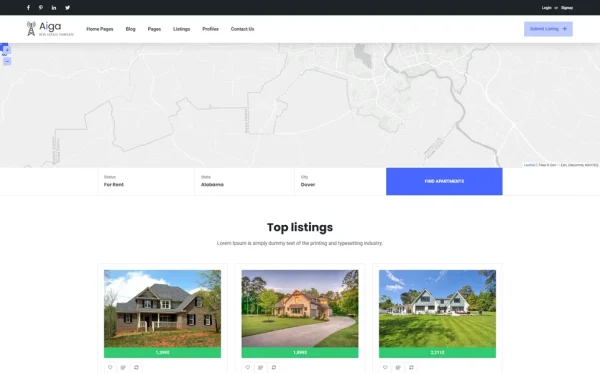
Full-width map home page layouts — where the map is the primary interface and listings appear as the user interacts with the map — cater to the geographic-first search behavior that is increasingly dominant among buyers.
9. Mobile-First Responsive Design
Real estate browsing happens everywhere: in the car between showings, on the couch after dinner, at the coffee shop during a lunch break. More than 70 percent of real estate website traffic comes from mobile devices. A website that is not fully responsive with touch-friendly navigation, swipeable galleries, and thumb-optimized buttons is functionally broken for most visitors.
10. Lead Capture and User Authentication
Every real estate website’s ultimate purpose is generating leads. Prominent contact forms on listing pages, agent profiles, and dedicated contact pages capture prospect information. But user registration takes lead capture further by enabling saved searches, favorited listings, and listing comparison — features that require an account and therefore provide more detailed lead data.
Login and signup modals that appear contextually — when a visitor tries to save a listing or access premium features — capture leads without creating friction for casual browsers.
How Much Does a Real Estate Website Actually Cost?
The cost spectrum for real estate websites is wider than almost any other industry, driven by the complexity of property data, search functionality, and platform integrations.
| Approach | Cost | Recurring Fees | Code Ownership |
|---|---|---|---|
| Basic Agent Site | $800 – $2,500 | $50–$100/month | Yes |
| Mid-Range with MLS/IDX | $3,000 – $8,000 | $25–$100/month IDX | Yes |
| IDX Platform (Placester) | $0 setup | $59 – $500+/month | No |
| Premium HTML Template | $14 – $59 one-time | None | Yes |
Key Insight: Over three years, a $100/month IDX platform costs $3,600 — and you own nothing. A one-time template purchase provides professional listing pages, agent profiles, and search functionality with full code ownership.
Basic Agent Websites: $800 to $2,500
A simple informational site with an about page, a few listing pages, and a contact form. Suitable for agents who primarily generate leads through other channels and need a basic web presence. Limited functionality — no property search, no agent profiles, no map integration.
Mid-Range Agent and Brokerage Sites: $3,000 to $8,000
Includes property search filters, multiple listing views, agent profiles, and lead capture forms. MLS and IDX integration adds another layer of cost and complexity. This tier covers the needs of most independent agents and small brokerages.
Large Portals and Enterprise Sites: $16,000 to $100,000+
Full property portals with advanced search, user accounts, listing submission systems, CRM integration, and custom features. Reserved for large brokerages, property management companies, and real estate tech startups.
IDX Platform Subscriptions: $59 to $500+ Per Month
Platforms like Placester, Real Geeks, and IDX Broker provide real estate websites as a service with MLS integration. Monthly costs add up quickly — a $100 per month subscription costs $3,600 over three years, and you own nothing. Cancel and your website, content, and SEO investment vanish.
Premium HTML Templates: $14 to $59 One-Time
A single purchase provides a complete, multi-page real estate website with listing pages, agent profiles, search functionality, map integration, and more. No monthly fees. Full code ownership. The most cost-effective option for real estate professionals who want professional design without platform dependency.
Design Principles That Sell Properties
Let Properties Be the Hero
Real estate websites should showcase properties, not design elements. Clean, minimal layouts with generous white space let property photos command attention. Avoid cluttered sidebars, excessive animations, or busy backgrounds that compete with listing images.
Prioritize Search Accessibility
The property search should be accessible from the homepage — ideally as a prominent search bar or filter panel in the hero section. Every additional click between landing on the site and filtering listings to match a buyer’s criteria increases bounce rates.
Use High-Quality Property Photography
This seems obvious, but the quality of listing photos directly impacts time on site, inquiry rates, and perceived property value. The website template should provide gallery layouts that display photos at their best — large format, well-lit, with lightbox viewing for full-screen browsing.
Build Trust Through Agent Visibility
Buyers trust agents they can see and learn about. Prominently featured agent photos, credentials, and contact information throughout the site — not just on a buried team page — humanize the experience and encourage direct outreach.
Choosing the Right Real Estate Template
Most real estate templates available today fall into two categories: WordPress themes that require ongoing CMS management and SaaS platforms that charge monthly fees. Both approaches have merits, but both come with ongoing costs and dependencies.
HTML real estate templates offer a third path: professional design, full code ownership, zero recurring fees, and complete customization flexibility. The best HTML real estate templates include multiple listing views, agent profiles, property detail pages, search functionality, map integration, and lead capture — all the features that agents and brokers need without the platform overhead.
Common Mistakes Real Estate Professionals Make With Their Websites
Real estate professionals who invest in a website often sabotage their own lead generation with avoidable mistakes. The most common errors stem from treating the website as a brochure rather than a conversion tool.
Over-relying on third-party portals. Agents who funnel all their online presence through Zillow, Realtor.com, or Redfin build audience and SEO authority for those platforms — not for themselves. When a buyer searches for properties in your market, your portal profile competes against every other agent on that platform. Your own website creates a space where your listings, your expertise, and your brand stand alone.
Using outdated listing photos. Properties that were photographed with a phone camera in poor lighting communicate unprofessionalism. In a market where competitors use professional HDR photography, drone shots, and virtual tours, low-quality imagery is not just a cosmetic issue — it directly reduces inquiry rates and extends days on market for your listings.
Ignoring neighborhood content. Buyers do not just buy homes — they buy into communities. Agents who only display listing data miss the opportunity to demonstrate local market expertise. Neighborhood guide pages that cover schools, amenities, commute patterns, and community character establish you as a local authority while capturing organic search traffic from buyers researching areas.
Making property search difficult. If a buyer cannot filter listings by their basic criteria — price range, bedrooms, property type, location — within seconds of landing on your site, they will leave for a portal that makes it easy. Property search should be accessible from the homepage, not buried behind multiple navigation clicks.
Neglecting mobile performance. More than 70 percent of real estate browsing happens on mobile devices. Agents whose websites load slowly on mobile, display tiny text, or require pinch-to-zoom navigation are invisible to the majority of their potential clients. Mobile optimization is not a nice-to-have — it is a requirement for any agent serious about digital lead generation.
Evaluating Real Estate Templates: What Actually Matters
The real estate template market is saturated with options that look impressive in previews but fall short in practice. Many templates display beautiful property photos in their demo but include only three or four pages — far too few for a functional real estate website. Before purchasing, evaluate these factors that separate serious real estate templates from attractive but incomplete options.
Home page variety. Different real estate businesses need different homepage approaches. A solo agent needs an agent-focused layout. A brokerage needs a listing-forward design. A property portal needs map-based search. Templates with multiple home page layouts give you the flexibility to match your business model without custom design work. Seven or more variants is exceptional in this category.
Listing view options. Buyers browse properties differently. Some scan photos in a grid. Others read details in a list. Many start with geography on a map. A template offering all three views — grid, list, and map — accommodates every buyer preference. Templates limited to a single view frustrate visitors whose preferred browsing style is not supported.
Agent profile pages. In real estate, the agent is the product as much as the property. Templates without individual agent profile pages force you to build this critical feature from scratch. Look for templates that include both a team archive page and individual agent profiles with space for listings, credentials, and contact forms.
Property detail page completeness. The listing detail page is where buying decisions happen. It needs gallery support, amenity lists, map integration, agent contact forms, and ideally a floor plan section. Evaluate the demo detail page carefully — it should feel comprehensive, not sparse.
Listing submission capability. For brokerages and portals that accept listings from multiple agents or property owners, a multi-step submission form is essential. jQuery Steps-powered wizard forms guide submitters through the listing creation process without overwhelming them with a single massive form.
Comparison tools. Side-by-side property comparison helps buyers evaluate shortlisted properties efficiently. This feature is valuable but uncommon in real estate templates. Its presence signals a developer who understands real estate buyer behavior beyond basic browsing.
Why Aiga Stands Out for Real Estate Professionals
Aiga is a real estate HTML5 template that delivers the most comprehensive feature set available in a single HTML template. With 21 fully designed pages and 7 unique home layouts, it provides a level of variety and completeness that competitors in the same price range simply cannot match.
The seven home layouts cover every major real estate website style: Standard, Video Hero, Carousel Grid, Agent Focus, Single Listing Showcase, Parallax Listing, and Full-Width Map. This means a single-agent personal brand site, a large brokerage portal, a luxury property showcase, and a map-driven search portal can all be built from the same template.
Property listings are available in three views — Grid, List, and Full-Width Map — matching the browsing preferences of different buyer types. The listing detail page includes a full property profile with gallery, amenities, map, and agent contact form. Agent and broker profile pages provide individual agent pages and brokerage overview pages for firms with multiple team members.
The neighborhood page offers an area guide format with local information and nearby listings — a feature that generates organic search traffic and establishes local market expertise. The multi-step listing form powered by jQuery Steps provides a wizard-style property submission interface for portals and brokerages accepting listings from multiple sources.
Additional features include a compare listings modal for side-by-side property evaluation, login and signup modals for user authentication, countdown timer functionality for open house events or auction deadlines, and Slick carousels for featured listing and testimonial sliders. Built on Bootstrap 4 with Isotope grid filtering, Magnific Popup lightbox, and interactive map integration, Aiga provides everything a real estate professional needs to compete online.
Frequently Asked Questions
What is a real estate listing website template?
A real estate listing website template is a pre-designed, pre-coded website package built specifically for real estate agents, brokers, and property management firms. It includes purpose-built pages for property listings in multiple views (grid, list, map), individual property detail pages with galleries and amenity information, agent profile pages, property search functionality, and lead capture forms — all styled and ready for customization with your own listings and branding.
How much does a real estate website cost?
Costs range from $800 for basic agent sites to $100,000+ for large property portals. IDX platform subscriptions run $59 to $500+ per month in ongoing fees. Premium HTML templates offer the most cost-effective option at $14 to $59 as a one-time purchase with no recurring fees, providing professional designs with listing pages, agent profiles, map integration, and search functionality included.
Do I need IDX integration for my real estate website?
IDX integration pulls live MLS listings directly onto your website, which is valuable for agents who want to display all available properties in their market. However, IDX services add $25 to $100+ per month in fees. Many agents and brokerages effectively showcase their own listings without IDX by manually updating their website with current properties — especially when using templates with well-designed listing management pages.
What listing views should a real estate website offer?
The most effective real estate websites offer at least three listing views: a grid view for visual browsing with property photos prominently displayed, a list view for detail-oriented buyers who want to scan specifications quickly, and a map view for geographically focused buyers who want to explore properties by location. Offering all three views lets visitors choose their preferred browsing experience, increasing engagement and time on site.
Why do real estate agents need their own website instead of using Zillow?
Zillow and similar portals display your listings alongside competitors, share or sell your leads, and build their SEO authority — not yours. Your own website gives you exclusive lead capture, full brand control, no competing agent ads on your listings, content ownership that builds long-term search authority, and analytics insights about visitor behavior. Over time, your website becomes a marketing asset you own rather than rented visibility on someone else’s platform.
Can I use a real estate template for a property management company?
Absolutely. Property management companies benefit from the same core features — listing pages for available rentals, detail pages with amenities and photos, neighborhood guides for location context, and lead capture for prospective tenants. Templates with multi-step listing forms are particularly valuable for property managers who add new listings frequently. Agent profile pages can be adapted to showcase property managers or leasing agents instead.
How many home page layouts do I really need?
Multiple home layouts provide flexibility to match different business models and brand identities without custom design work. A solo agent might choose an Agent Focus layout that centers their personal brand. A brokerage might select a Carousel Grid that showcases featured listings. A property portal might prefer a Full-Width Map for geographic search. Having seven or more options means you can launch with one style and A/B test alternatives to optimize conversion rates over time.
The real estate industry is experiencing a fundamental shift in how properties are marketed and discovered. Buyers who once relied on Sunday open houses and newspaper classified sections now begin their search online months before they are ready to transact. Agents who establish a strong digital presence early in that search journey — through SEO-optimized content, neighborhood guides, and comprehensive listing pages — position themselves as the natural choice when the buyer is ready to engage. The agents who wait for referrals while their competitors build digital market share are playing a game they will increasingly lose.
For brokerages managing multiple agents, a unified website that showcases the full team under one brand creates a market presence that individual agent sites cannot match. The combined listing inventory, the team depth, and the brand consistency all contribute to a perception of market authority that wins both clients and agent recruitment.
Final Verdict
The real estate industry’s digital shift is permanent, and agents who invest in their own web presence gain a competitive advantage that compounds over time. The key is choosing a solution that provides professional listing display, agent profiles, property search, and lead capture — without the ongoing monthly costs that eat into commission income.
A purpose-built real estate HTML template with multiple home layouts, three listing views, agent profiles, map integration, and comparison tools delivers enterprise-level functionality at a one-time cost that makes financial sense for agents and brokerages at every stage of growth.