The global anime industry surpassed $30 billion in market value and shows no signs of slowing down. Anime conventions sell out in hours. Manga sales have outpaced traditional American comics for several consecutive years. Streaming platforms are locked in bidding wars for exclusive anime licensing deals. And across every social media platform, anime content generates billions of views monthly.
Yet despite this explosion in mainstream popularity, the web design market has barely acknowledged anime as a category. Search for a professional anime website template and you will find a handful of basic options recycled from gaming templates, a few free Bootstrap starters with a dark background slapped on, and almost nothing purpose-built for the unique visual language and content structure that anime demands.
This gap represents both a problem and an opportunity. Anime creators, fan community builders, manga publishers, and entertainment portals deserve web solutions that match the visual ambition of the medium they celebrate. This guide explores what makes anime websites different from every other category, what features they need to succeed, and how to build one without commissioning a $20,000 custom project.
Why Anime Websites Are Different From Everything Else
Anime is not just a content category — it is a visual culture with its own rules, expectations, and aesthetic standards. Building an anime website using a generic template is like screening a Studio Ghibli film in a fluorescent-lit conference room. The content might be the same, but the experience is wrong.
Anime audiences are visually sophisticated. They spend hours consuming content where every frame is meticulously crafted. They notice animation quality, color grading, typography, and visual rhythm. When they visit a website dedicated to anime content, they carry those same expectations. A flat, static, corporate-looking website immediately signals that the creators behind it do not understand the medium or its audience.
The aesthetic requirements are specific. Anime websites demand dark backgrounds that make vibrant character artwork pop. They need cinematic motion — not the generic fade-in effects that every business template uses, but fluid, choreographed animations that feel like they belong in the same visual universe as the content being showcased. They require character-centric design, because anime is fundamentally about characters and their stories. And they need the kind of immersive browsing experience that keeps visitors exploring content the way they binge-watch a series — one episode leading naturally to the next.
Beyond aesthetics, anime websites have structural requirements that generic templates cannot accommodate. Character profile pages that display detailed character information — backstory, abilities, relationships, voice actors — are a core feature with no equivalent in standard website categories. Story and series archive pages that organize content by narrative arcs, seasons, or publication volumes are essential. And blog systems need enough layout variety to handle episode reviews, chapter discussions, news updates, and editorial features without everything looking identical.
The 10 Essential Features for an Anime Website
Whether you are building a fan community site, a creator portfolio, a manga publisher platform, or an entertainment portal, these features define the difference between an amateur anime page and a professional anime web experience.
1. Dark Mode as Default (With Toggle)
This is non-negotiable. The anime audience overwhelmingly prefers dark interfaces. Dark mode reduces eye strain during late-night browsing sessions — exactly when anime fans are most active. It makes character artwork and vibrant promotional images visually striking against the dark canvas. And it aligns with the cinematic, immersive atmosphere that anime content demands.
But dark mode should be an option, not an imposition. A clean toggle that lets visitors switch between dark and light modes accommodates users who prefer lighter interfaces while keeping the dark experience as the default for the core audience.
2. Character Profile System
Characters are the beating heart of anime. A website dedicated to anime content needs character profile pages that go beyond a name and a picture. Effective character profiles include full artwork or illustrations, detailed biographical information, personality traits and abilities, relationship maps to other characters, voice actor or creator credits, and links to the stories or series they appear in.
An archive grid that displays all characters with filtering by series, genre, or affiliation lets visitors browse and discover characters the way they browse episode lists. Individual character detail pages then provide the deep-dive information that dedicated fans crave.
3. Story and Series Archive
Anime websites organize content around narratives. A story or series archive page that displays all available titles in a browsable grid — filterable by genre, status (ongoing, completed), and type (anime, manga, light novel) — provides the structural backbone of the content experience.
Individual story detail pages should include a synopsis, episode or chapter listings, character connections, genre tags, and promotional artwork. This is the equivalent of a product catalog for an anime platform, and it needs to be comprehensive and easy to navigate.
4. Professional-Grade Animations
Basic CSS transitions feel cheap in the context of anime. An anime website needs animation quality that respects the medium. GSAP (GreenSock Animation Platform) provides the kind of choreographed, professional-grade entrance and transition animations that create a cinematic browsing experience — smooth reveals, paralleled movements, and sequenced element appearances that feel intentional and polished rather than templated.
The difference between CSS transition effects and GSAP animations on an anime website is the difference between a slideshow and a trailer. Both show content, but one creates anticipation and emotion.
5. Multiple Home Page Variants
Anime brands, fan communities, and content platforms vary enormously in their identity and focus. A character-focused community site needs a different homepage treatment than a streaming portal, which needs a different approach than a manga publisher’s promotional site.
Having multiple home page layout options — each with distinct hero styles, content arrangements, and visual emphasis — lets creators choose the homepage that best represents their specific brand identity without commissioning custom design work.
6. Comprehensive Blog System
Anime websites generate enormous amounts of written content: episode reviews, chapter discussions, character analyses, industry news, creator interviews, convention coverage, and editorial features. A blog system limited to a single layout cannot handle this variety effectively.
Multiple blog layout variants — grid, list, left sidebar, right sidebar, masonry, and different detail page styles — ensure that each content type gets the presentation it deserves. Visual-heavy episode reviews benefit from grid layouts with large featured images. Long-form analysis pieces work better in list or sidebar formats. And masonry layouts create engaging browsing experiences for content discovery.
7. Team and Cast Pages
For studios showcasing their creative team, or fan sites profiling voice actors, directors, and creators, team pages with archive views and individual detail pages provide the biographical showcase these profiles demand.
Cast pages are particularly important for anime platforms, where voice actors (seiyuu) have their own devoted fan followings. A detailed cast page that links voice actors to their character roles creates cross-navigation opportunities that keep visitors exploring the site.
8. Parallax and Immersive Scrolling
Parallax effects — where background and foreground elements scroll at different speeds — create a sense of depth and cinematic movement that enhances the anime browsing experience. Jarallax-powered parallax sections between content blocks break up the page into distinct visual chapters, mimicking the scene transitions that anime audiences experience in the shows they watch.
When combined with GSAP entrance animations and Swiper carousels, parallax creates a layered, dynamic experience that feels like navigating through a visual story rather than reading a flat webpage.
9. Full-Screen Media Gallery
Anime is a visual medium, and the gallery experience needs to match. A lightbox implementation that opens artwork, screenshots, and promotional images in full-screen without navigating away from the current page keeps visitors immersed in the content.
Fancybox-powered galleries with touch support for mobile devices, keyboard navigation for desktop users, and smooth transitions between images create the kind of polished viewing experience that anime fans expect.
10. Coming Soon and Launch Pages
Anime series operate on announcement cycles — teaser reveals, trailer drops, premiere dates, and season launches all generate intense fan anticipation. A coming soon page with countdown functionality, teaser imagery, and email capture for notifications lets websites build hype around upcoming content releases.
This page type is surprisingly absent from most templates but invaluable for anime platforms that need to promote upcoming series, manga volumes, or community events.
How Much Does an Anime Website Cost?
The cost of building an anime website depends heavily on the platform type and visual ambition.
| Approach | Cost | Recurring Fees | Code Ownership |
|---|---|---|---|
| Custom Streaming Platform | $10,000 – $27,000+ | Server + licensing | Yes |
| Custom Portfolio/Fan Site | $3,000 – $10,000 | $50–$200/month | Yes |
| Freelance (Fiverr) | $220 – $500 | Varies | Varies |
| Premium HTML Template | $14 – $59 one-time | None | Yes |
Key Insight: The anime template market is thin but the audience is massive. A premium template with character profiles, dark mode, and GSAP animations delivers what custom development provides — at a fraction of the cost.
Custom Anime Streaming Platform: $10,000 to $27,000+
Building a full anime streaming platform with video hosting, content management, and user accounts from scratch is a significant investment. This excludes the massive ongoing costs of content licensing, server infrastructure, and content delivery networks. Only well-funded companies should consider this path.
Custom Portfolio or Fan Community Site: $3,000 to $10,000
Hiring a freelance developer to build a custom anime fan site or creator portfolio typically costs $3,000 to $10,000. The visual requirements of anime — custom animations, dark mode, character databases — push costs higher than typical website categories because they require specialized design skills.
Freelance Platforms: $220 to $500
Fiverr and similar platforms offer anime website development starting around $220 to $500. Quality varies enormously, and most deliverables at this price point are basic templates with an anime skin applied rather than purpose-built anime experiences.
Premium HTML Templates: $14 to $59 One-Time
A premium HTML template designed for anime delivers the best value proposition: professional design with anime-specific features, GSAP animations, dark mode, character pages, and multiple layouts — all at a one-time cost with no recurring fees. The gap between what a premium anime template delivers and what a $5,000 custom project produces has narrowed dramatically.
Design Principles for Anime Websites
Embrace the Dark Canvas
Dark backgrounds are not just an aesthetic preference in anime — they are a functional requirement. Vibrant character artwork, neon accent colors, and promotional imagery all look their best against dark backgrounds. Light themes wash out the visual intensity that anime demands.
Choreograph the Visual Journey
Every scroll should feel intentional. Elements should appear with timing and rhythm — not all at once, not randomly, but in sequences that guide the eye through the content like scenes in an episode. GSAP makes this possible in ways that CSS transitions cannot.
Center Characters in Every Decision
Navigation, layout, and content hierarchy should all orbit around characters and their stories. If a visitor cannot find characters within two clicks of the homepage, the architecture needs rethinking. Characters are the primary discovery mechanism for anime audiences, and the website should reflect this.
Prioritize Visual Density Without Clutter
Anime fans are comfortable with visually dense interfaces. They use platforms like MyAnimeList, Crunchyroll, and manga reader apps that pack substantial information into every screen. But density must be organized, not chaotic. Grid layouts with consistent spacing, clear typographic hierarchy, and strategic use of color prevent visual density from becoming visual noise.
Choosing the Right Anime Template
The anime template market is thin. Most options fall into two categories: free templates that are too basic to be taken seriously, and gaming templates that have been marketed as anime-adjacent but lack character profiles, story archives, and the visual language that anime demands.
The ideal anime template needs purpose-built character and story page systems, GSAP-level animation quality, native dark mode support, enough home page variety to serve different anime brand types, a comprehensive blog system for the diverse content types that anime platforms publish, and immersive visual features like parallax and full-screen lightbox galleries.
The Economics of Anime Web Presence
Understanding the economics of anime websites helps creators and community builders make informed investment decisions. The anime audience is one of the most engaged demographics online, which means a well-built website can generate significant value through multiple channels.
Advertising revenue. Anime websites with consistent traffic can monetize through display advertising, affiliate programs, and sponsored content. Anime-related CPMs (cost per thousand impressions) tend to be higher than general entertainment because advertisers targeting the anime demographic — streaming services, merchandise retailers, convention organizers, and gaming companies — compete for this specific audience.
Merchandise sales. The global anime merchandise market is worth billions annually. Websites that integrate e-commerce for figures, apparel, art prints, and accessories tap into an audience with demonstrated willingness to spend on their passion. Even fan community sites can generate revenue through curated merchandise recommendations and affiliate partnerships.
Community membership. Premium membership tiers that offer early access to content, exclusive discussions, ad-free browsing, and member-only features can generate recurring revenue. The anime community has a strong tradition of supporting creators and platforms they value, making subscription models viable even for smaller sites.
Creator portfolio value. For anime artists, animators, and studios, a professional website serves as a portfolio that attracts commissions, licensing deals, and collaboration opportunities. The difference between an artist with a polished website and one relying solely on social media profiles often determines who gets contacted for professional opportunities.
Evaluating Anime Templates: What Separates the Real From the Repackaged
The anime template market is small enough that most buyers will evaluate every available option. That evaluation should be rigorous, because the difference between a purpose-built anime template and a generic dark-themed template with anime screenshots is enormous in practice. Here is what to look for.
Character profile system. This is the single most important differentiator. Anime is character-driven content, and any template claiming to serve the anime niche must include both a character archive grid and individual character detail pages. If the template lacks character pages, it is not an anime template — it is a dark template being marketed as one.
Story and series archive. Anime content is organized around series and story arcs. Templates that include story archive pages with individual detail pages provide the content structure that anime platforms need. Without this, you are building the most fundamental navigation pattern of your site from scratch.
Dark mode implementation. A dark color scheme is not the same as dark mode. True dark mode means a toggle that lets users switch between dark and light themes, with the preference saved across sessions. Darkmode.js or equivalent implementations provide this functionality. A template that is simply designed with dark colors but offers no toggle is missing a feature that the anime audience considers standard.
Animation quality. CSS transition effects — fade-in, slide-up, basic transforms — feel amateur in the anime context. The anime audience consumes content where every frame is animated with professional precision. GSAP (GreenSock Animation Platform) provides choreographed, sequenced animations that match the visual quality standard this audience expects. Templates using only CSS animations will feel flat.
Blog system depth. Anime platforms publish diverse content: episode reviews, chapter discussions, character analyses, news, interviews, and editorials. A blog system with one or two layout options cannot handle this variety effectively. Look for templates with five or more blog layout variants — grid, list, sidebar options, masonry, and multiple detail page styles.
Home page variety. Anime brands are visually diverse. A fan wiki, a streaming portal, a manga publisher, and a convention site all need different visual identities. The more home page variants available, the more likely you will find one that matches your specific brand without custom design work. Ten variants is exceptional — most anime templates offer one or two at most.
Why Aminya Is Built for the Anime Community
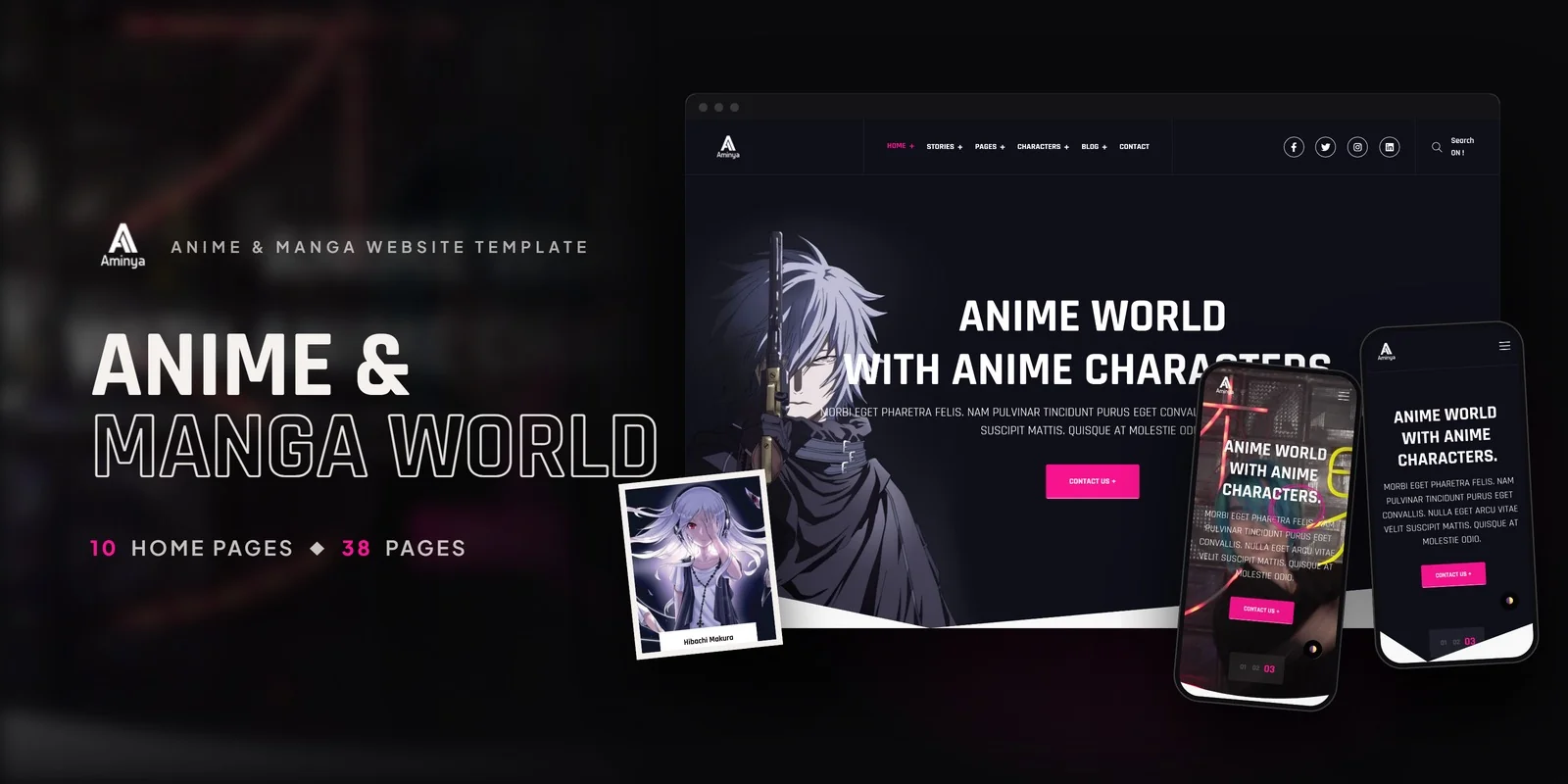
Aminya is an anime and entertainment HTML5 template that was designed from the ground up for anime platforms, fan communities, manga publishers, and entertainment portals. It is not a gaming template with an anime label or a generic dark theme with character images. Every feature was built with anime audience expectations in mind.
The template includes 10 unique home page layouts — far more than any competitor in the anime niche. Each layout offers a distinct hero style and content arrangement, meaning a character-focused fan wiki, a streaming portal, a manga publisher site, and an anime news platform can all use the same template with completely different visual identities.
Dark mode is built in with a full site toggle powered by darkmode-js. GSAP animations deliver professional-grade entrance and transition effects that create the cinematic feel that CSS transitions cannot achieve. Jarallax parallax adds depth and immersive scrolling. Swiper carousels provide touch-friendly content sliders. And Fancybox lightbox opens media in full-screen for the premium viewing experience anime content deserves.
The character profile system includes both an archive grid for browsing all characters and individual character detail pages with comprehensive biographical information. Story and series archives follow the same pattern with grid browsing and full detail pages. The blog system offers nine layout variants — grid, list, left sidebar, right sidebar, masonry, and multiple detail page styles — handling the full range of anime content types from episode reviews to news articles to editorial features.
Additional pages include team and cast profiles with archive and individual detail pages, a testimonials page for fan and critic reviews, an FAQ page for community questions, a coming soon page for upcoming series launches, and a custom 404 error page for branded error handling. Built on Bootstrap 4 with Isotope grid filtering for character and story organization, Aminya delivers the most comprehensive anime web experience available in a single template.
Frequently Asked Questions
What is an anime website template?
An anime website template is a pre-designed, pre-coded website package built specifically for anime platforms, manga publishers, fan communities, and entertainment portals. It includes purpose-built features like character profile pages, story and series archives, dark mode support, cinematic animations, and comprehensive blog systems — all designed with the visual aesthetic and content structure that anime audiences expect.
How much does it cost to build an anime website?
Costs vary dramatically. Custom anime streaming platforms run $10,000 to $27,000 or more. Custom fan community sites cost $3,000 to $10,000. Freelance platform projects start around $220 to $500 but vary in quality. Premium HTML templates offer the best value at $14 to $59 one-time, providing professional anime-specific designs with character pages, dark mode, GSAP animations, and multiple layouts.
Why do anime websites need dark mode?
Dark mode is essential for anime websites for several reasons. The anime audience overwhelmingly prefers dark interfaces, especially during evening browsing sessions. Dark backgrounds make vibrant character artwork and promotional imagery visually striking. Dark themes align with the cinematic atmosphere of anime content. And dark mode reduces eye strain during extended browsing sessions, which is important for an audience known for binge-consuming content.
What makes GSAP animations better than regular CSS animations?
CSS transitions provide basic effects like fade-in, slide-up, and simple transforms. GSAP (GreenSock Animation Platform) enables choreographed animation sequences where multiple elements animate with precise timing, easing, and coordination. On an anime website, this means elements appear with cinematic rhythm — staggered reveals, paralleled movements, and sequenced transitions that create the visual storytelling quality that the anime audience appreciates.
Can I use an anime template for a manga publishing website?
Yes. Manga publishers benefit from character profile pages to showcase characters across multiple series, story archive pages to organize manga titles by genre or publication status, blog layouts for chapter announcements and editorial content, and the dark aesthetic that manga audiences expect. The coming soon page is particularly valuable for manga publishers promoting upcoming volumes or new series launches.
How many home page layouts should an anime template offer?
The more variety available, the better — because anime brands are visually diverse. A fan wiki, a streaming portal, a manga publisher, and a convention site all have different visual identities and content priorities. Having 10 distinct home page layouts means you can choose the exact style that matches your brand without custom design work, and swap to a different layout as your platform evolves.
Do I need coding skills to use an anime website template?
Basic HTML and CSS knowledge is sufficient for content customization — replacing placeholder text, images, and links with your own content. The template structure handles the complex parts like dark mode functionality, GSAP animations, parallax effects, and responsive layouts automatically. For advanced customizations like database-driven character profiles or API integrations, a developer can build on the template foundation for a fraction of the cost of starting from scratch.
The anime community is global, passionate, and digitally native. Fans spend hours daily consuming and discussing anime content across platforms. When they encounter a website that truly understands their aesthetic preferences — dark themes, cinematic animations, character-centric navigation, and visually dense but organized layouts — the engagement is immediate and intense. Building that experience does not require the budget of a streaming platform. It requires choosing the right foundation — a template engineered specifically for the visual language and content structure that anime audiences demand.
Final Verdict
The anime industry’s explosive growth deserves web solutions that match its creative ambition. Generic templates forced into an anime context look exactly like what they are — afterthoughts. Purpose-built anime templates with character profile systems, story archives, dark mode, GSAP animations, and cinematic parallax effects deliver the visual quality that this audience expects and this content demands.
For anime creators, fan community builders, manga publishers, and entertainment portals, investing in a template designed specifically for anime is the difference between a website visitors forget and one they bookmark.