
Behind every flawless corporate gala, every perfectly orchestrated product launch, and every unforgettable celebration stands an event planner who made it all look effortless. The irony of the event planning profession is that success is measured by invisibility. When everything runs smoothly, guests assume it just happened naturally. The months of coordination, the vendor negotiations, the contingency planning, and the countless details remain hidden behind a seamless experience.
But there is one place where event planners cannot afford to be invisible: online. In an industry where personal reputation and visual proof are everything, your website is the stage on which you perform before you even meet a potential client. It is your portfolio, your pitch deck, and your business card combined into one digital experience that works around the clock to attract, convince, and convert visitors into clients.
The Digital Shift in Event Planning
The event planning industry has undergone a significant transformation in how clients find and evaluate planners. Word-of-mouth referrals still matter, but they now lead to a website visit rather than a phone call. When a friend recommends an event planner, the first thing the recipient does is look them up online. If the website does not reinforce the recommendation with stunning visuals, clear services, and professional presentation, the referral loses its power.
Social media platforms like Instagram and Pinterest have also changed the game. They serve as discovery channels where potential clients first encounter your work. But social media posts are fleeting and fragmented. Your website is where you control the narrative, presenting your best work in the context and sequence that tells the most compelling story about your capabilities.
For corporate event planners, the shift is even more pronounced. Corporate clients conduct formal vendor evaluations, and your website is often the first screening tool. A dated, unprofessional website can eliminate you from consideration before you ever get to present your portfolio in person. The stakes are high because corporate events represent the highest-value contracts in the industry.
What Clients Look for in an Event Planner’s Website
Understanding your website from the client’s perspective is the foundation of effective design. When someone visits an event planner’s website, they arrive with specific questions and expectations. Your site needs to answer those questions clearly and quickly.
Visual Proof of Capability
More than almost any other profession, event planning is judged visually. Clients want to see what you have actually created. Not stock photos, not renders, not mood boards, but real events you have planned and executed. A robust portfolio gallery featuring professional photography from past events is the single most important element on your website. It answers the client’s fundamental question: Can this planner deliver the quality and style I want?
Clear Service Offerings
Clients need to understand what you offer and whether it matches their needs. Do you handle everything from concept to cleanup? Do you offer day-of coordination only? Do you specialize in corporate events, weddings, social gatherings, or all of the above? Ambiguity about your services creates friction. Clients who cannot quickly determine if you are the right fit will move on to a planner whose website makes it obvious.
Social Proof and Testimonials
Event planning involves entrusting someone with significant budgets and important moments. Testimonials from past clients provide the reassurance potential clients need to take the next step. The most effective testimonials mention the type of event, the planner’s specific contributions, and the outcome. A quote from a corporate client praising how you managed a five-hundred-person product launch carries more weight than a generic statement about being wonderful to work with.
Easy Path to Contact
The ultimate goal of your website is to generate inquiries. Your contact information and inquiry form should be prominent and accessible from every page. Do not bury your phone number in the footer or hide your contact form behind multiple clicks. A well-designed inquiry form that captures the event type, estimated date, guest count, and budget range helps you qualify leads before the first conversation.
Essential Pages for an Event Planning Website
While every event planner’s website should be unique to their brand, certain pages are universally expected and serve specific strategic purposes.
Homepage
Your homepage is your elevator pitch. It should immediately communicate who you are, what you do, the caliber of events you plan, and what makes you different. Lead with a striking visual, whether it is a full-screen image from your most impressive event or a video reel showcasing your range. Include a concise value proposition, a few trust signals (client logos, awards, press mentions), and a clear call-to-action that leads to your contact or inquiry form.
Portfolio
Your portfolio is the heart of your website. Organize events by category, corporate galas, product launches, weddings, social celebrations, nonprofit fundraisers, so visitors can quickly find examples relevant to their needs. Each portfolio entry should include professional photos from multiple angles and moments, a brief description of the event scope and your role, key details like guest count and venue, and any notable challenges you overcame or creative solutions you implemented.
Services
Break your services into clearly defined categories that help clients self-select. Common divisions include Full Event Planning (concept through execution), Partial Planning (specific aspects like vendor management or design), Day-Of Coordination (ensuring smooth execution of pre-planned events), and Corporate Event Management (conferences, retreats, team building). For each service tier, explain what is included, the typical process, and the type of client it is best suited for. You do not need to list prices on this page, but giving prospects a general sense of investment level saves time for both parties.
About
Event planning is a personal business. Clients are not just hiring a company; they are hiring you. Your About page should tell your story: how you got into event planning, what drives your passion for it, your philosophy on creating memorable experiences, and the team behind your operation. Include professional photos of yourself and your team. Let your personality come through in the writing. This page builds the personal connection that often tips the decision in your favor.
Testimonials
A dedicated testimonials page aggregates the social proof that is sprinkled throughout your site into one powerful showcase. Include a mix of corporate and social event testimonials to demonstrate your versatility. If possible, pair testimonials with photos from the referenced event, creating a visual connection between the praise and the work.
Blog
A blog positions you as a thought leader in the event planning space while driving organic search traffic to your website. Topics like event planning checklists, venue selection guides, trend reports, and behind-the-scenes looks at your recent events attract potential clients during the research phase. Consistent publishing also signals to both search engines and visitors that your business is active and current.
The Cost of Building an Event Planning Website
Your website is an investment in your business, and understanding the cost landscape helps you allocate your budget wisely. The range is broad, and the right choice depends on where you are in your business journey and how important digital lead generation is to your growth strategy.
| Approach | Cost | Design Quality | Customization | Best For |
|---|---|---|---|---|
| DIY with free builder | $0-$20/month | Basic | Limited | Brand-new planners testing the market |
| Professional HTML template | $15-$69 one-time + hosting | High | Full code access | Planners who want premium look, low cost |
| Squarespace/Showit | $16-$40/month | High | Medium | Design-conscious planners |
| Freelance web designer | $800-$3,500 | Custom | Collaborative | Established planners with specific vision |
| Design agency | $4,000-$15,000+ | Premium | Full custom | High-volume, luxury event firms |
For event planners who want a professional website without the professional price tag, an HTML template offers the most compelling value. You get a design that rivals what agencies charge thousands for, complete customization control, and ownership of your files without ongoing subscription fees. The investment you save can go toward professional event photography, which ultimately provides the content that makes any website effective.
Photography: The Foundation of Your Event Website
No amount of beautiful website design can compensate for poor event photography. Conversely, stunning photography can make even a simple template look extraordinary. For event planners, investing in quality photography of your events is arguably more important than the website itself.
Every event you plan is a content opportunity. Arrange for professional photography that captures the venue setup and decor before guests arrive, the ambiance during the event, key moments (speeches, performances, revelations), candid guest reactions that show the atmosphere, and detail shots of table settings, floral arrangements, signage, and lighting.
Build a consistent photography brief that you share with photographers at every event. This ensures you always walk away with the types of images your website needs. Over time, your portfolio grows organically, and your website becomes richer with every event you complete.
SEO Strategy for Event Planners
Search engine optimization helps potential clients find you when they are actively searching for event planning services. For a local or regional event planning business, SEO can be one of your most cost-effective marketing channels.
Local SEO is particularly important for event planners. Most clients want a planner in their geographic area. Optimize your website for location-specific keywords: “corporate event planner Chicago,” “wedding coordinator Austin,” “event planning services Miami.” Claim and optimize your Google Business Profile with accurate information, photos, and client reviews. Ensure your business name, address, and phone number are consistent across all online directories.
Content marketing through your blog targets informational searches that attract potential clients earlier in their planning journey. Articles about event planning tips, venue guides for your area, seasonal event trends, and budget planning advice capture traffic from people who are considering hiring a planner but have not yet started their search.
Portfolio pages optimized with descriptive titles, alt text on images, and detailed event descriptions help you rank for specific event types. A well-optimized portfolio page for “corporate product launch events” can rank for related searches and bring you directly qualified leads.
Building Client Trust Through Your Website
Event planning is a trust-intensive business. Clients are handing you significant budgets and asking you to manage occasions that often carry personal or professional importance. Your website must systematically build that trust through multiple reinforcing elements.
Professional certifications and industry memberships demonstrate your commitment to the profession. Display logos for organizations like ILEA (International Live Events Association), MPI (Meeting Professionals International), or NACE (National Association for Catering and Events). Insurance and licensing information reassures clients that you operate professionally and responsibly.
Case studies that go beyond portfolio images to tell the full story of an event, including the client’s brief, your creative approach, the challenges you navigated, and the final result, demonstrate your process and problem-solving capabilities. These detailed narratives give prospects confidence that you can handle the complexities of their event.
A vendor network page listing the caterers, florists, photographers, venues, and entertainment providers you work with regularly shows the depth of your professional relationships. It also provides SEO benefits through relevant keyword inclusion and potential reciprocal linking opportunities.
Corporate vs. Social Event Planning: Website Considerations
If your business spans both corporate and social event planning, your website needs to speak to distinctly different audiences without creating confusion.
Corporate clients evaluate planners on professionalism, logistics capability, vendor management efficiency, and return on investment for their events. They want to see case studies with business outcomes, evidence of experience with large-scale events, and processes that suggest reliability and accountability.
Social event clients, particularly wedding and celebration clients, evaluate planners on creative vision, personal connection, attention to detail, and emotional understanding. They want to see beautiful events that reflect unique personalities, testimonials that mention the personal experience of working with you, and a brand personality that feels warm and approachable.
The solution is not to create two separate websites, but to organize your content so each audience can quickly find what is relevant to them. Separate portfolio sections for corporate and social events, distinct service pages for each category, and testimonials sorted by event type allow each visitor to see the version of your brand that resonates with their needs.
How Egala Empowers Event Planning Professionals
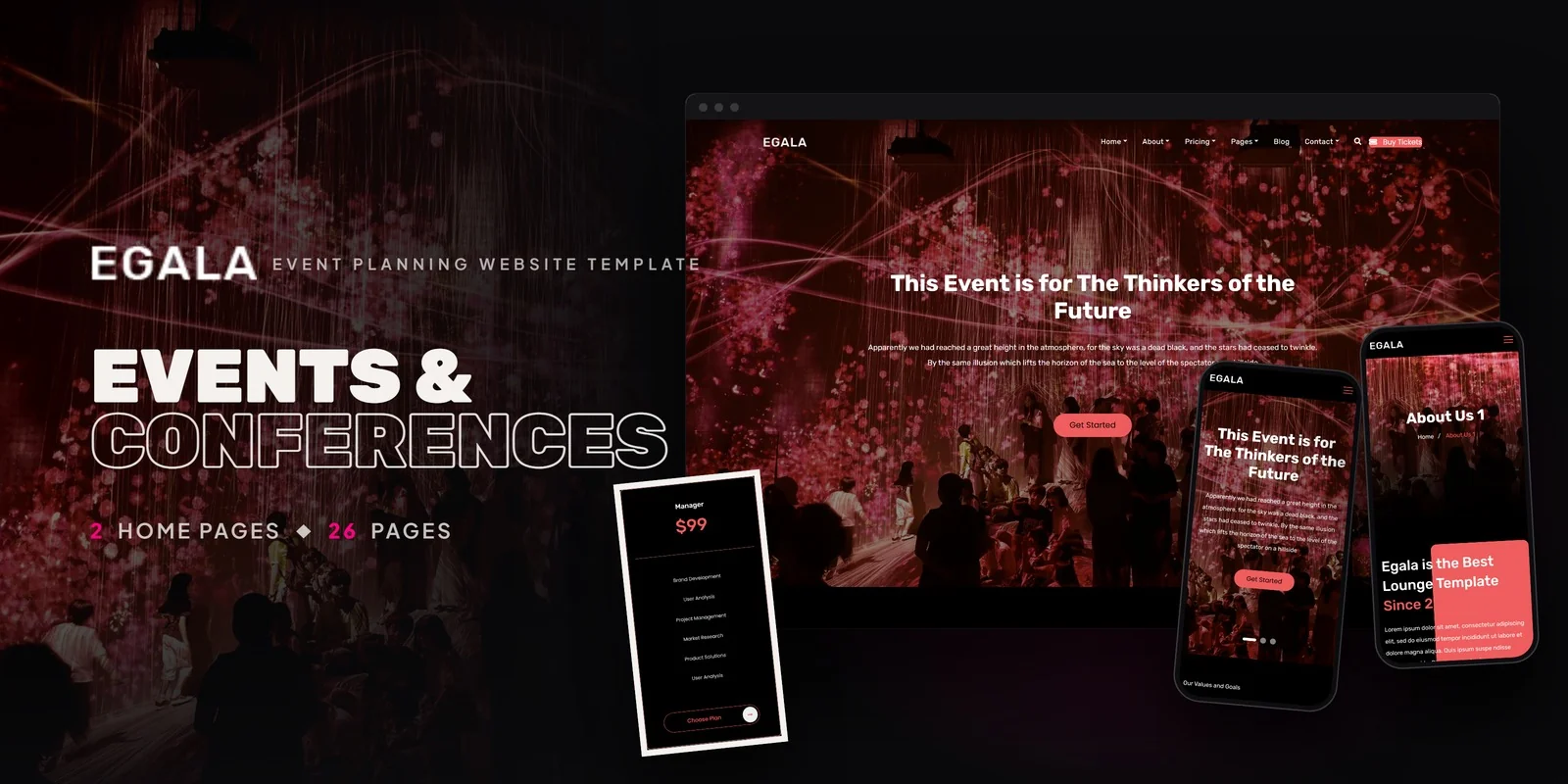
For event planners who need a website as impressive as the events they create, Egala is a comprehensive event planning website template designed specifically for the industry. Built on Bootstrap 5, Egala provides a responsive, elegant framework that showcases your work and converts visitors into clients.
Egala includes dedicated sections for every element discussed in this guide: a dramatic hero area designed for impactful event photography, portfolio galleries with category filtering, detailed service descriptions, team profiles, client testimonials, a blog layout, and strategically placed contact and inquiry forms. The design balances visual impact with professional functionality, creating a website that impresses both social event clients seeking creative vision and corporate clients evaluating operational capability.
The template’s modular structure makes it easy to customize. Swap images, adjust colors to match your brand palette, reorganize sections to suit your priorities, and add or remove elements as needed. The code is clean and well-documented, making modifications straightforward even for planners without deep technical expertise.
Preview the full Egala template at demo.metropolitanhost.com/egala/ and see how it can transform your event planning business’s digital presence.
Frequently Asked Questions
Visual proof of your work. In event planning, your portfolio is your most persuasive selling tool. Invest in professional photography of every event you plan and feature it prominently on your website. A stunning portfolio with even a minimal surrounding website will outperform a beautifully designed site with mediocre or missing event photos. The quality of your imagery communicates the quality of your events more effectively than any words can.
This is a strategic decision with valid arguments on both sides. Showing pricing ranges helps pre-qualify leads, saves time on inquiries from clients outside your budget, and builds trust through transparency. Not showing pricing allows for custom quoting based on specific event needs and avoids losing clients who might be flexible on budget after understanding your value. A middle ground that works well for many planners is showing starting prices for each service tier without detailed breakdowns, giving prospects enough information to self-qualify while leaving room for personalized quoting.
Quality always trumps quantity. Feature ten to fifteen of your best events rather than every event you have ever planned. Choose examples that represent the types of events you want to attract more of. If you want more corporate clients, feature your strongest corporate work prominently. Rotate your portfolio periodically, removing older events and adding recent ones to keep the website fresh and to demonstrate that you are actively working. Each portfolio entry should include eight to twelve carefully selected images that tell the story of the event.
Focus on three areas: traffic, trust, and friction reduction. Drive traffic through local SEO optimization, consistent blog content targeting event planning keywords, and social media that links back to your website. Build trust through strong portfolio presentation, authentic testimonials, and professional certifications. Reduce friction by making your contact form visible on every page, limiting the required fields to essentials (name, email, event type, approximate date), and offering multiple contact methods including phone and email. Follow up on every inquiry within twenty-four hours; response speed is one of the strongest predictors of conversion in service businesses.
In most cases, no. A single well-organized website can effectively serve multiple audiences. Use clear navigation categories (Corporate Events, Social Events, Weddings) to help visitors find relevant content quickly. Separate your portfolio by event type so corporate clients see your corporate work first and social clients see celebrations. If your brand positioning is dramatically different for each segment, say ultra-luxury weddings versus corporate team building, then separate websites might make sense. But for most planners who handle a range of events, one website with thoughtful organization is more manageable and cost-effective.
Event planning templates are designed around visual storytelling and portfolio presentation, which are the primary conversion drivers in this industry. They include gallery layouts optimized for event photography, service tier presentations suited to planning packages, testimonial sections designed for client stories, and contact forms tailored for event inquiries. General business templates often prioritize text content and generic layouts that do not do justice to visual work. An event-specific template saves you from trying to force your content into a structure that was not designed for it.
SEO is one of the most cost-effective marketing channels for event planners, particularly for local and regional businesses. When someone searches for an event planner in your area, appearing in the top results puts you in front of a highly motivated potential client at exactly the moment they are looking for your service. Unlike social media or paid advertising, organic search traffic is free and compounds over time. Every blog post you write, every portfolio page you optimize, and every positive review you collect strengthens your search presence permanently. For most event planners, investing time in SEO delivers a better long-term return than any other marketing activity.
Leveraging Technology for Client Management
Your website can do more than attract new clients. With the right integrations, it can streamline your entire client management workflow. Online booking systems that sync with your calendar eliminate the back-and-forth of scheduling consultations. Client portal features let you share mood boards, vendor proposals, and timeline updates in a branded, professional environment rather than through scattered email chains.
CRM integration connects your website inquiry forms directly to your client management system, ensuring no lead falls through the cracks. When a potential client submits an inquiry, their information automatically populates your CRM, triggers a follow-up sequence, and alerts your team for personal outreach. This automation is particularly valuable during peak seasons when inquiry volume can overwhelm manual processes.
Payment processing through your website simplifies the financial aspects of event planning. Whether it is collecting retainers, processing milestone payments, or managing final settlements, an integrated payment system saves time and provides a professional experience for your clients. It also creates a documented payment trail that protects both parties.
Staying Current: Website Maintenance for Event Planners
An event planning website is not a set-and-forget project. Regular maintenance keeps your site functioning properly, looking current, and performing well in search results. Establish a monthly routine that includes updating your portfolio with recent events, refreshing testimonials with new client feedback, checking all links and forms for proper functionality, and reviewing analytics to identify improvement opportunities.
Seasonal updates are equally important. If you specialize in weddings, your website should feel different in January (when many couples get engaged) than in September (when fall weddings are in full swing). Update your homepage imagery, featured portfolio pieces, and blog content to align with the season and the types of events prospective clients are currently planning.
Technology evolves rapidly, and website design trends shift alongside it. Conduct an annual design audit to assess whether your website still feels contemporary. This does not mean a complete redesign every year. Often, updating photography, refreshing the color palette, or modernizing a few key sections is enough to keep your site looking current without the expense and disruption of a full rebuild.
Security updates are another critical maintenance task. If your website runs on WordPress or another CMS, keep themes, plugins, and core software updated to protect against vulnerabilities. For static HTML sites, the attack surface is smaller, but you should still maintain current SSL certificates and monitor for any security issues with your hosting provider.
Social Media as a Website Extension
For event planners, social media platforms like Instagram and Pinterest function as visual extensions of your website. Instagram showcases your latest work in real time, while Pinterest serves as a long-term discovery platform where potential clients find inspiration boards months or even years after posting. Your website should integrate seamlessly with these platforms, embedding your Instagram feed to create a constantly refreshing gallery and including Pinterest save buttons on portfolio images so visitors can add your work to their planning boards.
The relationship between social media and your website should be symbiotic. Social media drives traffic to your website where conversions happen, while your website provides the depth and professionalism that social media alone cannot deliver. A stunning Instagram portfolio with a link to a mediocre website loses the conversion opportunity. Conversely, a beautiful website with no social media presence misses the discovery channel where many modern clients first encounter event planners. Both channels working together create a marketing engine that consistently attracts and converts new clients.
Creating Your Digital Showcase
Your events are exceptional. Your website should be too. In an industry where visual impact and professional credibility drive every client decision, settling for a mediocre online presence is a luxury no event planner can afford.
The path from where you are today to a website that actively generates leads and elevates your brand is shorter and more affordable than most planners realize. A professionally designed template, populated with your authentic portfolio, clear service descriptions, and compelling client testimonials, creates a digital presence that works as hard as you do.
Start by auditing your current website through the lens of a potential client. Does it answer their questions? Does it showcase your best work? Does it make contacting you effortless? If the answer to any of these is no, the time to upgrade is now. Every week with a subpar website is a week of potential clients choosing competitors whose online presence better represents the quality of work you both deliver.