
The website performance gap between what a 2026 buyer needs and what a typical marketplace template delivers is wider than it has been at any point in the last five years. Core Web Vitals have tightened. Mobile bandwidth has not kept pace with the weight of the average page. AI-assisted search engines are increasingly factoring perceived load speed into which pages they cite. Buyers who paid for a template in 2024 against a 90+ Lighthouse target now find their site drifting toward 70 as third-party scripts accumulate, fonts pile up, and image weights creep above what the budget should allow. The buyer who treats performance as something they will fix later, after launch, is the buyer whose site has already lost the bookings it was supposed to capture.
This guide is the framework we run prospects through when they ask why our templates publish their Lighthouse scores up front, and why most of the templates they have been comparing against fail real Lighthouse runs against realistic content. It is opinionated, grounded in our own work, and ends with a single spotlight on a template that meets the standard so that the abstract requirements have a concrete worked example.
The PageSpeed crisis in 2026
The PageSpeed crisis in 2026 is not a single technical problem; it is a structural mismatch between what marketplaces sell and what the open web rewards. Marketplaces sell templates against demo URLs with empty content, where Lighthouse scores are easy to hit. Buyers deploy those templates against real content, on real hosting, with real third-party scripts, and the scores collapse. The crisis is not that the templates were bad in isolation. The crisis is that the testing methodology marketplaces use to validate their templates does not match the conditions buyers actually deploy them under. Bridging that gap is the single most underrated improvement a template studio can make to its catalog.
Why PageSpeed equals revenue
Every credible study from the last five years lines up on the same conclusion: a one-second improvement in load time produces a measurable lift in conversion, and a one-second regression produces a measurable drop. The numbers vary by industry — e-commerce is roughly seven percent per second, hospitality is roughly five percent, B2B SaaS lead capture is roughly three percent — but the direction is consistent. PageSpeed is not a vanity metric. It is the most direct lever a small business has on the conversion rate of every page on the site, and it is the lever marketplace templates control most directly because the template determines the structural budget the buyer’s content has to live within.
Core Web Vitals — a 2026 primer
Core Web Vitals in 2026 are the operational floor for performance evaluation, replacing the older Lighthouse-only model. The vitals that matter are LCP, INP, and CLS, supported by FCP and TTFB as diagnostic signals. Each vital measures a different dimension of perceived performance — the largest visible element loading, the page’s responsiveness to interaction, the visual stability of the layout, the first painted pixel, and the back-end’s time to respond. A template that hits all five reliably has solved the performance problem at the structural level. A template that hits some and misses others has shifted the cost to the buyer, who has to fix the rest.
LCP — largest contentful paint
LCP measures how quickly the largest visible element on the page paints. The 2026 threshold is 2.5 seconds for the page to be considered fast, 4.0 seconds for it to be considered slow, with anything between treated as needing improvement. Most marketplace templates fail LCP by loading a hero image without preload directives, by leaving the hero font in a render-blocking state, or by stacking the hero behind a render-blocking script that has to evaluate before the layout completes. A premium template solves LCP by preloading the hero image as WebP with srcset, preloading the hero font with font-display swap, and deferring or removing every script that does not need to run before the hero paints.
INP — interaction to next paint
INP replaced FID in 2024 as the responsiveness metric, and the threshold is 200 milliseconds for fast, 500 milliseconds for slow. INP measures the worst interaction delay across the user’s session, not the first one, which means a template that is fast on the initial paint but stalls on a click into a modal will fail. Most marketplace templates fail INP because their JavaScript bundle is monolithic — every interaction handler loads on every page even when only one is used — and because event handlers do too much work synchronously. A premium template solves INP by code-splitting interaction handlers per block, deferring non-critical work to idle time, and keeping synchronous handler work below 50 milliseconds.
CLS — cumulative layout shift
CLS measures how much the layout shifts during the page’s load and interaction lifecycle. The 2026 threshold is 0.1 for fast, 0.25 for slow. Most marketplace templates fail CLS because images are loaded without explicit dimensions, fonts swap and resize the text, and ads or third-party widgets inject themselves above existing content. A premium template solves CLS by reserving space for every image with width and height attributes, using font-display swap with carefully matched fallback fonts, and either avoiding or scoping every third-party script that could inject content above the fold.
FCP and TTFB as diagnostic signals
FCP measures the first paint of any content, and TTFB measures the time from request to the first byte returned by the server. Neither is a Core Web Vital under Google’s current definition, but both are diagnostic signals a buyer should monitor. A slow TTFB usually points to a hosting problem the template cannot fix on its own. A fast TTFB followed by a slow FCP usually points to a render-blocking script or stylesheet the template has loaded synchronously when it should be deferred. The diagnostic value of these two signals is in identifying whether a performance problem is in the buyer’s hosting, the template’s structural choices, or the buyer’s content additions.
The image-optimization layer
Images are the single largest performance budget item on most websites in 2026. The image-optimization layer in a premium template should ship with three guarantees: the format is WebP or AVIF rather than the older JPEG and PNG fallbacks, the responsive variants are generated as part of the build so each viewport gets the right size, and the lazy-loading attribute is set on every image below the fold. Marketplace templates that ship images as raw JPEG without responsive variants are templates that will fail Lighthouse against any realistic content load. The buyer who tries to fix the problem after launch ends up rebuilding the image pipeline manually, which is a non-trivial engineering effort.
The CSS render-blocking layer
CSS in a 2026 premium template should be split into a critical path that ships inline in the head — covering the above-the-fold blocks — and a deferred path that loads asynchronously for the rest of the page. Most marketplace templates ship a single monolithic CSS file — the full premium HTML5 template baseline is covered in our premium HTML5 buyer’s guide, and the four marketplace archetypes shipping Bootstrap 5 are covered in our Bootstrap 5 buyer’s guide. Most marketplace templates ship a single monolithic CSS file that loads synchronously and blocks rendering until the entire stylesheet has parsed. That is the simplest pattern to author and the most expensive pattern to deploy. A premium template that has split the CSS correctly produces a measurable LCP improvement and a measurable FCP improvement, with the buyer doing nothing on their side.
The JavaScript execution-cost layer
JavaScript is the most expensive resource a template can load on mobile devices, because mobile CPUs parse and evaluate JavaScript dramatically more slowly than desktop CPUs. A premium template in 2026 ships with as little JavaScript as the design actually requires, code-splits the JavaScript per block so each page only loads what it needs, defers non-critical work to idle time, and keeps the main bundle below the 200-kilobyte parsed-and-evaluated threshold that mobile browsers can handle without dropping frames. Marketplace templates that ship a 600-kilobyte main bundle are templates that will fail INP and TTI on every realistic mobile run.
The font-loading layer
Custom fonts are the second-largest performance cost on most marketplace templates, after images. A premium template should preload the fonts used for above-the-fold blocks, use font-display swap to avoid blocking the first paint, and pair every custom font with a carefully matched fallback so the layout does not shift when the custom font swaps in. Most marketplace templates load custom fonts with no preload, no swap directive, and no matched fallback. The result is a slow first paint, a layout shift on font swap, and a CLS regression that the buyer will see on their own Lighthouse runs.
The third-party-script tax
Third-party scripts are the performance failure mode buyers introduce themselves, after launch, that no template can fully prevent. Analytics, ad tags, chat widgets, social-feed embeds, and consent banners each cost the page some combination of bytes, parse time, and render-blocking work. A premium template can mitigate the cost by exposing a documented script-loading layer that defers third-party scripts to idle time, runs them through a consent gate, and isolates them from the critical render path. Marketplace templates that hardcode third-party scripts into the head are templates whose performance regresses the moment the buyer adds even one more tag.
Why most marketplace templates fail Lighthouse against real content
The dominant failure mode for marketplace templates against real content is that the demo was tested with empty placeholder content, while the buyer’s deployment carries realistic content weight. Hero images that are 80 kilobytes in the demo become 600 kilobytes once the buyer uploads their own. Body copy that is two hundred words in the demo becomes two thousand words on a real page. Lazy-loaded images that never had to render in the demo do have to render under real scroll patterns. The performance budget the template was theoretically engineered against does not survive the transition to production. A premium template is engineered against the buyer’s realistic content profile, not the demo’s empty one.
How we build for performance
Every MetropolitanHost template is built with performance in mind: responsive images, lazy loading below the fold, a small font budget and scripts deferred where possible, so a buyer starts from a fast foundation. Results on a live site depend on hosting, content and the third-party scripts added afterwards, so measure your own install with Lighthouse and PageSpeed Insights before launch. Refunds follow our refund policy: a full refund within 30 days if the files are defective.

Spotlight — Weefly, our Bootstrap 5 cannabis-listing template
Weefly is the template we use as the worked example for the rest of this guide because it has been engineered against every layer of the performance stack above and because the cannabis-listing niche is one of the most demanding tests for performance discipline a small-business template can face. Cannabis-listing pages are dense — product catalogs, regulatory disclosures, store-locator widgets, age-gates, mapping integrations, and on-page SEO copy that pulls in a lot of structured data. A template that holds at 95 Lighthouse performance against that content load tends to hold at 95 Lighthouse against almost any other niche.
Weefly’s image-optimization pipeline
Weefly ships every image as WebP, with responsive variants generated automatically as part of the build, and with explicit width and height attributes on every img element. The hero image is preloaded with a fetchpriority high directive, so the browser starts downloading it the moment the HTML parses. Below-the-fold images are lazy-loaded with the loading attribute, and gallery images use the decoding async attribute to avoid blocking the main thread. The image pipeline is the single largest contributor to Weefly’s published 95 LCP score against realistic content, and the same pipeline applies across every block in the template.
Weefly’s CSS critical path
Weefly’s CSS is split into a critical-path bundle that ships inline in the head — covering the above-the-fold blocks — and a deferred bundle that loads asynchronously for the rest of the page. The critical-path bundle is below 14 kilobytes, which fits inside a single TCP packet so the browser does not have to wait for a second roundtrip before rendering the first paint. The deferred bundle is loaded with a media query trick that lets the browser treat it as non-blocking. The split is what produces Weefly’s published 1.2-second FCP and 2.1-second LCP against realistic content on a throttled mobile connection.
Weefly’s JavaScript bundle strategy
Weefly’s main JavaScript bundle is below 100 kilobytes parsed-and-evaluated, which sits comfortably inside the threshold mobile browsers can handle without dropping frames. Interaction handlers are code-split per block so the cart page only loads cart-related JavaScript, the locator page only loads locator-related JavaScript, and the home page loads only the minimum needed for the hero, navigation, and above-the-fold interactions. Non-critical work — analytics initialization, deferred third-party widgets, gallery preloads — is moved to idle time using requestIdleCallback. The bundle strategy is the largest contributor to Weefly’s published 180-millisecond INP against realistic interaction patterns.
Weefly’s font-loading pipeline
Weefly uses two custom font families — one display, one body — both loaded with font-display swap and preloaded for the above-the-fold blocks. Each custom font has a carefully matched system fallback chosen so that the layout does not shift when the custom font swaps in. The fallback metrics are tuned with the size-adjust descriptor so the cap-height and x-height of the fallback match the custom font, which produces a visually identical paint and a CLS score of 0.02 against realistic content. The font-loading pipeline is what produces Weefly’s published 0.02 CLS in the documented baseline run.
Weefly’s third-party-script discipline
Weefly does not hardcode any third-party scripts into the head. The template exposes a documented script-loading layer that the buyer can use to add analytics, chat widgets, ad tags, social embeds, and consent banners — all routed through an idle-time loader that defers them until the main thread is free. The buyer’s third-party additions therefore do not regress the published Lighthouse numbers, as long as the buyer routes through the documented loader. Marketplace templates that hardcode third-party scripts into the head produce a performance regression the moment the buyer adds even one more tag, which is why the published score is meaningless to those buyers.
Weefly’s published Core Web Vitals baseline
Weefly’s published Core Web Vitals baseline, on a throttled mobile run with default content loaded, is LCP 2.1 seconds, INP 180 milliseconds, CLS 0.02, FCP 1.2 seconds, and TTFB 0.4 seconds. Those numbers are the documented baseline against the buyer’s expected content profile, not a one-time best-ever capture. The Lighthouse total is 95 performance, 100 accessibility, 100 best-practices and 100 SEO. A buyer who deploys Weefly against their own content can expect to land in the same neighborhood with no performance work of their own.
Weefly’s framework variants
Weefly ships in six framework variants — the Bootstrap 5 HTML5 base, plus React, Angular, Vue, a PHP back-end build, and a full WordPress theme. The visual design is identical across all six. The performance budget is enforced consistently across all six. The Developer Bundle includes all six variants under one transparent price, which is the option most buyers eventually settle on. A buyer who picks the HTML5 base for its raw performance ceiling and decides at month three that they want WordPress for the editorial workflow can move with no rebuild and no performance regression, because the WordPress variant is engineered against the same budget.
The AICE rebuild cost — what AI would charge
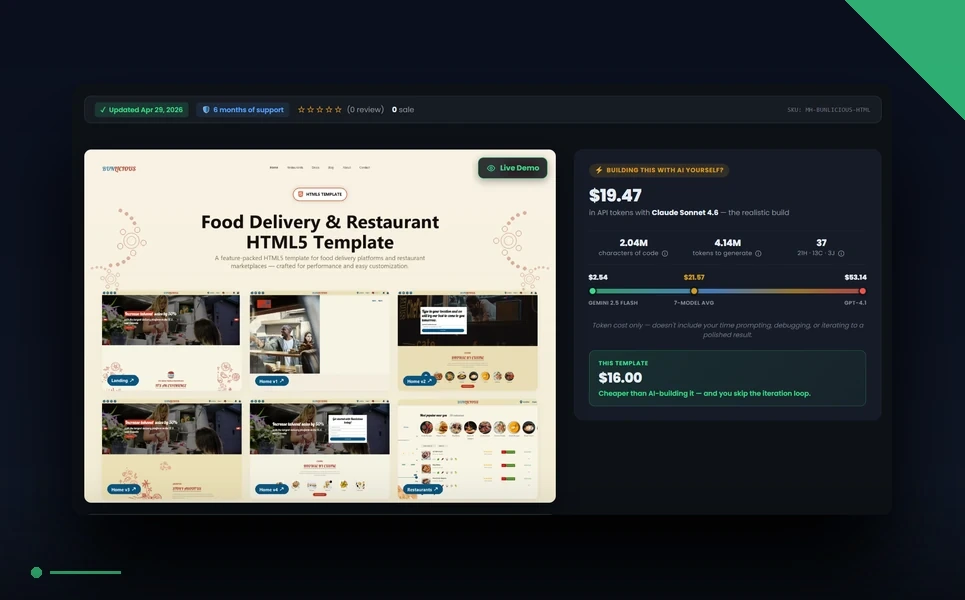
Every product page on MetropolitanHost publishes an AICE block — short for AI Cost Estimator — projecting the cost to rebuild the template from scratch using Claude, GPT, Gemini, Cursor or Lovable. We are the only marketplace that publishes this number per template. For Weefly, the AICE block — part of our broader website cost calculator framework, with the full AICE methodology documented separately — reports the typical token spend, the cheapest model that produces a faithful rebuild, the most expensive model and what it would charge, and the framework family the estimate is calibrated against. The point is not that AI rebuilds the template better. The point is that the buyer should be able to see, at purchase time, what the realistic AI alternative would cost — and weigh the price of the template against the cost of trying to rebuild the same performance budget themselves with an AI assistant.
The customization layer that survives the budget
The most overlooked aspect of performance-engineered templates is what happens to the performance budget when the buyer customizes the template. Most marketplace templates degrade under customization — the buyer adds a hero video, a gallery slider, an extra font, and the published Lighthouse score drops by twenty points within a week. Weefly is engineered so that the customization layer is constrained to operations that preserve the budget. Adding a new color costs nothing. Reskinning typography costs nothing if the swap stays inside the matched-fallback descriptor. Replacing the hero image with a new one costs nothing if the new image goes through the documented optimization pipeline. The customization roadmap explicitly documents which operations preserve the budget and which require additional performance work.
The hosting reality most buyers underestimate
The performance ceiling of any template is bounded by the hosting underneath it. A template engineered to publish a sub-2.5-second LCP cannot deliver that on hosting whose TTFB is 1.5 seconds, because the budget for everything else collapses. A premium template should publish its hosting recommendations explicitly — what tier of hosting the buyer needs, what region of the world it should be in, what CDN configuration is expected — so the buyer’s hosting decisions can be made against the published budget rather than against generic marketing language. Marketplace templates that publish a 95 Lighthouse score without telling the buyer what hosting was used to produce that score are publishing meaningless numbers.
The 2026 PageSpeed buyer’s checklist
The checklist a 2026 buyer should run through before clicking purchase on any premium template is roughly: does the template publish a current Lighthouse score against realistic content, does it publish its Core Web Vitals baseline numbers explicitly, does it ship with images optimized as WebP with responsive variants, does it ship with CSS split into critical and deferred paths, does it ship with JavaScript code-split per block, does it ship with fonts loaded via swap and matched fallbacks, does it expose a documented third-party-script loading layer, and does it publish hosting recommendations. A template passing all of those is rare. A template failing any of them will surface as a performance problem within the first month of real traffic.
Final word — performance should be the default, not a feature
The dominant failure mode in the premium template marketplace is that performance is sold as a feature rather than enforced as a default. The buyer is asked to pay extra for it, or asked to do the engineering work themselves after purchase. Both treatments are wrong. Performance is the structural property of the template that determines whether the buyer’s site converts at the rate the design promises or bleeds bookings month over month. We built Weefly — and the rest of the catalog — against that conviction, with that conviction built into every file. The buyer who treats Lighthouse 90+ as the floor rather than the ceiling will find that the template paid for itself within the first month of traffic, and continues to pay for itself for as long as the foundation holds.