The phrase “website cost calculator” used to point at a kind of tool that does not really exist anymore: a calculator that asked how many pages, what design tier, and whether you needed a CMS, then printed back a dollar range that was supposed to land inside your project’s actual cost. Those calculators were calibrated against the 2018 web. The 2026 web is structurally different — different stack, different growth tax, different AI economics — and the calculators that did not update are still ranking for the query, still printing the old numbers, and still misleading the buyers who land on them. This guide is the framework we run prospects through when they ask why our pricing looks different from those calculators, and what they should actually be measuring before they spend money on a template, a theme, or a custom build.
It is opinionated. It is grounded in our own work as an in-house template studio at MetropolitanHost. It ends with a single worked example — Miranda, our Bootstrap 5 hotel template — because the 2026 cost calculation only becomes concrete when the buyer can see the full breakdown applied to a real template the way we publish it on every product page in our catalog.
What 2018 calculators got right and what they got wrong
The 2018-era website cost calculators got one thing right: they decomposed the build cost into legible line items — pages, copywriting, design tier, ecommerce, CMS — and printed a one-time number. That decomposition was useful. What they got wrong was treating that one-time number as the website cost. In 2018 the gap between the build cost and the lifetime cost was small enough to ignore. In 2026 the gap is larger than the build cost itself, because the website’s lifetime now includes recurring AI integrations, automation stack subscriptions, AEO and GEO retainers, server-side tagging maintenance, CRO iteration, and the maintenance burden of a stack that changes more often than it used to. A calculator that prints only the build cost in 2026 is printing roughly the smallest part of the real number.
The four cost dimensions a 2026 website actually has
Any honest 2026 website cost calculation has to break the number across four dimensions: the one-time build cost, the customization labor cost, the maintenance burden over a multi-year horizon, and the AI rebuild cost — the new fourth dimension that did not exist five years ago. Each dimension has its own logic, its own pitfalls, and its own way of being misrepresented in marketplace listings. A buyer who optimizes for the smallest of the four ends up paying the most across the other three. A buyer who looks at all four ends up making a decision the math actually supports.
Dimension one — the one-time build cost
The one-time build cost is the number marketplace listings advertise. For a premium template it lands somewhere between forty-nine and one hundred forty-nine dollars in the in-house marketplace tier. For an offshore template it lands between five and thirty dollars. (We cover how the four marketplace archetypes structure their pricing in our Bootstrap 5 marketplace buyer’s guide, and the small-business-specific math in our best website templates for small businesses guide.). For a global marketplace listing it lands between nineteen and eighty-nine dollars before author-tier extras and license up-charges. For a local studio engagement it lands between twenty-five hundred and twenty-five thousand dollars depending on scope. The one-time build cost is the easiest of the four dimensions to compare across options — but it is the least predictive of the actual three-year cost the buyer will absorb, because the cheaper templates carry larger costs in the other three dimensions.
Dimension two — the customization labor cost
Customization labor is the dimension marketplace listings hide. A template that ships — like the templates covered in our premium HTML5 buyer’s guide — with a documented customization layer — CSS custom properties, tokenized typography, a section catalog the buyer can rearrange without breaking the structure — costs the buyer almost nothing in customization labor, because the operations are documented and reversible. A template that ships without the layer costs the buyer between five hundred and five thousand dollars in developer time to make any meaningful customization, depending on the scope. The buyer who saw a nineteen-dollar template and a one-hundred-forty-nine-dollar template and picked the cheaper one is usually the buyer who pays four thousand dollars in customization labor inside the first year. The customization layer is the biggest leverage point in the calculation, and the one most marketplace listings do not advertise.
Dimension three — the maintenance burden over three years
Maintenance is the dimension that compounds. Every template has a maintenance burden — security patches, framework upgrades, content updates, image optimization, broken-link cleanup. The question is whether that burden falls on a developer the buyer has to retain, or on a non-developer the buyer already has on staff. A premium template that ships as a CMS theme with a familiar admin interface costs the buyer almost nothing in routine maintenance, because the buyer or a non-technical staff member can make updates directly. A template that requires recompiling Sass, managing build pipelines, or deploying static files costs the buyer between two and ten hours of developer time per month, which works out to between twenty-four and one hundred twenty hours a year, which works out to between two and twelve thousand dollars at a junior developer’s billing rate.
Dimension four — the AI rebuild cost (new in 2026)
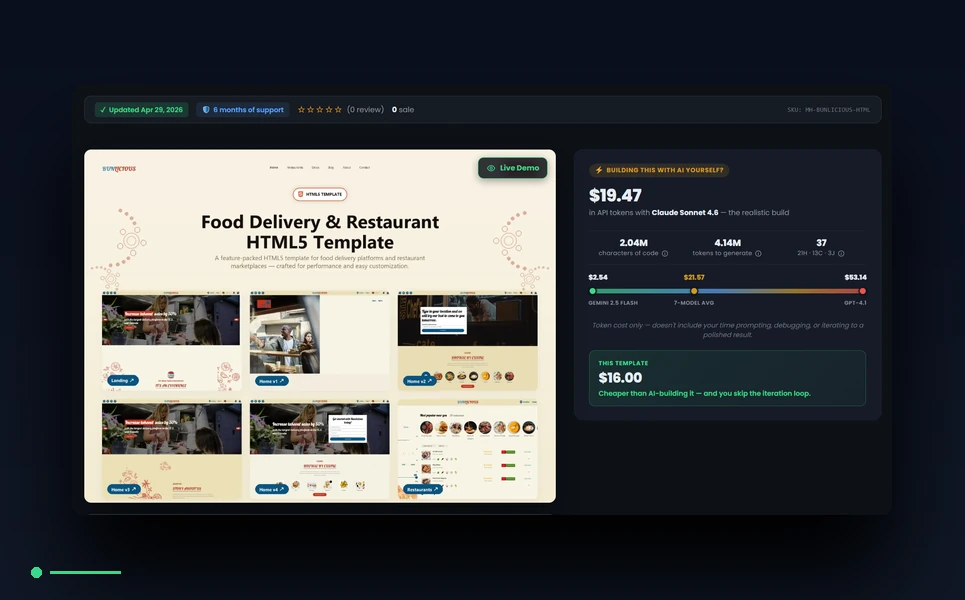
The AI rebuild cost is the fourth dimension and the new one. As of 2025, every premium template a buyer is considering has a realistic alternative: skip the purchase, hand the requirements to Claude or GPT or Gemini or Cursor or Lovable, and have the model build a faithful approximation from scratch. The cost of that AI rebuild is calculable. It depends on the size of the codebase, the framework family, the model the buyer chooses, and how many iterations the buyer is willing to run. We publish that cost on every product page on MetropolitanHost — the AICE block, which stands for AI Cost Estimator. We are the first template marketplace to publish it. Every other marketplace expects the buyer to do the math themselves, and most buyers do not, which is the structural reason the math usually tips against the marketplace template by accident.
What “website calculator” should actually mean in 2026
A 2026 website calculator that did its job would print four numbers, not one. The one-time build cost, the customization labor estimate over three years, the maintenance burden over three years, and the AI rebuild cost across the major model families. The buyer who sees all four side by side can make a real decision. The buyer who sees only the first one is making a decision against an incomplete picture. The calculator we are building inside our catalog publishes all four numbers per template, and the AICE block specifically publishes the AI rebuild cost across every major model the buyer is likely to use as an alternative. The math is published openly on every product page, with the model prices linked back to the vendor’s official pricing pages so the numbers can be verified.
The marketplace’s calculator problem
Marketplace calculators have a structural conflict of interest. The marketplace makes more money when the buyer underestimates the lifetime cost of a template, because the buyer is more likely to click purchase. A calculator that printed the four-dimension number honestly would lower the marketplace’s conversion rate, even if it would land the buyer in a better long-term outcome. That conflict is why the marketplace calculators that exist today print the build cost and stop. It is also why the responsibility to calculate the other three dimensions falls on the buyer, who almost never has the numbers required to do it. Our position is that publishing all four dimensions per template is the right answer, even if it lowers the conversion rate on the cheapest SKUs in our own catalog. The buyer who pays a hundred forty-nine dollars for the right template after seeing the math is a better outcome for the buyer and for us than the buyer who pays nineteen dollars and surfaces a problem at month three.
How to measure the one-time build cost honestly
The honest one-time build cost — separate from the performance baseline covered in our PageSpeed-optimized templates guide — includes the listing price plus any author-tier extras the buyer needs to actually use the template, plus the framework variants the buyer’s team will eventually need, plus the license cost if the marketplace charges separately for commercial use. Marketplace listings rarely lay this out. A nineteen-dollar listing on a global marketplace often includes only the HTML5 base, with the WordPress version sold separately, the React version sold separately, the developer-team license sold separately, and the figma source sold separately — so the buyer who needs three of those four ends up paying ninety dollars instead of nineteen. The right calculation is to total up everything the buyer will plausibly need within the first year, not just what the listing displays in its hero.
How to measure customization labor
Customization labor is measured by reading the template’s documentation before purchase. If the documentation lists CSS custom properties for color, a tokenized typography scale, a section catalog with named blocks, and a customization roadmap that names specific operations and their files, the labor cost over three years is roughly zero — the buyer’s non-developer can do the work in the admin interface or in a single config file. If the documentation says “edit the Sass variable file and recompile,” the labor cost is between five hundred and five thousand dollars per year of developer time, depending on how often the buyer needs changes. The documentation is the proxy for the customization layer’s existence. A template with thin documentation is a template the buyer will pay for again in labor.
How to measure maintenance burden
Maintenance burden is measured by asking the studio how the template gets updated and who runs the update. CMS themes with a familiar admin interface cost the buyer almost nothing in routine maintenance. Templates that require recompiling and redeploying cost the buyer developer time on a continuous basis. The studio’s update cadence matters: a template that ships quarterly minimum updates with immediate security patches has a maintenance burden the studio largely absorbs. A template whose author shipped one version and then went silent has a maintenance burden the buyer absorbs entirely after month twelve. The buyer’s checklist for this dimension is to ask the studio explicitly: who runs the update, when, and what does it cost the buyer per occurrence.
How to measure the AI rebuild cost
The AI rebuild cost is measured by counting the codebase size in characters, dividing by the chars-per-token ratio for the buyer’s chosen model, applying a realistic input-to-output ratio for an agentic build, and multiplying by the model’s published per-token rate. Every model that supports agentic coding publishes its rates per million tokens. The math is straightforward but the buyer almost never runs it. The AICE block — the per-template AI Cost Estimator we publish, with the full AICE methodology documented separately — runs that math automatically per template, across the major models, and publishes the result. We use chars divided by 3.5 for token estimation, a typical-build ratio of six input tokens for every output token, and the official per-token rates from each model vendor’s pricing page. The buyer can see the floor estimate, the typical estimate, and the ceiling estimate side by side.

Spotlight — Miranda’s published numbers as a worked example
Miranda is our Bootstrap 5 hotel template, and the AICE block on its product page is the worked example we use for the rest of this guide. Miranda’s first-party codebase is roughly 2.28 million characters across 19 HTML files, 74 CSS files, and 22 JavaScript files. At 3.5 characters per token, that is roughly 651,000 first-party output tokens. At a typical-build ratio of six input tokens to one output token, the typical build costs roughly 4.6 million tokens of input plus the 651,000 output tokens — a total of roughly 5.25 million tokens per faithful agentic rebuild. Those numbers are not estimates. They are computed directly from the Miranda source on every sync and published on the product page.
Miranda’s price across the major model families
Miranda’s published AICE numbers, against the verified model prices as of the May 2026 audit, are 2.83 dollars on Gemini 2.5 Flash at the floor, 24.02 dollars as the average across the major model families on a typical agentic build, and 59.17 dollars on GPT-4.1 at the ceiling. Claude Sonnet 4.6 lands at 21.69 dollars on a typical build. Claude Opus 4.7 lands at 36.15 dollars on the same. Those numbers are recomputed on every plugin sync against the latest pricing manifest, and the manifest itself is hand-edited from each vendor’s official pricing page on the audit date — so the buyer can verify any of them directly. We publish the audit date alongside the numbers on every product page.
The Miranda comparison — template purchase versus AI rebuild
Miranda’s listing price across the framework variants is in the forty-nine to one hundred forty-nine dollar range, with the Developer Bundle including all six variants at the ceiling. The cheapest faithful AI rebuild on Gemini 2.5 Flash costs 2.83 dollars in raw model time but does not include the buyer’s time, the iteration overhead, the integration with the buyer’s design system, or the customization layer Miranda ships with built-in. The most expensive faithful AI rebuild on GPT-4.1 costs 59.17 dollars in raw model time and still does not include those things. The honest comparison is not Miranda’s price against the cheapest AI number; it is Miranda’s price against the AI number plus the buyer’s time plus the operational tax of running an in-house build. Most buyers who run that math end up purchasing the template.
Why we publish the AICE numbers anyway
Publishing the AI rebuild cost is, on a naive read, an argument against the buyer purchasing our template. We publish the numbers anyway for two reasons. First, the buyer who is going to run the math will run it whether we help or not, and providing the numbers transparently makes it easier for the buyer to trust the rest of our claims about the template. Second, the AI rebuild cost is the floor of what a comparable engineering effort should cost — and our pricing reflects the actual engineering value of an in-house build that comes with documentation, customization layer, accessibility audit, performance budget, and direct support. Publishing the AICE number reframes the buyer’s decision as a value comparison rather than a price comparison, which is the framing our work actually wins on.
The AICE methodology — what we publish per template
Per template, the AICE block on every MetropolitanHost product page publishes: the chars-per-token estimation method, the input-to-output ratio used for the typical scenario, the source character counts split by HTML, CSS and JavaScript, the framework family the estimate is calibrated against, the floor and typical and ceiling cost across each major model, the cheapest model and what it would charge, the most expensive model and what it would charge, the platform-amortized cost across Cursor, Claude Code, Lovable, Replit, Bolt and v0, and the date the pricing manifest was last audited against the vendor pricing pages. Every number is computed from the source, not estimated. We are the first template marketplace to publish this level of transparency on every product page, and we expect to remain the only one for the foreseeable future because the engineering and content overhead of maintaining the manifest is non-trivial.
How buyers should use the AICE block
The AICE block on a product page is not a sales argument; it is a buyer’s reference. The right way to use it is to take the typical-cost number for the model the buyer would actually use as an alternative, multiply by an honest estimate of how many iterations the buyer would need to land a faithful rebuild, add the buyer’s own time at the buyer’s own billable rate, and compare the total against the template’s listing price plus its customization labor and maintenance burden. The buyer who runs that math fairly arrives at a number that almost always favors the template, because the template includes all the things the AI rebuild does not. The buyer who runs the math and arrives at a number that favors the rebuild has discovered that the template is wrong for the project, which is also a useful outcome.
The 2026 buyer’s calculator checklist
The checklist a 2026 buyer should run through, before clicking purchase on any template, is roughly: does the listing publish a current Lighthouse score against realistic content, does it ship with WCAG 2.2 AA accessibility audited and documented, does it ship with the structured data graph the page actually represents, does it ship with framework variants the buyer’s team can grow into, does it have a documented customization layer, does the support reach the engineer who wrote it, does the studio publish an honest update cadence, does the listing price include the framework variants the buyer will eventually need, and does the studio publish an AI rebuild cost the buyer can verify against the vendor pricing pages. A template that passes all nine is rare. A template that fails any of them is going to surface as a problem within months. The calculator most buyers really need is the checklist.
What our pricing looks like under the four-dimension lens
Under the four-dimension lens, MetropolitanHost’s pricing is in the forty-nine to one hundred forty-nine dollar range for one-time build, near zero for customization labor over three years because the customization layer is documented, near zero for maintenance burden over three years because the templates ship as CMS themes with familiar admin interfaces and the studio absorbs the patch cadence, and a published AICE number per template across the major model families. Total three-year cost across all four dimensions is the listing price plus a small fraction of a developer’s hour for occasional advanced customization. The same number on a nineteen-dollar offshore template typically lands four to ten times higher across the other three dimensions, which is the structural reason buyers who run the math switch to the in-house tier.
Why we are the first marketplace publishing this
MetropolitanHost is the first template marketplace to publish the AI Cost Estimator per template, and the only one we are aware of as of the May 2026 audit. The reasons other marketplaces have not adopted this transparency are structural. Global marketplaces with third-party authors cannot enforce a uniform manifest across their catalog because each author would need to opt in. Offshore marketplaces lack the engineering capacity to maintain the manifest at the cadence the model vendors ship pricing changes. Local studios do not have a catalog at all to publish across. In-house marketplaces — the smallest of the four archetypes — are structurally the only kind of marketplace that can ship a consistent manifest across an entire catalog, because the same team owns every product and the same plugin computes every number. We are happy for the rest of the market to follow. We expect them to take a while.
Final word — calculate against the lifetime, not the listing
The 2026 website cost calculator that does its job is the four-dimension calculator: one-time build, customization labor, maintenance burden, AI rebuild cost. Anything less is a 2018 calculator wearing a 2026 thumbnail. Buyers who calculate against the lifetime arrive at decisions the math actually supports. Buyers who calculate against the listing price get the answer marketplace conversion funnels are tuned to deliver, which is rarely the answer that serves the buyer. We built the AICE block to make at least one of the four dimensions verifiable per template across the catalog, and we expect to keep adding to the per-template transparency the longer this calculator lives. The buyer’s job is to demand that level of transparency from every studio they consider, including ours.
More buyer's guides
- How We Calculate Every Template’s AI Rebuild Cost — The MetropolitanHost AICE Methodology
- AI Website Generators vs Premium Templates — Honest Comparison (2026)
- Best AI Website Generators — 10 Tools Tested by Code Quality (2026)
- AI Website Generators for WordPress — Honest 2026 Comparison (7 Tools Reviewed)