
The phrase “Bootstrap 5 marketplace” still does a surprising amount of work for buyers in 2026. Bootstrap 5 has been the dominant CSS framework for premium HTML and WordPress templates since 2021 — and the broader question of which premium HTML5 template fits a project is covered in our premium HTML5 buyer’s guide, and the marketplace landscape that grew up around it has quietly stratified into four distinct kinds of seller — each with a different cost structure, support model, quality bar, and update cadence. The buyer who treats “Bootstrap 5 templates” as a single search category and clicks the first listing that looks reasonable is making a decision that turns into operational debt within months. The buyer who understands the four kinds of marketplace, and how they differ, can pick the one that actually fits the project they’re trying to launch.
This guide is the breakdown we use internally when prospects ask why our pricing looks different from the marketplace listings they’ve been comparing against. It is opinionated, because we are one of the four kinds of marketplace and we have a position. It is also honest about the tradeoffs of every model — including ours — because there is no universal right answer, and the decision should be made against the actual buyer’s situation, not against marketing language.
Why Bootstrap 5 still dominates 2026 marketplace templates
Bootstrap 5 is the framework with the largest pool of developers who can pick it up without retraining. That is the entire reason it dominates the premium template marketplace in 2026, and the reason it will continue to dominate for the rest of the decade unless something with the same characteristics displaces it. Tailwind has carved out a strong second-place position for templates aimed at developer-heavy buyer pools. Vanilla CSS has earned a niche for buyers who want zero framework lock-in. But the breadth of teams who can be handed a Bootstrap 5 codebase and ship against it on day one remains larger than for any other system. Marketplaces that ship Bootstrap 5 templates are buying themselves the largest possible buyer pool, which is also the reason their listings tend to look generic.
The four marketplace archetypes
The Bootstrap 5 template market in 2026 sorts into four archetypes. Offshore template shops in low-cost regions sell Bootstrap 5 builds for five to thirty dollars, often with an unmaintained roadmap. Local studios and freelancers sell custom Bootstrap 5 builds as engagements that range from twenty-five hundred to twenty-five thousand dollars. Global marketplaces resell whatever third-party authors upload, in the nineteen-to-eighty-nine-dollar range, with author-tier extras and license up-charges. In-house marketplaces — the tier we cover for small business buyers in our best website templates for small businesses guide — are the smallest of the four archetypes, and employ their own developers and ship their entire catalog under one quality bar. We are an in-house marketplace, and the rest of this guide treats that archetype as the baseline.
Offshore template shops — low cost, low support
Offshore template shops are the cheapest way to acquire a Bootstrap 5 template in 2026. The pricing reflects the labor cost of the regions the templates are produced in, not the quality of the template itself, and the buyer who understands this tradeoff can sometimes get an acceptable starting point for a project where the team plans to do most of the work themselves. The risk is that support is variable, sometimes unreachable for days, sometimes unreachable indefinitely after the original author moves on. The quality varies wildly per author. Documentation is usually thin. Updates often stop after the first release. For buyers who can absorb the operational risk, offshore is real value. For buyers who need a defensible support position, offshore is a trap.
Local studios and freelancers — high cost, narrow catalog
Local studios and freelancers will deliver a Bootstrap 5 build engineered to the buyer’s exact specifications, on a timeline measured in weeks, with the studio principal answering the buyer’s questions personally. The engagement is typically priced as a custom project — twenty-five hundred dollars for the smallest scope, twenty-five thousand and up for anything resembling a full site. The buyer who needs custom design, custom integrations, or a niche-specific build that no marketplace template can fit will end up here regardless of price, and the engagement is often worth the cost. The two structural problems are that the studio’s taste and quality bar are the only ones the buyer gets, and that updates after the initial engagement are billable per hour.
Global marketplaces — lottery quality at scale
Global marketplaces are the largest distribution channels for Bootstrap 5 templates, with author networks measured in tens of thousands of contributors and catalogs measured in millions of listings. The strength of the model is the breadth of choice. The structural weakness is that the marketplace itself does not write the templates and cannot enforce a quality bar across them. A buyer who picks a top-rated listing from a verified author may get a production-grade template. A buyer who picks a similar-looking listing from a less-established author may get a template whose original code was abandoned three years ago and whose author no longer responds to support requests. The quality variance inside a single global marketplace is enormous, and the marketplace’s filtering tools make it hard to predict in advance.
In-house marketplaces — the rare fourth archetype
In-house marketplaces employ their own developers and ship their entire catalog under one quality bar. The catalog is smaller. The pricing typically lands in the forty-nine to one-hundred-forty-nine-dollar range for a single template with all framework variants included. The support is answered by the engineer who wrote the template. The update cadence is published and enforced. The structural advantage is consistency: a buyer who has used one template from an in-house marketplace can pick up another with no learning curve, because the underlying patterns are identical. The structural cost is breadth: the in-house marketplace will never have the catalog size of a global marketplace, so a buyer searching for a niche-specific template may not find it. We run an in-house marketplace, so this archetype is the lens we know best.
What “premium Bootstrap 5” should mean in 2026
The marketplace listing word “premium” has been so devalued by the global-marketplace floor that it has lost most of its original meaning. A useful definition of “premium Bootstrap 5” in 2026 is a template that meets six floors at once — accessibility, structured data, performance, customization, framework portability, and support. A template that hits all six is rare across the four archetypes. A template that hits five but fails one is the most common form of “premium” in the market today, and the missing floor is usually the one that ends up costing the buyer most. The rest of this guide walks through each floor and what passing it actually looks like.
The accessibility floor
Accessibility is the floor where Bootstrap 5 templates fail most often, and the failure modes are usually the same. Decorative icons are exposed to screen readers when they shouldn’t be. Form fields use placeholder-as-label patterns that disappear the moment a user starts typing. Modals trap focus inconsistently. Skip links are missing or broken. Color contrast is acceptable in the default state but fails on hover and disabled. The 44-pixel minimum target size from WCAG 2.2 is ignored on mobile menu items. A premium Bootstrap 5 template should ship with the audit log already published — what was tested, what passed, what was deliberately scoped out and why — not just a “WCAG compliant” badge. Buyers in regulated industries should expect to see the audit log before they buy.
The structured data floor
Structured data is the floor that determines whether the template surfaces in AI-assisted search. Google’s AI Overviews, Perplexity, ChatGPT, Gemini, and the long tail of more specialized engines all prefer structured data over raw text. A premium Bootstrap 5 template should ship with the schema graph the page actually represents — Organization, LocalBusiness, Product, Service, Article, FAQPage, BreadcrumbList — already wired into the markup so that updating the visible content automatically updates the structured data. Most marketplace templates ship with schema as a single hardcoded JSON-LD block in the head that the buyer is supposed to edit by hand. That approach falls out of sync within months. The right approach treats schema as a property of every block, not a property of the page.
The performance floor
The performance floor for premium Bootstrap 5 in 2026 is 90+ Lighthouse mobile, on a throttled connection, against the buyer’s expected content profile. Hitting that floor reliably requires a coherent strategy across image optimization, CSS render-blocking, JavaScript execution cost, font loading, and third-party script discipline. Most marketplace templates hit 90+ on the demo URL with empty content, and fall apart the moment the buyer’s actual content is added. A premium Bootstrap 5 template should publish a performance budget — what each page is allowed to weigh, what each script is allowed to cost — and the budget should hold up against realistic content loads, not just against the empty demo.
The customization floor
The customization floor is the one buyers underestimate most. A real customization layer in 2026 looks like a documented set of CSS custom properties, a tokenized typography and color system the buyer can reskin from a single file, a section catalog that names every block in the template so the buyer can swap blocks without breaking the structure, and an upgrade path that survives the customization. Most marketplace templates expose customization as “edit this Sass variable, recompile, hope nothing breaks.” That is not a customization layer, it is an invitation to fork. A buyer who forks the template is on their own for every future update.
The framework portability floor
The framework portability floor is the floor that distinguishes templates a team can grow with from templates a team will outgrow. Most marketplace Bootstrap 5 templates ship as exactly one variant — the HTML5 build — and stop there. The buyer who picks the HTML5 base on Tuesday and decides on Friday they want it as a WordPress theme, or as a React app, or as an Angular dashboard, has to either rebuild from scratch or buy a different template that happens to look similar. A premium Bootstrap 5 template in 2026 should ship — or at least offer as a parallel SKU — the same visual and structural design across HTML5, React, Angular, Vue, PHP and WordPress. Studios that maintain framework parity have made a long-term commitment to the design. Studios that don’t are pretending the buyer’s stack will never change.
The support floor
The support floor is the floor where the four marketplace archetypes diverge most sharply. Offshore typically routes support to a forum staffed by a single author who may or may not respond. Local studios route support to the studio principal, who responds quickly during the engagement and inconsistently afterward. Global marketplaces route support to whichever author wrote the listing, with no marketplace-level escalation if the author goes dark. In-house marketplaces route support to the engineer who wrote the template. The buyer experience differs accordingly. A premium Bootstrap 5 template should publish its support policy explicitly — who answers, in what timeframe, on what channels, with what escalation path — not bury it in a generic FAQ.
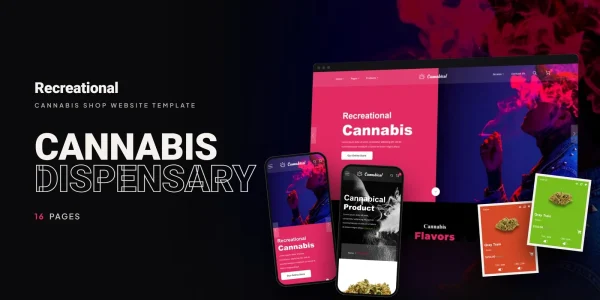
Spotlight — Recreational, our Bootstrap 5 cannabis dispensary template
Recreational is the template we use as the worked example because it has been engineered against every floor above and because we built it ourselves, in-house. The cannabis vertical is one of the most demanding small-business niches in 2026, and a Bootstrap 5 template that holds up in cannabis tends to hold up everywhere else. Regulated content disclosures, payment-processor friction, age-gate flows, store-locator UX, schema requirements that differ by state — Recreational solves all of them inside a single Bootstrap 5 codebase that drops directly onto a buyer’s hosting and ships with framework parity into React, Angular, Vue, PHP and WordPress.
Recreational’s section architecture
Recreational ships as a flat catalog of self-contained blocks rather than a deeply nested layout. Hero, navigation, age-gate modal, product grid, category list, store locator, reservation form, blog index, blog single, contact, regulatory disclosures, and a checkout funnel that mirrors WooCommerce parity — each block lives as its own unit with its own documented markup, styles, and scripts. A buyer can drop or rearrange any block without breaking the others. That flatness is the structural choice that makes the customization layer practical: the buyer’s edits stay scoped to the block, not bleeding across the whole template.
Recreational’s responsive breakpoints
Recreational uses Bootstrap 5’s breakpoint set as its baseline and adds two custom breakpoints — one for the awkward middle around 880 to 992 pixels where most marketplace templates produce alignment glitches, and one for ultra-wide layouts above 1600 pixels where most templates leave the content stranded in a narrow center column. Every block has been re-examined against both, and every interactive element has been audited for the 44-pixel minimum target size. The result is that Recreational renders cleanly on the long tail of viewport widths, not just on the three or four widths the demo URL is captured at.
Recreational’s typography and color tokens
Typography in Recreational is two families — display and body — both loaded with font-display swap and preloaded for the above-the-fold blocks. Color is expressed as a documented set of CSS custom properties scoped to the root, so the buyer can reskin the entire template by editing roughly twelve variables in a single file. Contrast ratios were audited against WCAG 2.2 AA for every text-on-background pair, including the hover, focus and disabled states. The typography scale is fluid using clamp functions, so it adapts to viewport width without breakpoint jumps.
Recreational’s age-gate and regulatory disclosure pattern
Cannabis dispensaries in regulated markets need a defensible age-gate before content is exposed, plus state-specific regulatory disclosures that need to remain visible without dominating the design. Recreational ships an age-gate built on a native dialog element with the right ARIA attributes, focus trap, and return-focus on close, plus a regulatory disclosure block that can be configured per state without rewriting the markup. The disclosure block satisfies the schema requirements for cannabis retailers in the major regulated states, and the age-gate satisfies the accessibility requirements for assistive technology.
Recreational’s store-locator and reservation flow
The store-locator block in Recreational supports both the multi-location case — buyers running a regional chain who need a map plus a filterable list — and the single-location case where the locator is a static block with the address, hours, and contact details. Reservation flow captures product selection, preferred pickup window, and identity verification state, and posts to a documented endpoint the buyer can wire to a back-end or to a vertical CRM. The form fields are named according to a consistent schema, so an AI booking agent can plug into the same flow without rewriting the markup.
Recreational’s e-commerce cart pattern
Recreational’s cart was designed for WooCommerce parity from the beginning, so the WordPress variant drops the markup directly onto the WooCommerce cart, checkout and account pages without restyling. For the HTML5 base, the cart is a static demonstration of the pattern, ready to be wired up to whatever back-end the buyer chooses. The pattern includes the elements modern e-commerce shoppers expect — quantity steppers, line-item subtotals, promotional code entry, shipping calculator, payment method selection — and ships with markup that satisfies the Product schema for individual line items.
Recreational’s published Lighthouse scores
Recreational’s published Lighthouse numbers, on a throttled mobile run with default content loaded, are 95 performance, 100 accessibility, 100 best-practices and 100 SEO. Those numbers are the documented baseline against the buyer’s expected content profile, not a one-time best-ever capture. The performance budget was set deliberately: every above-the-fold image preloaded as WebP with srcset, every render-blocking script deferred, every font preloaded for the first paint, every third-party script either removed or moved behind a consent gate. A buyer who deploys Recreational against their own content can expect to land in the same neighborhood with no performance work of their own.
Recreational’s framework variants
Recreational ships in six framework variants — the Bootstrap 5 HTML5 base, plus React, Angular, Vue, a PHP back-end build, and a full WordPress theme. The visual design is identical across all six. The structural decisions and the customization layer map the same way. A buyer who picks the HTML5 base on day one and decides at month three that they want WordPress can move with no rebuild. A buyer whose stack is React from the start can skip the HTML5 base entirely. The Developer Bundle includes all six variants under one transparent price, which is the option most buyers eventually settle on.
The AICE rebuild cost — what AI would charge
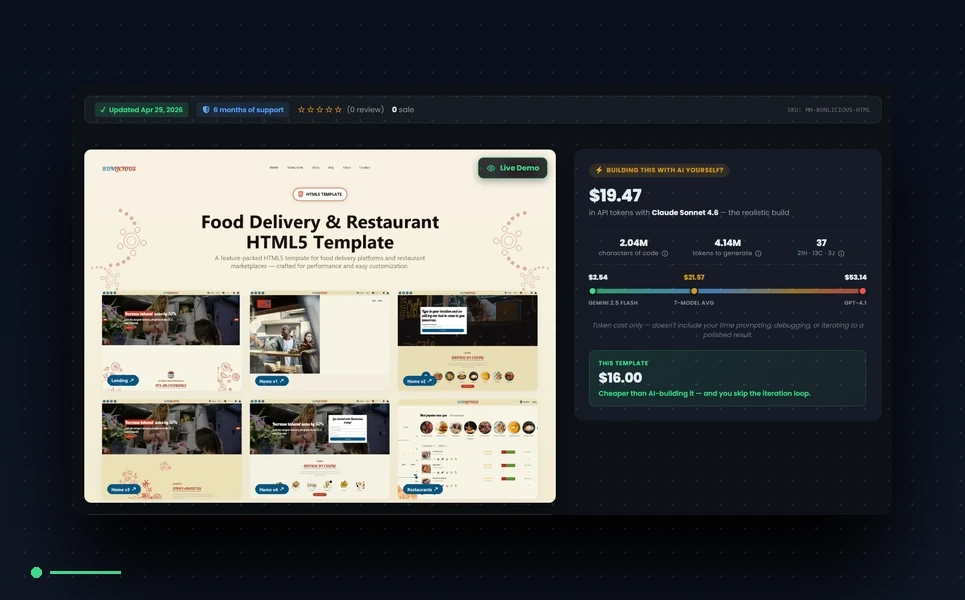
Every product page on MetropolitanHost publishes an AICE block — short for AI Cost Estimator — projecting the cost to rebuild the template from scratch using Claude, GPT, Gemini, Cursor or Lovable. We are the only marketplace that publishes this number per template. For Recreational, the AICE block — part of our broader website cost calculator framework, with the full AICE methodology documented separately — reports the typical token spend, the cheapest model that produces a faithful rebuild, the most expensive model and what it would charge, and the framework family the estimate is calibrated against. The point is not that AI rebuilds the template better. The point is that the buyer should be able to see, at purchase time, what the realistic AI alternative would cost — and weigh the price of the template against it.
The customization roadmap most marketplaces won’t show you
Recreational ships with a documented customization roadmap that maps the most common buyer modifications — brand reskinning, section reordering, language localization, integration with a chosen CRM, swap of the reservation form for a third-party booking widget — to specific files and specific operations. Every modification listed in the roadmap has been performed against the template at least once, by the same team that wrote it. The roadmap is not a marketing document, it is an operational guide. Buyers who follow it stay on the upgrade path. Buyers who deviate can still customize freely, but they accept the risk that their modifications may complicate future updates.
Why we built Recreational in-house
The decision to build Recreational in-house, in New York, instead of commissioning it through a third-party author network, was deliberate. Marketplaces optimize for breadth of catalog. We optimize for depth of consistency. The same in-house team that wrote Recreational also wrote our restaurant template, our cycling template, our church template, our hotel template, our legal template, and the rest of the catalog. The visual languages differ. The structural decisions and the quality bar do not. A buyer who has used one MetropolitanHost template can pick up another from us with no learning curve. That consistency is impossible to maintain across a marketplace of independent authors. It is only possible with a small, dedicated, in-house team.
Pricing — why our number looks different
Recreational’s price is in the forty-nine to one-hundred-forty-nine-dollar range depending on the SKU. The HTML5 base is at the floor. The Developer Bundle, which includes all six framework variants, is at the ceiling. Both are higher than the offshore floor and the global-marketplace floor, and dramatically lower than any local-studio engagement. The pricing reflects the cost of running an in-house team rather than a third-party author network, the cost of maintaining framework parity across six codebases, and the cost of staffing real support from the engineer who wrote the template. We could ship cheaper, the way offshore does, by removing the in-house piece. We could ship more expensive, the way local studios do, by treating every install as a custom engagement. We don’t, because we think the in-house marketplace tier is the right tradeoff for buyers who want consistency without the cost of bespoke.
The 2026 Bootstrap 5 buyer’s checklist
The checklist a 2026 buyer should run through before clicking purchase on any premium Bootstrap 5 template is roughly: does the template publish a current Lighthouse score against realistic content, does it ship with WCAG 2.2 AA accessibility audited and documented, does it ship with the structured data graph the page actually represents, does it ship with framework variants the buyer’s team can actually use, does it have a documented customization layer rather than a Sass-variable-and-pray approach, does the support reach the engineer who wrote it or only an author forum, does the studio behind it publish an honest update cadence, and does the price include the framework variants the buyer will eventually need. A template that passes all of those is rare across the four marketplace archetypes. A template that fails any of them is going to surface as a problem within months.
Final word — pick the marketplace, not just the template
Picking a Bootstrap 5 template in 2026 is really picking a marketplace. The template’s price tag is the smallest part of the decision. The marketplace’s quality bar, support model, update cadence, and framework portability commitments are the parts that determine whether the template ages well or fails within months. Buyers who treat the purchase as a long-term decision rather than a one-time download will find that the right template, from the right marketplace, is dramatically cheaper in operational terms than the bargain alternative. We built Recreational to be a defensible answer to that decision in the cannabis vertical, and as the worked example for the rest of our in-house catalog. The same standards apply to every other niche we ship.