What Is a Finance Company Website Template?
A finance company website template is a pre-designed, fully coded website built specifically for financial advisory firms, loan companies, insurance agencies, investment consultancies, accounting practices, and fintech startups. It includes every page a financial services business needs — homepage with authoritative visual presence, services module with individual detail pages for each offering, portfolio gallery showcasing client outcomes and case studies, team profiles with professional credentials, animated business statistics, FAQ section for common client questions, blog for thought leadership, and contact page — all designed to communicate the trust, professionalism, and competence that financial clients demand.
For financial services companies that need a website projecting institutional credibility without paying $8,000 to $38,000 for a custom build or $50 to $200 per month for an agency retainer, a template delivers the most practical path to a professional online presence. But financial websites have unique requirements that generic templates cannot address. Your design must communicate trustworthiness within seconds. Your credentials must be visible and verifiable. Your services must be presented with the clarity and precision that clients handling their finances expect. This guide covers what financial clients look for in a company website, what technical features build trust, and how to choose the right template for your financial services business.
Template vs Website Builder vs Custom Build
Financial services companies typically face three options when establishing their digital presence:
| Factor | Website Builder (Wix, Squarespace) | Finance Website Template | Custom Website Build |
|---|---|---|---|
| Upfront Cost | $0–50 | $29–69 | $8,000–38,000 |
| Monthly Cost | $16–49/month | $3–10/month (hosting only) | $50–200/month |
| 3-Year Total Cost | $576–1,814 | $137–429 | $9,800–45,200 |
| Code Ownership | No — you rent it | Yes — you own it forever | Yes — you own it |
| Design Authority | Shared templates — competitors look identical | Fully customisable professional design | Fully custom |
| Page Speed | Platform-dependent — often slow | Lightweight HTML — fastest option | Varies |
| Trust Perception | Medium — platform branding visible | High — professional standalone presence | Highest |
| Time to Launch | 1–3 days | 3–7 days | 6–16 weeks |
| Vendor Lock-in | High — limited export | None | None |
Website builders offer speed but carry visible platform branding that can undermine the institutional credibility financial clients expect. A Squarespace or Wix URL — or even a custom domain with detectable platform fingerprints — signals “small operation” to prospects evaluating financial advisors. A standalone website with professional hosting communicates permanence, independence, and the kind of established presence that financial clients associate with trustworthy firms. The template path delivers that professional authority at a fraction of custom build costs.
What Financial Clients Expect From Your Website
People evaluating a financial services company online are making one of the most trust-dependent decisions of their lives. They are considering giving you access to their money, their financial data, or their long-term financial planning. Your website must overcome natural scepticism by communicating competence, stability, and trustworthiness within seconds. Here is what financial clients look for:
Immediate Trust Signals
Financial clients scan for trust indicators before reading a single word of content. Professional design with clean typography and authoritative colour schemes. Team photos that show real people — not stock images. Business statistics that demonstrate track record. Regulatory registration numbers where applicable. Client testimonials from identifiable sources. Professional certifications and memberships. These trust signals work at the subconscious level, forming an impression of legitimacy and reliability before the prospect consciously evaluates your services. A website that looks amateur, outdated, or generic triggers the same alarm bells that a shabby office would.

Service Clarity Without Financial Jargon
Most financial clients are not financial experts — that is why they are seeking professional help. Your services section must explain what you offer in language that a non-specialist understands. “Wealth management” means different things to different people — your service page should explain exactly what it includes, who it is for, what the process looks like, and what outcomes clients can expect. Individual service detail pages allow you to provide this depth for each offering without overwhelming the overview page. Services should be organised logically: investment management, retirement planning, tax advisory, insurance, lending — each with a dedicated page that answers the prospect’s specific questions.
Credentials and Team Authority
In financial services, the team is the product. Clients hire people they trust with their financial wellbeing. Team profiles must include professional headshots, qualifications (CFA, CFP, CPA, Series 7), years of experience, areas of specialisation, and a professional bio that communicates both competence and approachability. Animated skill charts showing expertise levels in different financial disciplines — investment analysis, tax planning, risk management, estate planning — add a visual credibility layer that text alone cannot achieve. These data-driven skill visualisations communicate depth of expertise in a format that is instantly understandable.
Social Proof Through Numbers
Financial clients want evidence of scale and track record. Animated statistics that display “500 Clients Served” or “$250M Assets Under Management” or “15 Years of Experience” or “98% Client Retention Rate” provide concrete proof of credibility. These numbers, animated as the visitor scrolls, create a sense of substance and achievement that positions your firm above competitors whose websites make claims without backing them with data. In financial services, numbers speak louder than words — and animated counters present those numbers in the most engaging format possible.
Case Studies and Client Outcomes
Prospective clients want to see results, not just promises. A portfolio section repurposed as a case study gallery — showcasing anonymised client outcomes with before-and-after financial scenarios, challenges addressed, and results achieved — provides the proof that converts sceptical prospects into scheduled consultations. Filterable categories let prospects find case studies relevant to their situation: retirement planning, business succession, tax optimisation, investment growth. Each case study demonstrates your methodology and outcomes in a format that speaks directly to the prospect’s own financial concerns.
FAQ That Addresses Financial Anxiety
Financial decisions trigger anxiety. Prospects worry about minimum investment requirements, fee structures, how their data will be protected, what happens if they want to change advisors, and whether your firm is regulated. A comprehensive FAQ page that addresses these concerns transparently reduces the psychological barriers to making contact. Every unanswered question is a reason to delay, and in financial services, delay often means the prospect chooses a competitor who answered their concerns more clearly.
Technical Features That Build Financial Trust Online
Beyond visual design, certain technical features specifically enhance financial services websites and communicate the professionalism that clients in this sector demand.
Animated Credential Charts
EasyPieChart provides animated circular skill visualisations that elevate team profiles from text-based bios to data-driven credential displays. A chart that fills to 95% for “Investment Analysis” or 90% for “Tax Planning” or 85% for “Estate Planning” communicates expertise in a format that is visually compelling and instantly credible. For financial advisory firms, these charts on each advisor’s profile page demonstrate specific expertise areas — helping prospects identify the right advisor for their particular financial needs.
Animated Business Statistics
CountTo animated statistics display your firm’s credentials in an attention-grabbing format. Numbers that animate from zero to their final value as visitors scroll — clients served, assets managed, years in operation, client satisfaction percentage — create immediate authority. These animated counters work particularly well on the homepage and about page, where first-time visitors form their initial impression of your firm’s credibility and scale.
Filterable Case Study Gallery
Isotope grid filtering transforms a static case study section into an interactive gallery that prospects can navigate by service type. A prospect interested in retirement planning filters to see retirement planning case studies. A business owner exploring succession planning filters to that category. This targeted navigation connects prospects with the most relevant proof of your expertise, shortening the path from website visit to consultation request.
Multiple Homepage Layouts for Brand Positioning
Different financial services firms project different brand personalities. A private wealth management firm requires an understated, exclusive aesthetic. A fintech startup needs a modern, technology-forward look. A general financial advisory firm needs approachable professionalism. Three unique homepage layouts provide the flexibility to match your template’s visual positioning to your firm’s brand personality and target market, rather than forcing every financial firm into the same visual box.
Trust Stack: Financial websites that combine animated credential charts on advisor profiles, animated business statistics on the homepage, and filterable case studies in the portfolio section create a three-layer trust stack. Visitors see the firm’s scale (statistics), the team’s expertise (credential charts), and the firm’s results (case studies) — each reinforcing the others. This layered approach to trust-building converts sceptical financial prospects far more effectively than text-heavy “About Us” pages that make claims without visual proof.
Compliance and Regulatory Considerations
Regulatory Disclosure Requirements
Depending on your jurisdiction and the financial services you provide, your website may need to display specific regulatory information. Investment advisors registered with the SEC or state regulators should display their registration status. Insurance agents must display licensing information. Mortgage brokers must include NMLS identification numbers. Your template’s footer and about page must accommodate these disclosures cleanly — they are not optional additions but legal requirements that also serve as trust signals for informed prospects who check for regulatory compliance.
Privacy and Data Protection
Financial clients provide sensitive personal and financial data. Your website must include a clear privacy policy explaining how client data is collected, stored, protected, and used. If you collect information through contact forms, the form should reference your privacy policy. For firms subject to regulations like GDPR, CCPA, or industry-specific data protection requirements, your website must include appropriate consent mechanisms and data handling disclosures. A template provides the page structure for these legal requirements — your compliance officer or attorney provides the content.
Content Disclaimers
Financial content requires careful disclaimers. Blog posts discussing investment strategies, market commentary, or financial planning topics should include appropriate disclaimers about the nature of the content — that it is educational, not personalised financial advice. Past performance disclosures, risk warnings, and the distinction between general information and specific advice must be clear. Your template’s blog module should accommodate footer disclaimers on every post, and your services pages should include appropriate disclosures about the nature and limitations of your services.
How to Evaluate a Finance Template Before You Buy
Assess the Trust Communication
Does the template’s design language communicate financial authority? Look for clean typography, professional colour schemes (blues, greys, whites, and greens project financial stability), generous whitespace, and a structured layout. Avoid templates with trendy animations, dark themes, or creative layouts that may work for design agencies but undermine financial credibility. The template should feel institutional without being sterile.
Check the Services Architecture
Does the template include both a services overview page and individual service detail pages? Financial firms offer multiple services that each require thorough explanation. A single services page that lists everything in summary form fails to provide the depth that prospects need. Individual service pages for investment management, financial planning, tax advisory, and other offerings let you address each prospect’s specific needs and rank for service-specific search terms.
Evaluate Team Profile Depth
Do the team profiles offer enough space for qualifications, specialisations, professional headshots, and bios? Are there skill visualisation components like animated charts? Financial clients evaluate advisors personally — a shallow team section with only names and titles fails to build the personal trust that drives consultation requests. The profile system must support the credential-heavy presentation that financial professionals require.
Cost Breakdown: Building a Finance Company Website
| Component | DIY with Template | Freelancer Build | Agency Custom Build |
|---|---|---|---|
| Design/Template | $29–69 (one-time) | $2,000–6,000 | $8,000–38,000 |
| Hosting | $5–15/month | $15–40/month | $30–200/month |
| Domain | $10–15/year | $10–15/year | $10–15/year |
| SSL Certificate | Free (Let’s Encrypt) | Free–$200/year | $100–300/year |
| Legal Review | $300–800 | $300–800 | Included in build |
| Year 1 Total | $399–1,064 | $2,490–7,295 | $8,500–41,315 |
| Year 2+ Annual | $70–195 | $190–495 | $460–2,715 |
Legal review is included because financial websites require compliance review of disclaimers, privacy policies, and regulatory disclosures regardless of the build path. The template path keeps the design cost minimal while allowing you to invest in the legal and compliance review that financial services websites genuinely require. The result is a professionally designed, legally reviewed website at a fraction of what agencies charge.
Mitor — A Template Built for Financial Services
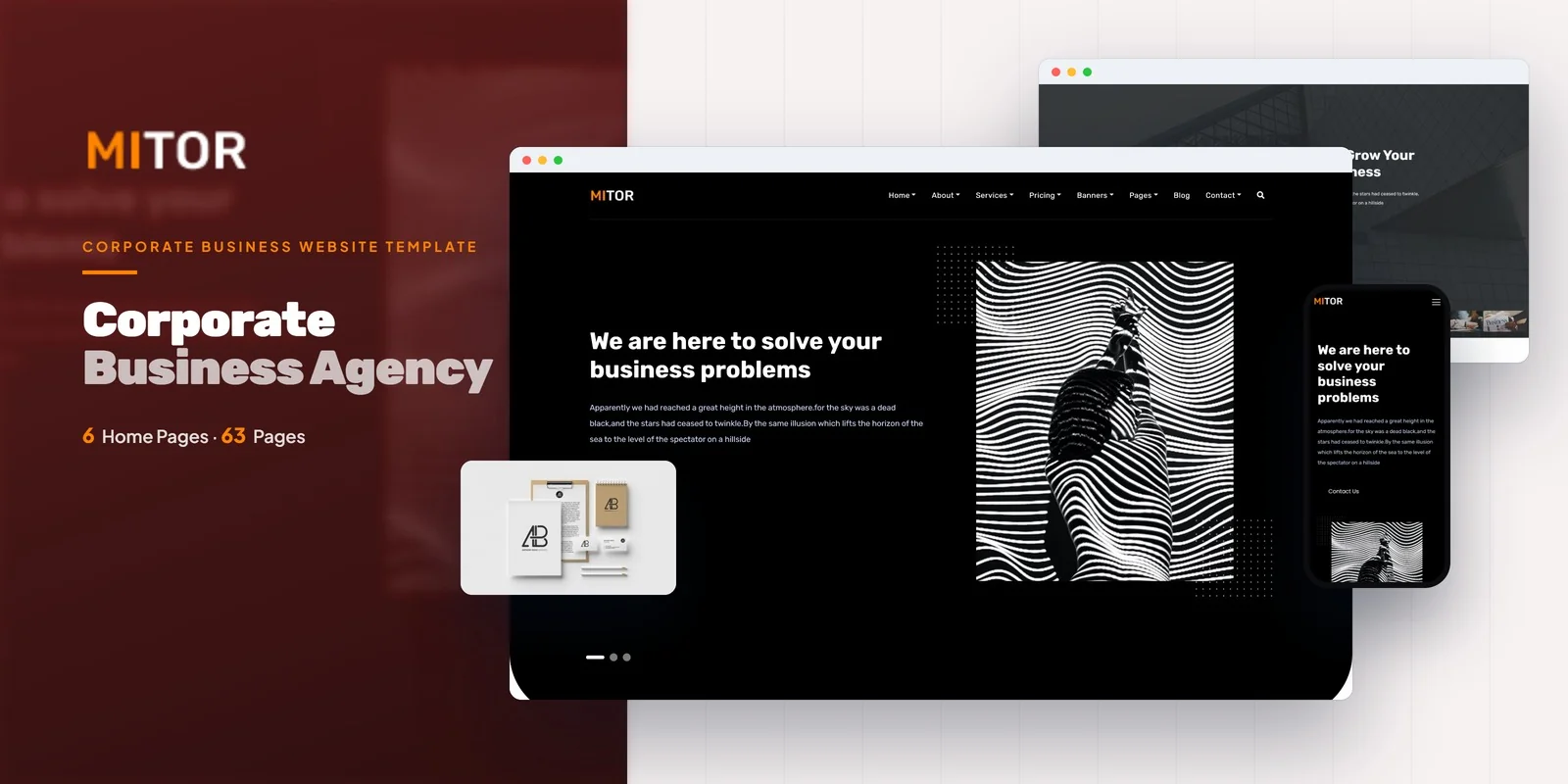
Mitor is a professional agency and portfolio HTML5 template that maps perfectly to financial services website requirements. Built with 18 fully designed pages, 3 unique homepage layouts, comprehensive service architecture, and trust-building credential visualisations, it delivers the authoritative online presence that financial clients expect — with animated statistics and skill charts that no generic website builder includes.
What Mitor Includes
- 18 Fully Designed HTML5 Pages — homepage, services, case studies, team, blog, FAQ, and more
- 3 Unique Homepage Layouts — match the visual positioning to your firm’s brand — institutional, modern, or approachable
- Services Module — services overview plus individual service detail pages for each financial offering
- 3 Portfolio Gallery Styles — Grid, Masonry, and Slider views for client case studies and outcome presentations
- Isotope Filtering — category-based case study navigation by service type
- EasyPieChart Skill Charts — animated circular credential visualisations for advisor expertise profiles
- CountTo Animated Statistics — clients served, assets managed, years of experience in animated format
- Team Pages — advisor profiles with individual pages, credentials, and skill charts
- FAQ Page — common client questions about services, fees, and processes
- Blog Module — thought leadership articles, market commentary, and financial education content
- Magnific Popup Lightbox — full-screen viewing for case study details and credentials
- Why Choose Us Page — dedicated trust-building page with differentiators and statistics
- Contact Page — consultation scheduling and professional enquiry form
Technical Foundation
Mitor is built on Bootstrap 4 with jQuery, Slick carousels for testimonial and featured content showcases, Isotope grid filtering for case study browsing by service category, EasyPieChart for animated credential visualisations on advisor profiles, CountTo for animated business statistics, Magnific Popup lightbox for detailed case study viewing, and responsive design across all pages. Every component supports the trust-building, credential-heavy presentation that financial services websites require.
Credential Visualisation: Mitor is one of the few templates that combines EasyPieChart animated skill charts with CountTo animated statistics and a dedicated “Why Choose Us” page. For a financial services firm, this means each advisor profile displays expertise levels — 95% Investment Analysis, 90% Tax Planning, 88% Risk Management — while the homepage and “Why Choose Us” page showcase firm-wide statistics and differentiators. This combination of individual credentials and institutional metrics creates the multi-layered trust presentation that converts sceptical financial prospects into scheduled consultations.
Customisation Roadmap for Financial Firms
Week One — Content and Compliance: Write service descriptions in clear, jargon-free language. Prepare advisor bios with qualifications, certifications, and specialisations. Draft case studies with anonymised client outcomes. Compile your regulatory disclosures, privacy policy, and content disclaimers. Have your compliance officer or attorney review all website content. Replace all placeholder content and adjust the colour palette to match your firm branding — blues, greys, and greens project financial stability.
Week Two — Configuration and Launch: Set up the services section with individual pages for each offering. Configure advisor profiles with EasyPieChart skill levels for each expertise area. Organise case studies by service category using Isotope filtering. Set CountTo statistics with your firm’s actual metrics. Integrate contact forms with your CRM or email system. Test across all devices. Deploy, verify all compliance disclosures display correctly, and submit to Google Search Console for indexing.
Frequently Asked Questions
Need Help Launching Your Financial Website?
MetropolitanHost provides professional web development services for HTML template deployments. Our team understands financial services website requirements and delivers clean, compliant, well-structured implementations.
- WordPress Theme Installation — live in under 24 hours
- Full Website Package — complete front-to-back deployment
- Colour Customisation — match your firm branding across all pages
- Website Speed Optimisation — Core Web Vitals improvements
- Accessibility Compliance — WCAG audit and remediation