The real estate market in 2026 runs on search. According to the National Association of Realtors, 97% of home buyers use the internet at some point in their home search, and the vast majority begin their journey online long before they ever call an agent. For brokers, agents, and property developers, this means your website is not a supporting brochure. It is the first showing, the first impression, and often the first point of contact a buyer or seller ever has with your brand. Professional real estate web design is no longer optional. It is the foundation of how leads find you, judge you, and decide whether to reach out.
The numbers make the case plain. The U.S. residential real estate market is valued in the trillions of dollars, with millions of transactions closing every year, and online property portals influence a commanding share of them. Roughly half of buyers find the home they eventually purchase on the internet, and more than three quarters use a mobile device at some stage of the search. In a market this large and this digital, the agents and agencies that win are the ones whose websites load fast, present listings beautifully, and capture inquiries before a competitor does.
Why Your Real Estate Website Is Your Most Important Asset
Most agents in a given market sell from the same MLS inventory. The listings on your site are often the same listings a buyer can find on three other agents’ sites and on the national portals. When the product is identical, the differentiator becomes the experience. A real estate website that loads quickly, presents properties with large, high-quality imagery, and makes scheduling a viewing effortless will convert the lead that a slower, cluttered competitor loses. This is measurable in inquiry rates, time on site, and the volume of qualified appointments your forms generate.
Mobile traffic dominates real estate. Buyers browse listings on their phones during lunch breaks, save favorites from the couch, and pull up a property’s map and neighborhood data while sitting in the driveway. More than three quarters of home shoppers use a smartphone in their search, and for younger buyers that share is even higher. If your real estate website does not perform flawlessly on a small screen, with tappable photo galleries and forms that are easy to complete with a thumb, you are invisible to the largest segment of your market. Every design decision must start with mobile and scale up to desktop.
First impressions carry enormous weight in real estate because the stakes for the customer are high. A home is the largest purchase most people ever make, and choosing an agent to guide that purchase is a decision rooted in trust. A website that looks dated, loads slowly, or hides its contact information signals an agent who is behind the times. A polished, professional realtor website template signals competence, market knowledge, and attention to detail, the exact qualities a seller wants in the person listing their home. In a relationship business, your real estate web design is your single most powerful credibility tool.
What Makes a Great Real Estate Website
Property Listings and IDX Search
The listing catalog is the heart of any real estate website. Buyers want to search by location, price range, property type, number of bedrooms and bathrooms, and square footage, then sort and filter the results without friction. Static pages with a single photo and a paragraph of description are not competitive anymore. The best real estate website designs provide filterable property grids, detailed listing pages with multi-image galleries, floor plans, and clear structure that can connect to an IDX or MLS feed so your inventory stays current automatically. A property website template built for the industry gives you these search and listing patterns from the start, rather than forcing you to bolt them on later.
Listing detail pages deserve special attention. Each one should present the property’s gallery prominently, surface the key facts at a glance, and place a contact or viewing-request form within easy reach. Related-property suggestions keep buyers browsing, and saved-search or wishlist functionality brings them back. These are the patterns that turn a casual browser into a qualified lead.
Lead Capture and Inquiry Forms
Real estate is a lead-generation business, and your website’s primary job is to convert anonymous visitors into named, contactable leads. That means inquiry forms on every listing, a prominent valuation or “what’s my home worth” form for sellers, and clear calls to action that invite buyers to schedule a viewing or request more information. The best real estate website templates treat lead capture as a first-class feature, not an afterthought. Forms should be short, mobile-friendly, and positioned exactly where intent peaks, alongside a listing the buyer loves or at the moment a seller is curious about their property’s value.
Beyond the form itself, the path to contact must be frictionless. Click-to-call phone numbers, visible agent contact details, and instant-response messaging options all reduce the gap between interest and inquiry. Every unnecessary step between “I like this property” and “I sent a message” costs you a lead that a faster competitor will happily capture.
Mobile-First Performance and Maps
Google’s Core Web Vitals directly influence your search rankings, and real estate sites are frequently penalized for poor performance. Large, uncompressed property photos, heavy map embeds, and bloated scripts push load times past the point where mobile users abandon the page. A quality real estate website template is built on a lightweight framework like Bootstrap 5, with optimized assets and lazy loading so galleries and maps render fast even on a phone over a cellular connection. Target under 2.5 seconds for Largest Contentful Paint, because every second of delay measurably reduces inquiries.
Location is everything in real estate, so maps and neighborhood context are core features, not extras. Interactive maps, neighborhood guides, walkability and amenity highlights, and proximity to schools or transit help buyers picture life in a property. These elements must work smoothly on mobile, where touch targets need to be large and map interactions need to feel natural under a thumb.
Agent Credibility and Trust Signals
Choosing an agent is a trust decision, and your website needs to actively build confidence through visible trust signals. Genuine client testimonials and reviews displayed prominently, sold-listing track records, professional team and agent photos, licenses and certifications, and a clear company story all do the heavy lifting. Generic stock photography and vague mission statements do not build trust. Specificity does. A cohesive visual identity across every page, paired with real proof of results, creates the professional impression that turns a first-time visitor into a signed client. For both buyers and sellers, the agent who looks credible online is the one who gets the call.
6 Real Estate Website Templates Worth Using in 2026
We evaluated dozens of real estate website templates and selected the six that deliver the best combination of design quality, feature depth, and real-world usability. Each template is built on Bootstrap 5, fully responsive, and crafted specifically for agents, agencies, and property businesses. Here is the full collection at a glance.
1. Aiga (21 Pages)
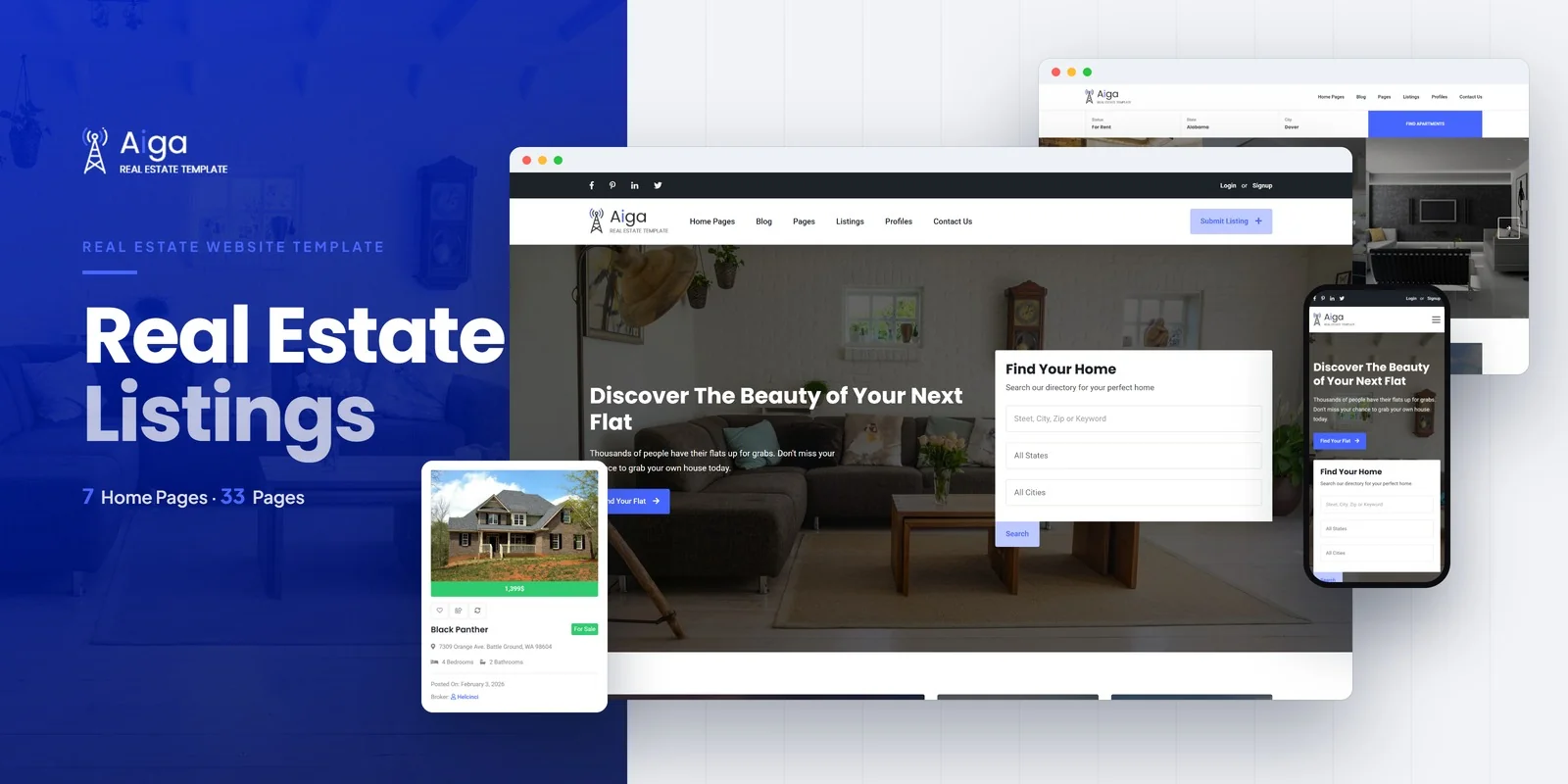
Aiga is a clean, modern real estate website template built for agencies and individual agents who want a polished property-listing presence without unnecessary bulk. Across its 21 pages, it delivers a well-rounded set of property listing layouts, detailed single-property pages with image galleries, and the supporting pages an agency actually needs, from about and team to contact and blog. The design language is contemporary and uncluttered, putting the focus where it belongs: on the properties and the imagery that sells them.
The property listing pages are the highlight. Grid and list views let buyers browse the way they prefer, while single-property pages present galleries, key specifications, and an inquiry form in a layout that guides visitors toward making contact. The blog system is well-integrated, supporting the content marketing that drives organic traffic to a real estate site over time. For an agency that wants a professional, conversion-focused site that can go live quickly, Aiga hits the sweet spot between depth and simplicity.
Best for: Real estate agencies and individual agents who want a modern, listing-focused website that launches fast without sacrificing design quality. View Live Demo
2. Beibuild (19 Pages)
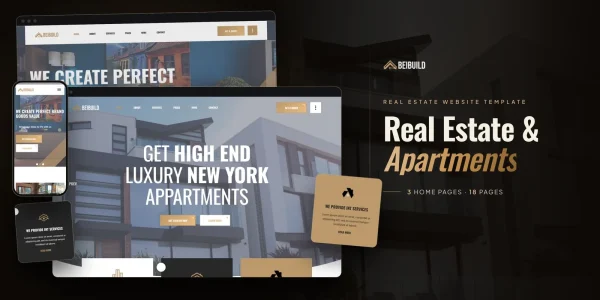
Beibuild brings a strong visual emphasis to property presentation, with a 19-page structure organized around its photo gallery and showcase layouts. It suits agents and developers whose listings sell on imagery, where high-end photography of interiors, exteriors, and amenities is the primary selling tool. The gallery-driven design makes properties feel aspirational, which is exactly the impression a premium listing needs to make in the first few seconds.
Beyond the galleries, Beibuild covers the practical pages an agency depends on: property listings, single-property detail pages, agent profiles, about, contact, and a blog. The photo-forward layouts give developers marketing a new building or agents listing luxury homes a framework to present visuals at scale without the page feeling heavy. For a real estate business whose competitive edge is the quality of its imagery, Beibuild provides the stage.
Best for: Developers and agents marketing image-heavy or premium listings where photography is the primary driver of interest. View Live Demo
3. Bestate (29 Pages)
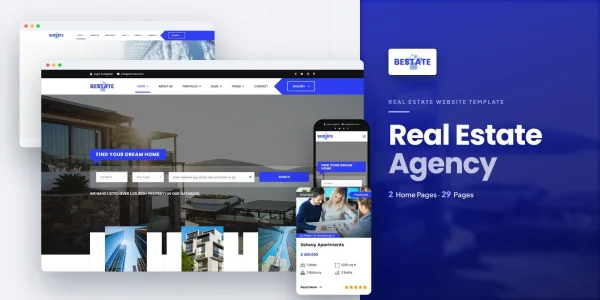
Bestate is a comprehensive real estate website template built for established agencies that need room to grow. With 29 pages and full property-listing functionality, it provides multiple listing layouts, detailed single-property pages, and the supporting structure a multi-agent brokerage requires. The page count reflects genuine depth rather than filler, covering scenarios smaller templates skip, from agent directories to dedicated property-category pages.
The property listing system is the standout. Buyers can browse filterable grids, switch between views, and drill into rich detail pages that present galleries, specifications, location context, and inquiry forms in a clear hierarchy. For an agency managing a sizable portfolio across price points and property types, Bestate offers the architecture to organize that inventory cleanly while keeping the customer-facing experience uncluttered. It is a strong foundation for a brokerage that wants a website to match the scale of its business.
Best for: Established brokerages and multi-agent agencies that need a deep, well-organized property-listing site with room to scale. View Live Demo
4. Chipy (30 Pages)
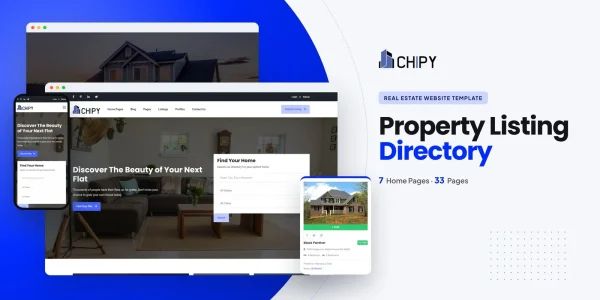
Chipy is a feature-dense real estate website template with 30 pages and a standout property comparison tool, letting buyers evaluate multiple listings side by side across key attributes like price, size, bedrooms, and location. For markets where buyers are weighing several properties at once, this comparison feature removes friction from the decision process and keeps shoppers engaged on your site rather than bouncing between tabs.
The 30-page scope gives Chipy the depth to serve a busy agency: multiple property listing layouts, detailed single-property pages, agent profiles, blog layouts, and the conversion-focused contact and inquiry pages that turn interest into leads. The design is modern and confident, with strong placement for property photography and clear navigation that helps buyers move from search to comparison to inquiry without getting lost. For an agency that wants to give buyers genuine decision-making tools, Chipy delivers.
Best for: Agencies in competitive markets where buyers compare multiple listings and benefit from side-by-side property comparison tools. View Live Demo
5. Estatee (13 Pages)
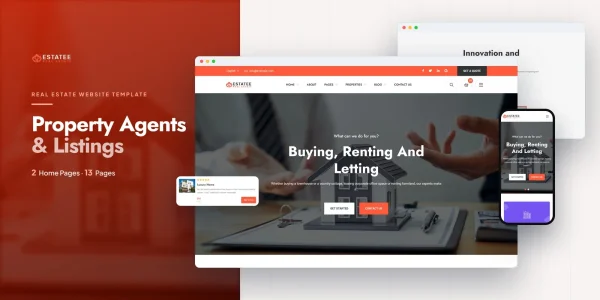
Estatee is the most compact template in this collection, and that is deliberate. At 13 pages, every page serves a clear purpose, with no padding you will never use. It is built for individual agents and small teams who want a focused, fast-launching real estate website that does the essential jobs well: showcase listings, present the agent’s credibility, and capture inquiries. The included wishlist feature lets buyers save the properties they love, a small touch that brings them back and signals which listings are generating the most interest.
The 13-page scope makes Estatee the quickest template here to customize and launch. If you need a professional real estate website live within days rather than weeks, this template gets you there without sacrificing design quality. The layout is modern and clean, with strong property-photo placement and a straightforward path from browsing to contact. For a solo agent who wants to compete online without investing months in a complex build, Estatee delivers excellent value per page.
Best for: Individual agents and small teams that want a fast-launching, focused real estate website with buyer wishlist functionality. View Live Demo
6. Highrise (15 Pages)
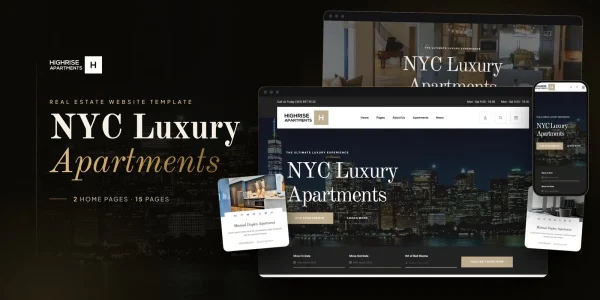
Highrise closes out the collection as the luxury specialist. Across its 15 pages and two distinct home layouts, it is purpose-built for the upscale end of the market: luxury apartment complexes, high-rise residential developments, premium rental agencies, and boutique property developers. The apartment-listings module gives each unit a detailed property page with full specifications, while the refined, image-forward design projects exactly the premium positioning a high-end listing needs to command attention in the first few seconds.
Highrise also ships the conversion tools a premium rental operation depends on. NiceSelect-enhanced filtering lets buyers narrow listings by the criteria that matter, DatePicker-powered booking turns interest into a scheduled viewing or reservation, and a dedicated offers-and-promotions section surfaces time-sensitive deals. Built on Bootstrap 5.3 with WOW.js scroll animations, Slick carousels, and a Magnific Popup lightbox for galleries, it is a polished, production-ready foundation for any brand competing at the luxury end of real estate.
Best for: Luxury apartment complexes, high-rise developments, and premium rental agencies that want a refined, booking-enabled real estate website with filtered property listings. View Live Demo
Essential Features Every Real Estate Website Needs
Whether you build from scratch or start with a real estate website template, these eight features are non-negotiable for any agent or agency competing online in 2026.
- Filterable property search. Buyers expect to search by location, price, property type, bedrooms, bathrooms, and square footage. A fast, filterable listing catalog with detailed property pages is the core of any real estate website and the feature buyers use most.
- IDX or MLS-ready listing structure. Your listings should be organized so they can connect to an IDX or MLS feed and stay current automatically. Stale, manually updated inventory erodes trust and wastes the lead’s time.
- Prominent lead capture forms. Inquiry forms on every listing, a “what’s my home worth” valuation form for sellers, and clear calls to action turn anonymous visitors into named, contactable leads. This is the website’s primary job.
- Mobile-responsive layout. With more than three quarters of home shoppers using a smartphone, your site must perform flawlessly on mobile, with tappable galleries and forms that are easy to complete with a thumb.
- Interactive maps and neighborhood data. Location sells property. Maps, neighborhood guides, and proximity to schools, transit, and amenities help buyers picture life in a home and keep them engaged on your site.
- High-quality image galleries. Large, fast-loading photo galleries on every listing are essential. Property photography is the single biggest driver of buyer interest, so it must be presented at its best on every device.
- Client testimonials and credentials. Visible reviews, sold-listing track records, agent photos, and certifications build the trust that wins listings and buyer representation. Display them prominently, not on a page nobody visits.
- Fast page load speed. Target under 2.5 seconds for Largest Contentful Paint. Compress images, minimize scripts, use a CDN, and choose a template built on a lightweight framework like Bootstrap 5.
Choosing the Right Template for Your Real Estate Business
Selecting a real estate website template starts with understanding your business model. A solo agent has different requirements than a multi-agent brokerage or a luxury property developer. Templates like Bestate and Chipy are built for established agencies with deep inventory and room to grow. Estatee and Aiga are designed for individual agents and small teams who want a focused, fast-launching site. Chipy adds a property comparison tool for competitive markets, Beibuild leads with photo-forward presentation, and Highrise brings a luxury-focused design with apartment listings and built-in viewing booking. Match the template’s architecture to your actual use case, not to whichever one has the longest feature list.
Page count is a practical indicator of scope, but more pages does not automatically mean a better fit. A 30-page template like Chipy gives you maximum flexibility, but it also demands more time to customize and populate with listings. A 13-page template like Estatee can be live in days. Consider your timeline and resources honestly. A fully customized 13-page site that launches next week will generate more leads than a half-finished 33-page project that never goes live. Every template in this article is built on Bootstrap 5 with clean, well-documented source code, so you can move from purchase to launch with minimal friction.
Budget matters, but consider it in context. A premium real estate website template costs a fraction of what custom development runs, and you get a professionally designed, tested, and documented starting point. The real cost is not the template purchase. It is the time required to customize it with your branding, listings, and content. Choose a template with clear documentation and well-organized code to minimize that effort, and prioritize the features that map directly to how you actually win business, whether that is property search, lead capture, comparison tools, or appointment booking.
Start Building Your Real Estate Website
The real estate market is only getting more competitive and more digital. Agents and agencies that invest in professional real estate web design now are building the brand equity and online presence that will carry their businesses forward as buyer behavior shifts further online. Every month you operate with an outdated website, or no website at all, is a month of lost leads, missed organic traffic, and weakened credibility against competitors who showed up looking sharper. The six templates featured in this article are not concepts or wireframes. They are production-ready, mobile-responsive, Bootstrap 5 templates built specifically for real estate.
Start by exploring the designs, testing the live demos, and identifying which template aligns with your business model. Then customize it with your branding, populate it with your listings, and launch. Your next client is already searching for a home, or for an agent to sell theirs, online right now. Make sure they find you. Browse All Real Estate Templates and pick the right foundation for your business.