The landscaping and lawn care industry in 2026 is a $176 billion market in the United States, with more than 600,000 businesses competing for homeowners and commercial clients who increasingly start their search online. In this environment, your website is not a digital business card you hand out at the end of a job. It is the first impression most prospects ever form of your company, the place where they judge the quality of your work before they ever speak to you, and the deciding factor in whether they request a quote or scroll on to a competitor. Professional landscaping website design is no longer optional. It is the price of entry.
Why Your Landscaping Website Is Your Most Important Asset
Most landscaping companies offer overlapping services: lawn maintenance, garden design, hardscaping, irrigation, tree care, and seasonal cleanup. When the service list on your site looks identical to the company three towns over, the differentiator becomes proof of work and the ease of getting in touch. A landscaping website that loads fast, showcases real before-and-after project photography, and makes requesting a quote effortless will win the client that a slower, harder-to-navigate competitor loses. This is not a theory. It shows up directly in lead volume, quote request rates, and the average value of the contracts you close.
Mobile traffic now accounts for the majority of landscaping website visits. Homeowners search for “landscapers near me” on their phones while standing in their own backyard, compare portfolios during a lunch break, and submit quote forms from the couch in the evening. If your landscaping website does not perform flawlessly on a 6-inch screen, you are effectively invisible to most of the people who could become customers. Every design decision, from navigation structure to how your gallery loads, must start with mobile and scale up to desktop, not the other way around.
First impressions carry outsized weight in a trade built on craftsmanship. A prospective client cannot inspect the quality of your stonework or planting design over the phone, so they judge it by the quality of your website. A site that looks outdated, loads slowly, or hides your portfolio behind clunky navigation signals that your fieldwork might be just as careless. A polished, well-organized landscaping web design does the opposite. It tells visitors that you sweat the details, and that is exactly the message a high-value landscaping client needs to hear before they invite you onto their property.
What Makes a Great Landscaping Website
A Project Portfolio That Sells the Work
The portfolio is the heart of any landscaping website. Clients buy what they can see, and nothing closes a landscaping lead faster than a gallery of completed gardens, patios, and lawn transformations that look like the result they want for their own property. The best landscaping website designs present projects in filterable grids, masonry layouts, and full-screen sliders, with individual project detail pages that tell the story of each transformation. A single thumbnail and two lines of copy is not competitive anymore. Prospects want to scroll through high-resolution photos, understand the scope of the work, and picture their own yard in its place. A landscaping website template built around a strong portfolio module gives you that structure from day one.
Clear Service Pages and Quote Capture
Landscaping is a services business, and your website needs to communicate exactly what you do and how to hire you. Dedicated service detail pages for lawn maintenance, garden design, hardscaping, irrigation, and seasonal care let you describe your process, set expectations, and rank for the specific terms clients search. Just as important is the path to contact you. A prominent “get a quote” section, a frictionless request form, and a visible phone number on every page turn a curious visitor into a qualified lead. A landscaping website template that bakes in service pages, a quote module, and clear calls to action removes the guesswork and shortens the distance between browsing and booking.
Mobile-First Performance
Google’s Core Web Vitals directly influence your search rankings, and image-heavy landscaping sites are frequently penalized for poor performance. Uncompressed portfolio photography, autoplaying background video, and bloated scripts push load times past the 3-second mark where most mobile users abandon a page. A quality landscaping website template is built on a lightweight framework like Bootstrap 5, with optimized assets, lazy-loaded galleries, and clean code that keeps your site fast even when it is packed with project imagery. Speed is not a vanity metric here. A slow gallery is a lost lead, because the homeowner comparing three landscapers will simply move on to the one whose photos appear instantly.
Mobile experience extends well beyond responsive breakpoints. Touch targets must be sized for thumbs, the portfolio filter must work without hiding behind a confusing menu, and the quote form must be completable in a handful of taps. Every unnecessary step between “I like this work” and “here is my contact information” costs you a lead. The strongest landscaping web design treats the small screen as the primary canvas and earns its conversions there.
Trust Signals and Local Credibility
Inviting a landscaping crew onto your property is a trust decision, and your website needs to actively earn that trust. Visible customer reviews, real team photos, before-and-after galleries, licensing and insurance details, service-area maps, and a clear company story all build the confidence a homeowner needs before reaching out. Generic stock imagery and a vague “about us” paragraph do not move the needle. Specificity does. A cohesive visual identity carried across every page, paired with genuine proof that you have done excellent work for real clients nearby, is what converts a first-time visitor into a booked estimate. The best landscaping website templates give every one of these trust elements a dedicated, well-designed place to live.
4 Landscaping Website Templates Worth Using in 2026
We evaluated every garden, plant, and landscaping template in the MetropolitanHost catalog and selected the four that deliver the best combination of design quality, feature depth, and real-world usability for a landscaping or lawn care business. Each one is built on Bootstrap, fully responsive, and available as a clean, production-ready HTML5 template. Here is the collection at a glance.
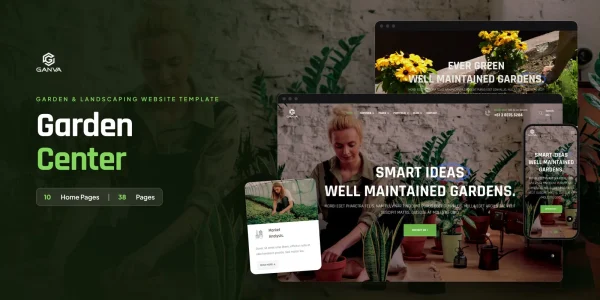
1. Ganva (39 Pages)
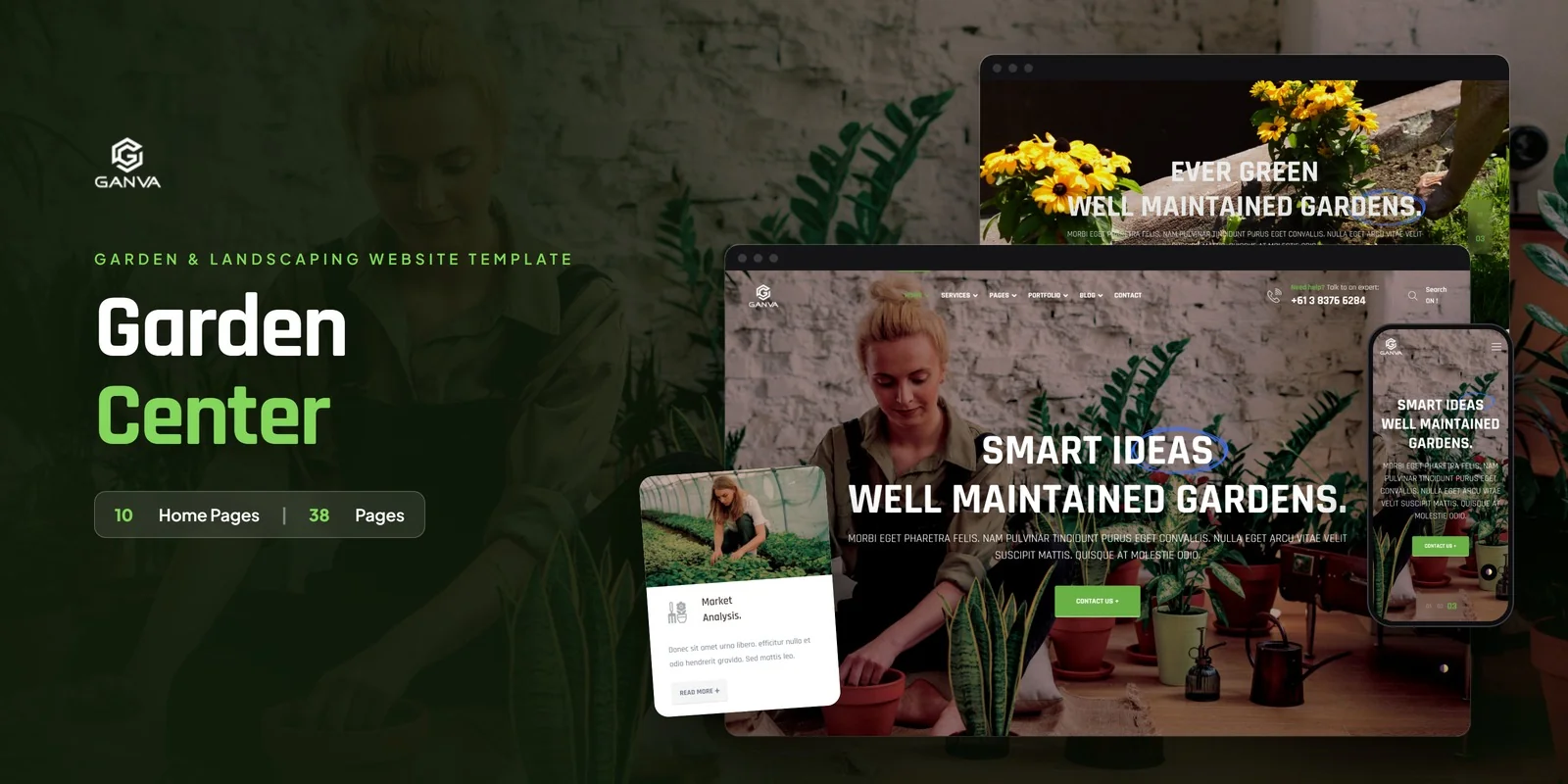
Ganva is the heavyweight of this collection and the most feature-dense landscaping template on the list. With 39 fully designed HTML5 pages and 10 unique home layouts, it gives a landscaping studio more design variety than almost any competitor, letting you test ten distinct hero treatments before settling on the one that best frames your work. The animation layer is the standout. GSAP scroll-triggered effects and Jarallax parallax bring seasonal planting and project photography to life, while a Swiper-powered portfolio carousel paired with Masonry grids and Isotope filtering lets clients browse your completed gardens by category without ever leaving the page.
Beyond the visual polish, Ganva ships with the full architecture a service business needs to look established: a services module with individual detail pages, a portfolio showcase with project detail pages, team profiles with individual bios, a testimonials page, and nine distinct blog formats for publishing seasonal guides and project case studies. That depth is exactly what a growing landscaping company wants when it expects to add services and team members over time. The 10 homepage variants also make Ganva a strong fit for design-led firms that want their site to feel as crafted as the gardens they build.
Best for: Established landscaping studios and garden design firms that want maximum design variety, rich animation, and room to grow across services, portfolio, and team. View Live Demo
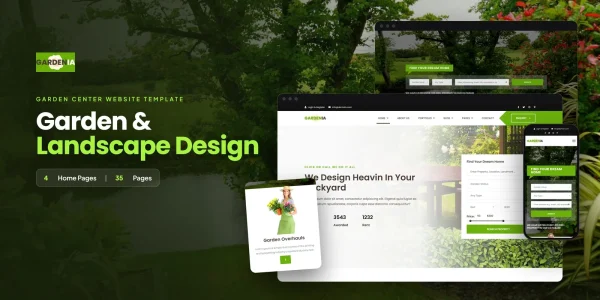
2. Gardenia (36 Pages)
Gardenia is built for landscaping companies that also sell garden supplies, blending a strong project portfolio with a full e-commerce shop. Across its 36 HTML pages and 4 unique home layouts, it pairs a multi-style portfolio with sidebar variants and a dedicated landscaping projects module against a four-layout shop for tools, plants, and garden products. Jarallax parallax hero sections and Swiper carousels give the design movement, while individual service and project detail pages let you document each transformation and each offering in depth. For a landscaping business that wants to showcase completed work and sell related products in the same place, Gardenia covers both jobs.
The template also includes a user profile dashboard, a gallery, six blog formats, an FAQ, and a coming-soon page, which makes it well suited to companies that want a content-rich, account-aware site rather than a simple brochure. The combination of a plant collection module and a landscaping projects module is unusual and genuinely useful: a garden center with a design-and-install arm can present both sides of the business under one cohesive identity. Gardenia is the most versatile pick here for operators who straddle retail and services.
Best for: Landscaping companies and garden centers that combine design-and-install services with a retail shop for plants, tools, and garden supplies. View Live Demo
3. Taouch (18 Pages)
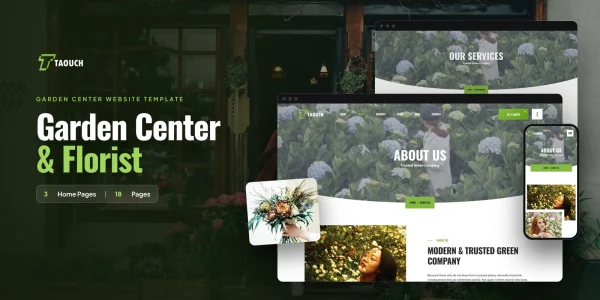
Taouch is a polished, services-driven template built specifically for garden centers, landscaping companies, and lawn-care brands that want to convert visitors into quote requests. Across its 18 HTML pages and 3 unique home layouts, it leads with a garden-project portfolio in grid, masonry, and slider formats, each with individual detail pages, backed by dedicated service pages for the core landscaping offerings: trees and plants, green grass and lawn care, garden maintenance, and watering and irrigation. That service structure maps cleanly onto how a real landscaping company actually packages and sells its work.
What makes Taouch convert is the trust-and-capture toolkit it ships with. An expert team directory with individual profiles puts faces to your crew, EasyPieChart and CountTo statistics quantify your experience, and a why-choose-us section plus a dedicated get-a-quote block guide visitors straight toward contacting you. A news module in grid and standard formats with article detail pages, plus an FAQ, rounds out a site designed to answer objections and close leads. For a landscaping or lawn-care business whose entire goal is more booked estimates, Taouch is the most purpose-built option in this lineup.
Best for: Lawn-care and landscaping service companies focused on generating quote requests, with strong team, statistics, and get-a-quote sections. View Live Demo
4. Legality (11 Pages)
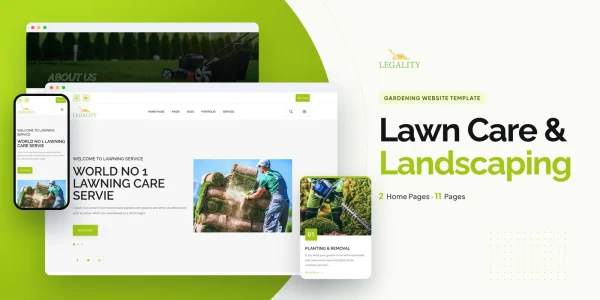
Legality is the most focused template in this collection, and that is exactly its strength. Built for landscaping companies, garden design services, lawn care businesses, and outdoor maintenance providers, its 11 HTML pages and 2 home layouts strip away everything a small landscaping firm does not need and concentrate on the essentials: an Isotope-filtered portfolio of completed garden and landscaping projects with individual project detail pages, a services module with individual service pages, and a blog with article detail pages for ongoing content. Slick carousels, an ionRangeSlider pricing filter, a Flaticon garden icon set, and a Magnific Popup lightbox give the portfolio a clean, professional finish without unnecessary weight.
The 11-page scope makes Legality the fastest template here to customize and launch. If you are a solo landscaper or a small crew that needs a credible, portfolio-forward website live within days rather than weeks, Legality gets you there without sacrificing design quality. Every page earns its place, the nature-inspired aesthetic suits the trade, and the lightweight build keeps the site fast even on mobile connections. For landscaping businesses that want to compete online quickly and affordably, Legality delivers excellent value per page.
Best for: Solo landscapers and small lawn care or garden design firms that want a fast-launching, portfolio-forward site without unnecessary complexity. View Live Demo
Essential Features Every Landscaping Website Needs
Whether you build from scratch or start with a landscaping website template, these eight features are non-negotiable for any landscaping or lawn care business competing online in 2026.
- A filterable project portfolio. Real before-and-after photography of completed gardens, patios, and lawns, organized in filterable grids or galleries with individual project pages. This is the single most persuasive element on a landscaping website.
- Mobile-responsive layout. Your site must function flawlessly on smartphones and tablets. With most landscaping searches happening on mobile, a poorly responsive site is functionally invisible to the majority of your prospects.
- Dedicated service pages. Separate, detailed pages for lawn maintenance, garden design, hardscaping, irrigation, and seasonal care let you explain your process and rank for the specific terms clients actually search.
- A clear quote-request path. A prominent get-a-quote section, a short request form, and a visible phone number on every page turn curious visitors into qualified leads with minimal friction.
- Trust signals and reviews. Genuine customer testimonials, team photos, licensing and insurance details, and service-area information reduce hesitation and build the confidence a homeowner needs before inviting a crew onto their property.
- A blog and content section. Regularly published seasonal guides, planting tips, and project case studies drive organic search traffic and position your company as the local landscaping authority.
- Local SEO and contact details. Your service areas, address, phone number, hours, and a map should be accessible from every page so that “landscapers near me” searches find and trust you.
- Fast page load speed. Target under 2.5 seconds for Largest Contentful Paint. Compress portfolio images, lazy-load galleries, minimize scripts, and choose a template built on a lightweight framework like Bootstrap 5.
Choosing the Right Template for Your Landscaping Business
Selecting a landscaping website template starts with understanding your business model. A solo landscaper or small crew has very different needs than an established design-build firm or a garden center that also sells retail. Templates like Ganva and Gardenia are built for larger operations with deep service menus, team directories, and, in Gardenia’s case, a full e-commerce shop. Taouch is purpose-built for lawn-care and landscaping companies whose entire goal is generating quote requests, with team, statistics, and get-a-quote sections doing the heavy lifting. Legality is designed for small firms that want a credible, portfolio-forward presence live quickly. Match the template’s architecture to your actual use case, not to whichever one has the longest feature list.
Page count is a practical indicator of scope, but more pages does not automatically mean a better fit. A 39-page template like Ganva gives you maximum flexibility and room to grow, but it also demands more time to customize and populate with real project content. An 11-page template like Legality can be live in days. Consider your timeline and resources honestly. A fully customized 11-page site that launches next week will generate more leads than a half-finished 39-page project that never goes live. Every template featured here is a clean HTML5 build, which means the lightest possible footprint and the fastest path to a fast, search-friendly landscaping website.
Budget matters, but consider it in context. A premium landscaping website template costs a fraction of what custom development runs, and you get a professionally designed, tested, and documented starting point. The real cost is not the template purchase. It is the time required to customize it with your branding, your project photos, and your service descriptions. Choose a template with clear documentation and well-organized code to minimize that effort. Every template in this list is built on Bootstrap with clean, commented source code and full documentation included, so your team spends its time on content and customization rather than fighting the framework.
Start Building Your Landscaping Website
The landscaping market is only getting more competitive. Companies that invest in professional landscaping web design now are building the brand equity and online presence that will carry their businesses forward as the industry matures and more of the buying decision moves online. Every month you operate with an outdated website, or no website at all, is a month of lost leads, missed organic traffic, and weakened credibility against competitors who took their digital presence seriously. The four templates featured in this article are not concepts or wireframes. They are production-ready, mobile-responsive, Bootstrap-based HTML5 templates built for the garden and landscaping industry.
Start by exploring the designs, testing the live demos, and identifying which template aligns with your business model. Then customize it with your branding, fill it with your real project photography, and launch. Your next client is already searching for a landscaper online. Make sure they find your work, not your competitor’s. Browse All Landscaping Templates and pick the right foundation for your business.