The construction industry is one of the largest sectors in the world, contributing more than $13 trillion to global GDP and accounting for roughly 13% of total economic output. In the United States alone, construction spending runs at an annualized rate of over $2 trillion, with more than 919,000 construction firms employing upward of 8 million workers. Yet despite the size and scale of the industry, the average construction company website lags years behind those of other sectors — and that gap is now costing real contracts. When 81% of buyers research a company online before making contact, and 75% of people judge a business’s credibility on its website design alone, your digital storefront is no longer optional. Choosing the right construction website template is one of the highest-leverage decisions a builder, contractor, or civil engineering firm can make this year.
The shift is being driven by how clients actually behave. More than 60% of all searches for local trade and construction services now happen on a mobile device, often from a job site or while standing in front of a half-finished property. If your pages take longer than three seconds to load, more than half of those visitors leave before they ever see your portfolio. Google’s Core Web Vitals — the loading, interactivity, and visual-stability metrics that feed directly into search rankings — punish slow, bloated, image-heavy sites, and construction sites are some of the heaviest on the web. A modern, performance-optimized construction website design built on a clean Bootstrap 5 foundation isn’t a nice-to-have; it’s the difference between appearing on page one and being invisible.
We evaluated dozens of construction and contractor templates across page depth, code quality, mobile performance, and the specific feature sets that win building contracts — project portfolios, service modules, appointment booking, and supply-shop integrations. In this guide we break down what actually makes a great construction website, walk through the must-have features, and showcase four production-ready construction website templates worth building on in 2026, each with a live demo you can explore before you commit.
Why Your Construction Website Is Your Most Important Asset
For a construction company, the website is the single most scalable sales tool you own. A field crew can be in one place at a time; a website works every hour of every day, presenting your completed projects, your safety record, and your service capabilities to every prospect who searches for a builder in your area. Unlike a billboard or a truck wrap, a well-built construction website captures intent at the exact moment a property owner, developer, or general contractor is actively looking to award work — and it routes that intent straight into your inbox.
Construction is a trust business. Clients are handing over six- and seven-figure budgets and trusting you with structures people will live and work inside. That trust is established long before the first phone call, and it is established visually. A dated, broken, or slow website signals a company that cuts corners; a sharp, fast, well-organized one signals a company that manages complexity well — exactly the impression a contractor needs to make. The right construction website template does this heavy lifting for you, packaging your credibility into a layout that has already been proven across thousands of construction businesses.
There is also a hard commercial reality: your competitors are catching up. The firms winning the most desirable residential and commercial contracts are increasingly the ones whose websites rank, load, and convert. A construction company that invests in a modern, mobile-first web presence today is building a moat — one that compounds as search engines reward the speed and structure of a clean Bootstrap 5 build. The website is not a brochure. It is your most important business-development asset, and it deserves a template built specifically for the way construction clients buy.
What Makes a Great Construction Website
Not every business template works for construction. The industry has specific demands — heavy project imagery, detailed service breakdowns, credibility signals, and lead-capture flows that match a long, considered buying cycle. A great construction website design is engineered around these realities. Here are the four pillars that separate a template that merely looks good from one that actually wins building contracts.
Project Portfolios and Case Studies That Prove Capability
Nothing sells construction work like finished construction work. The most important section of any builder’s site is the portfolio: a visual, filterable showcase of completed projects that lets a prospect see the quality, scale, and style of what you deliver. The best construction templates ship with grid and detail portfolio layouts, category filtering so a visitor can isolate residential from commercial or renovation from new-build, and dedicated project-detail pages where a single job can be told as a full case study — the brief, the challenge, the solution, and the result. This is where credibility is won, and it is the first thing a serious template must get right.
Mobile-First Performance for On-Site Decision Makers
Construction decisions are increasingly made in the field, on a phone, between site visits. A great construction website template is mobile-first by default — responsive grids, touch-friendly navigation, and image handling tuned for the heavy photography construction sites demand. Bootstrap 5 templates excel here because the framework’s mobile-first grid and lightweight footprint keep pages fast even when they are loaded with project photos. Fast, responsive pages don’t just satisfy visitors; they satisfy Google’s Core Web Vitals, directly improving where you rank for searches like “construction company near me” and “commercial contractor.”
Service Modules and Lead-Capture Built for Long Sales Cycles
A construction buyer rarely converts on the first visit. They research, compare, and return — which means your site has to both inform and capture. The strongest construction templates pair a structured services module, with individual detail pages for offerings like residential construction, commercial building, and renovation, with clear lead-capture: appointment-booking forms, consultation request flows, and prominent contact points. An integrated booking form with date scheduling turns a passive visitor into a booked consultation, shortening a sales cycle that can otherwise stretch for months.
Trust Signals, Team Profiles, and a Professional Blog
Because construction is a high-trust purchase, the surrounding content matters. Team profiles humanize the firm and showcase the experience behind the brand. Animated statistics — years in business, projects completed, square footage built — provide instant proof of scale. A blog or news module demonstrates expertise and feeds long-tail SEO, pulling in searches for everything from “how to choose a contractor” to “commercial renovation cost.” A great construction website template bundles these E-E-A-T signals natively, so your authority is built into the structure of the site rather than bolted on later.
4 Construction Website Templates Worth Using in 2026
After evaluating the full catalog, these four construction website templates stand out for their depth, code quality, and the specific construction features that convert visitors into contracts. Each is a production-ready HTML5 template built on a clean, responsive Bootstrap 5 foundation, and each ships with a live demo you can explore right now. They span the full range of construction needs — from the most comprehensive all-in-one build to a multi-purpose corporate powerhouse — so you can match the template to the way your firm actually sells.
1. Cali Constructions — The Most Complete Construction Template
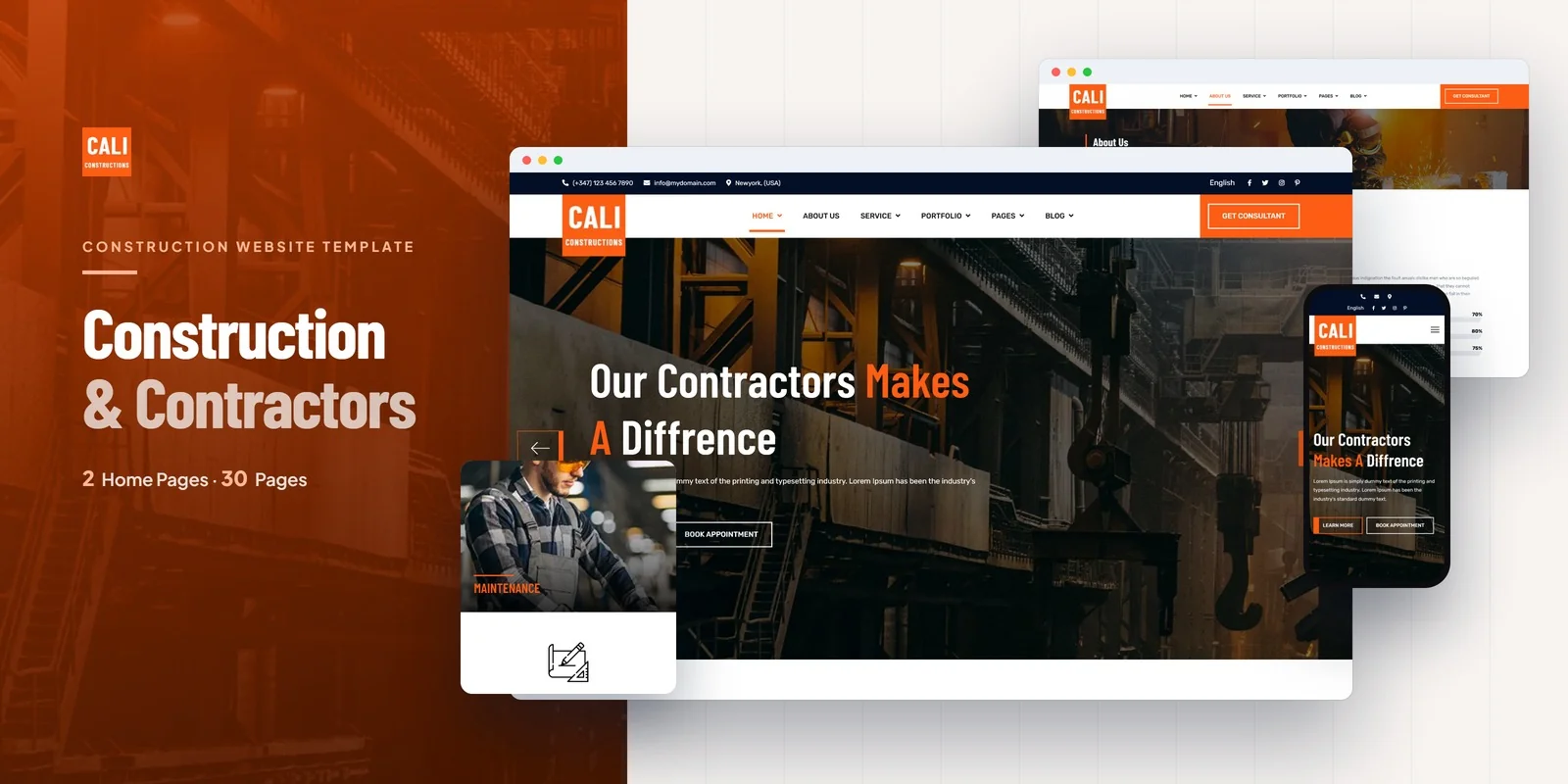
Cali Constructions is a robust HTML5 template purpose-built for construction companies, contractors, and building service firms, and it earns its place at the top of this list on sheer completeness. With an impressive 30 professionally designed pages, it covers every touchpoint a construction business website demands — from service showcases and project portfolios to e-commerce shop pages and a comprehensive blog system. Two distinct homepage designs anchor the template for different construction brand identities, supported by dual contact page styles, a FAQ section, a project gallery, and portfolio layouts in grid and detail views with sidebar options. The blog system runs across left-sidebar, right-sidebar, and standard layouts, while the full e-commerce shop provides product browsing and detail views in multiple column configurations — ideal if you sell construction supplies alongside your services. Built on Bootstrap and jQuery, it is fully responsive and optimized for the heavy imagery construction sites require.
Pages: 30 professionally designed pages, 2 homepage layouts, full e-commerce shop, grid and detail portfolio system, 6 blog variations.
Best for: Established construction firms that want a single, comprehensive template covering services, an extensive project portfolio, a supply shop, and a full blog — the most complete construction build available.
2. Convi — Multi-Purpose Corporate Power for Construction Brands
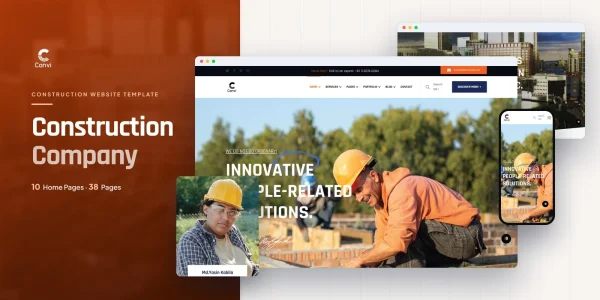
Convi is a versatile, feature-packed HTML5 template built for corporate enterprises, consulting firms, creative agencies, and construction companies of any scale — and it brings serious range to a builder’s web presence. With 38+ fully crafted HTML pages and 10 unique home layouts, Convi gives a construction company ten distinct ways to present its hero and services, so a national builder and a boutique renovation firm can both find a starting point that fits. It pairs that breadth with a comprehensive blog system featuring seven post formats and sidebar variants, a portfolio module, a full services section with detailed pages, team profiles, testimonials, and utility pages including coming-soon and 404 screens. Built on Bootstrap 5 with Swiper carousels, Fancybox lightbox, Isotope filtering, CountTo animated statistics, and Chart.js data visualisation, every feature is crafted for serious, credibility-driven business websites.
Pages: 38+ HTML pages, 10 unique home layouts, portfolio module, full services section, blog with 7 post formats, team and testimonial sections.
Best for: Larger construction companies and contractor groups that want maximum layout flexibility and a corporate-grade feature set, with ten homepage styles to test against their brand.
3. Metik — Portfolio-Driven Build for General Contractors
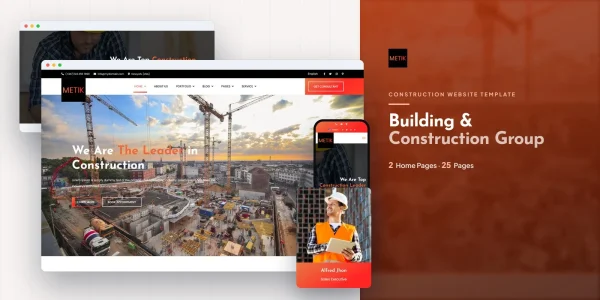
Metik is a robust, build-driven HTML5 template crafted for construction companies, general contractors, building firms, civil engineering teams, and home renovation services. Where it shines is the portfolio — Metik ships project showcases in three distinct layout variants with sidebar project-detail pages, plus a dedicated project gallery section, making it the standout choice for contractors whose work needs to be seen to be believed. Across its 26 fully crafted HTML pages and two homepage layouts, it organizes services and service-detail pages around real construction offerings like residential construction, commercial construction, and home maintenance, and rounds out the package with a blog in seven layout styles including gallery and video formats, FAQ pages, and a coming-soon page. Isotope category filtering lets visitors slice your project archive by type, while Swiper and Slick carousels and a Magnific Popup lightbox give the heavy project imagery the polished presentation it deserves.
Pages: 26 HTML pages, 2 homepage layouts, portfolio in 3 layout variants with project-detail pages, project gallery section, blog in 7 styles, FAQ pages.
Best for: General contractors and renovation firms whose sales hinge on showing the work — three portfolio variants plus a project gallery make completed projects the centerpiece.
4. Fornia — Booking-Ready Build for Contractors and Renovators
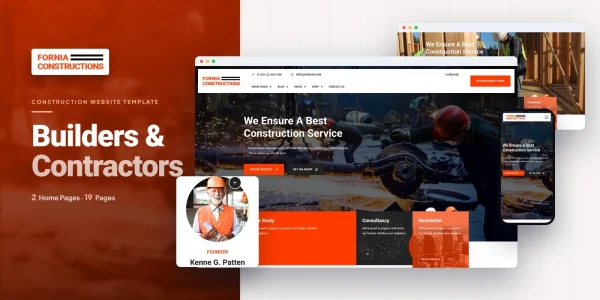
Fornia is a bold, professional HTML5 template built for construction companies, building contractors, renovation firms, civil engineering businesses, and construction project-management companies — and its standout strength is turning visitors into booked consultations. With 19 fully crafted HTML pages and two unique home layouts, Fornia centers on a services module with individual detail pages, completed-project case studies, a construction-supplies shop, and an appointment-booking form with DatePicker scheduling that lets a prospect lock in a consultation without ever picking up the phone. A renovation firm can combine the supplies shop with a Slick-powered project showcase and countdown promotions, while a civil engineering business can build credibility through team profiles and an editorial blog across its three blog formats. Built on Bootstrap 5 with ion.rangeSlider, a countdown timer, Slick carousels, and a Magnific Popup lightbox, every section is crafted specifically for the construction and building industry.
Pages: 19 HTML pages, 2 home layouts, services module with detail pages, case studies, construction-supplies shop, appointment-booking form with DatePicker, 3 blog formats.
Best for: Contractors and renovation firms that want lead capture front and center — the built-in appointment-booking form with date scheduling turns site traffic into booked consultations.
Essential Features Every Construction Website Needs
Whichever construction website template you choose, certain features are non-negotiable. These are the elements that separate a site that simply exists from one that consistently generates qualified construction leads. Use this checklist to evaluate any template before you commit to a build.
- A filterable project portfolio with grid, detail, and category views so prospects can see proof of your residential, commercial, and renovation work.
- A structured services module with individual service-detail pages for each offering, from new-build construction to maintenance and renovation.
- An appointment or consultation booking form — ideally with date scheduling — so on-site decision makers can lock in a meeting in seconds.
- Mobile-first responsive design on a Bootstrap 5 grid that stays fast even when loaded with heavy project photography.
- Animated statistics and trust signals — years in business, projects completed, square footage built — to prove scale at a glance.
- Team and about sections that humanize the firm and surface the experience behind your construction brand.
- A blog or news module to demonstrate expertise, target long-tail searches, and feed your construction SEO over time.
- An optional e-commerce or supplies shop for firms that sell materials or products alongside their construction services.
Choosing the Right Template
The right choice comes down to how your construction firm sells. If you want the most comprehensive all-in-one build with a supply shop and the deepest page count, Cali Constructions and its 30 pages is the safest bet. If you are a larger company or contractor group that values layout flexibility and a corporate-grade feature set, Convi’s 38+ pages and ten homepage layouts give you room to test and scale. If your work needs to be seen to be sold, Metik’s three portfolio variants and project gallery put completed projects front and center. And if lead capture is your priority, Fornia’s built-in appointment-booking form with date scheduling is purpose-built to turn traffic into booked consultations.
Beyond fit, evaluate every construction website template against three practical criteria. First, code quality: a clean, well-documented Bootstrap 5 build is far easier to customize and far faster to load than a bloated, dated one. Second, page depth: make sure the template actually includes the pages you need — services, portfolio, booking, blog — so you are not rebuilding core sections from scratch. Third, performance: heavy construction imagery makes speed the make-or-break factor for both visitors and Core Web Vitals, so favor templates engineered to stay fast under load. Each of the four templates above clears all three bars; the decision is simply which feature emphasis matches your sales motion.
Whichever direction you lean, resist the temptation to over-buy. A focused 19-page booking-driven template that matches how you actually win work will outperform a sprawling build you never fully populate. Pick the construction template that mirrors your sales process, customize the homepage and portfolio to your brand, and get it live — momentum beats perfection in lead generation every time.
Start Building Your Construction Website
A modern, fast, conversion-focused website is now the deciding factor in which construction firms win the most desirable contracts. Each of the four construction website templates in this guide is production-ready, built on a clean Bootstrap 5 foundation, and engineered around the features that actually move construction buyers — filterable portfolios, structured services, appointment booking, and the trust signals that close high-value work. Explore the live demos, match a template to the way your firm sells, and you can have a professional construction website live in days, not months.
Ready to build? Browse All Construction Templates to compare every construction and contractor template in the catalog, explore their live demos, and choose the foundation for your next construction website design. The contracts you win next year start with the website you build today.