What Is a Veterinary Clinic Website Template?

A veterinary clinic website template is a pre-designed, fully coded website built specifically for veterinary practices, animal hospitals, pet wellness centres, mobile vet services, and pet health product retailers. It includes every page a vet clinic needs — homepage with service overview and emergency contact information, detailed service pages for each treatment type, appointment booking form for scheduling visits, pet health product shop with price range filtering, case study pages showcasing treatment outcomes, team profiles with veterinary credentials, client testimonials with animated statistics, blog for pet care education, and contact page with location map and booking enquiry — all designed, responsive, and ready for your practice brand.
For veterinary clinics that need a professional web presence without paying $8,000 to $25,000 for a custom build or $200 to $500 per month for a managed veterinary platform subscription, a template delivers the most practical path to a client-generating online presence. But veterinary websites face a unique emotional challenge: pet owners are making healthcare decisions for family members who cannot speak for themselves. The trust threshold is extraordinarily high. Your website must communicate clinical competence, genuine compassion, and proven treatment outcomes before a pet owner will entrust their animal’s health to your practice. This guide covers what pet owners expect from your website, what technical features drive appointment bookings, and how to choose the right template for your veterinary practice.
Template vs Veterinary Platform vs Custom Build
Veterinary practice owners typically face three options when establishing their online presence:
| Factor | Vet Platform (PetDesk, Vetter) | Veterinary Clinic Website Template | Custom Website Build |
|---|---|---|---|
| Upfront Cost | $0–500 | $29–69 | $8,000–25,000 |
| Monthly Cost | $200–500/month | $3–10/month (hosting only) | $75–250/month |
| 3-Year Total Cost | $7,200–18,500 | $137–429 | $10,700–34,000 |
| Code Ownership | No — you rent it | Yes — you own it forever | Yes — you own it |
| Design Uniqueness | Same as every competitor clinic | Fully customisable source code | Fully custom |
| Appointment Booking | Built-in | Built-in booking form | Custom development required |
| Pet Health Shop | Basic or none | Full shop with price filtering | Any format |
| Case Studies | None or basic | Archive + detail pages | Any format |
| Vendor Lock-in | High — client data at risk | None | None |
Veterinary platforms like PetDesk and Vetter offer appointment management and client communication tools but charge monthly fees that compound into significant overhead. A $350/month platform costs $12,600 over three years — funds that could purchase diagnostic equipment, hire support staff, or invest in continuing education. A template provides the client-facing website that generates new patients and builds practice credibility, while allowing integration with any scheduling or practice management tool through embedded forms or API links.
What Pet Owners Expect From Your Veterinary Website
American households now spend $41.4 billion annually on veterinary care, with 95 million households owning at least one pet. The average household spends approximately $1,700 per year on pet care, with veterinary services representing roughly a third of that total. Competition among veterinary practices is intensifying, and pet owners are increasingly researching clinics online before making their first appointment. Over 60 percent of veterinary website traffic now comes from mobile devices. Here is what pet owners evaluate when choosing a veterinary practice:
Emergency Contact Information Above the Fold
Pet emergencies do not follow business hours. The single most important element on any veterinary website is a prominently displayed emergency contact number visible without scrolling. Pet owners in distress are not going to navigate through menus to find a phone number — it must be immediately visible on every page, ideally in the header. After-hours emergency protocols, relationships with emergency veterinary hospitals, and triage guidance should be clearly accessible from the homepage. A template with a strong header section that accommodates prominent phone display and emergency messaging is essential for veterinary use.
Species-Specific Service Pages
Pet owners want to see that your practice has specific expertise with their type of animal. A dog owner needs to see canine vaccination schedules, dental care, orthopaedic services, and breed-specific health management. A cat owner wants to know you understand feline behaviour, offer fear-free handling, and provide specialised feline wellness programmes. Exotic pet owners need confirmation that your practice has the equipment and expertise for avian, reptile, or small mammal care. Individual service detail pages — not just a generic list — demonstrate the depth of expertise that builds trust with each type of pet owner.
Appointment Booking Without Friction
Pet owners increasingly expect online appointment booking rather than phone-only scheduling. A dedicated appointment booking form that captures pet information, reason for visit, preferred date and time, and owner contact details converts website visitors into confirmed appointments. The booking form should be accessible from every page — a prominent “Book Appointment” button in the header and throughout service pages ensures that the moment a pet owner decides to visit, the path to booking is immediate. Forms that require registration or excessive fields lose busy pet owners who simply want to schedule a visit.
Veterinary Team Credentials and Compassion
Pet owners are entrusting their family member’s health to your team. They want to know who will be examining their pet before they arrive. Team profiles showcasing veterinary degrees, board certifications, areas of specialisation, years of experience, and personal pet ownership build the trust that drives first appointments. Real photographs of veterinarians examining animals — not stock photos — build trust faster than any testimonial. Pet owners want to see the faces and read the credentials of the people who will care for their animals. A team page with individual vet profiles, specialisation details, and personal touches about their own pets creates the emotional connection that distinguishes your practice from competitors.
Treatment Outcomes and Case Studies
Case studies showcasing treatment outcomes are the veterinary equivalent of before-and-after portfolios. A dog recovering from orthopaedic surgery, a cat’s dental transformation, a successful treatment of a complex condition — these stories demonstrate clinical competence through real results. Case study pages with treatment description, approach, outcome, and recovery timeline provide the clinical credibility that pet owners evaluate when choosing between practices. Filterable case study archives organised by treatment type or species allow pet owners to find evidence relevant to their specific veterinary need.
Pet Health Product Shop
Many veterinary practices generate significant supplementary revenue through pet health product sales — prescription diets, supplements, dental care products, flea and tick prevention, grooming supplies. An integrated e-commerce shop with price range filtering allows pet owners to purchase veterinarian-recommended products directly from your practice. This convenience strengthens the client relationship, generates recurring revenue, and positions your practice as a comprehensive pet health resource rather than just a treatment facility. Product pages with veterinary recommendations and usage guidance add clinical value that differentiates your shop from generic online pet retailers.
Educational Content That Builds Authority
Pet owners search for health information constantly — “why is my dog limping,” “cat not eating,” “puppy vaccination schedule,” “signs of arthritis in dogs.” A blog with authoritative veterinary content captures these searches, positions your practice as a trusted health resource, and brings your clinic to the attention of pet owners who did not know you existed. Educational blog content also provides value between appointments, keeping your practice relevant to clients year-round rather than only when their pet is sick.
Mobile-First Experience
With over 60 percent of veterinary website traffic coming from mobile devices, responsive design is non-negotiable. Pet owners searching “vet near me” or “animal hospital [city]” are on their phones, often during urgent situations. Your website must load fast, display emergency contact information immediately, and provide click-to-call functionality. Mobile-optimised appointment booking forms, service pages, and shop functionality ensure that the majority of your website visitors have a seamless experience.
Technical Features That Drive Veterinary Appointments
Beyond visual design, certain technical features specifically enhance veterinary clinic websites and improve patient acquisition.
Appointment Booking Form
A dedicated appointment booking page that captures pet name, species, breed, age, reason for visit, preferred date and time, and owner contact information is the most direct conversion tool on any veterinary website. This booking form eliminates the phone-tag friction that loses busy pet owners — particularly younger demographics who prefer online scheduling over phone calls. The form should validate required fields and provide confirmation feedback, creating a professional booking experience that reflects the quality of care your practice delivers.
E-Commerce Shop with Price Range Filtering
The ion.rangeSlider-powered price range filter allows pet owners to browse health products within their budget. Whether shopping for premium prescription diets or affordable dental chews, price filtering helps visitors find products quickly without scrolling through irrelevant items. Combined with product detail pages, cart, checkout, and wishlist functionality, the full e-commerce module provides a complete online shopping experience for veterinary-recommended pet health products.
Isotope Filterable Case Studies
Isotope provides animated, category-based filtering for case study archives. Pet owners click treatment categories — Surgery, Dental, Wellness, Emergency, Dermatology, Orthopaedics — and the archive rearranges to show only matching case studies. This targeted browsing helps pet owners evaluate your specific expertise in the treatment their pet needs, directly improving appointment quality and conversion rates.
CountTo Animated Practice Statistics
CountTo triggers animated number counting when practice statistics scroll into view — patients treated, surgical procedures completed, years of practice, satisfied pet families. For veterinary practices competing against other clinics in their area, these animated credibility metrics demonstrate experience and scale. A practice showing “25,000+ patients treated” and “15+ years serving the community” communicates the reliability that pet owners associate with established, trusted healthcare providers.
EasyPieChart Progress Indicators
EasyPieChart creates animated circular progress indicators that work well for displaying practice performance metrics — patient satisfaction rates, treatment success rates, same-day appointment availability, emergency response statistics. These visual indicators make practice credentials immediately understandable, providing quantitative credibility that complements qualitative testimonials.
Cost Breakdown: Veterinary Clinic Website Options
Veterinary practices face rising costs across equipment, staffing, and continuing education. Understanding the true cost of each website approach helps practice owners protect their margins:
| Cost Component | HTML Template | Vet Platform (PetDesk) | Custom Build |
|---|---|---|---|
| Template / License | $29–69 (one-time) | $0 | N/A |
| Hosting | $36–120/year | Included | $120–600/year |
| Platform Fee | None | $2,400–6,000/year | None |
| Appointment Booking | Built-in form | Built-in | $1,500–4,000 custom |
| Pet Health Shop | Built-in with price filtering | Basic or none | $3,000–8,000 custom |
| Design Customisation | $0–500 | $0–200 | $5,000–15,000 |
| Total Year One | $65–689 | $2,400–6,700 | $9,620–27,600 |
| 3-Year Total | $137–929 | $7,200–18,500 | $9,860–28,800 |
Revenue Per Dollar Invested: A veterinary practice spending $350/month on a website platform spends $4,200 per year. At an average new client value of $250 for the first visit (exam, vaccines, diagnostics), that platform fee equals 17 lost new clients annually — revenue that could fund diagnostic equipment upgrades, staff training, or practice expansion. An HTML template at $29–69 preserves that budget for the clinical improvements that directly improve patient outcomes and practice growth. With 20 pages including appointment booking, a full health product shop with price filtering, and case study showcasing, the template delivers more client-facing features than most platforms at a fraction of the cost.
How to Choose the Right Veterinary Clinic Template
Not all templates serve the veterinary industry effectively. Here is what to evaluate specifically for veterinary practice use:
Check for an Appointment Booking Form
This is the single most important differentiator. A veterinary template with a built-in appointment booking form immediately outperforms any template without one. The booking form is how pet owners convert from website visitor to confirmed patient — it replaces phone-tag scheduling with a professional, convenient experience that modern pet owners expect. If the template does not include a dedicated booking page, you will need custom development to add one — which can cost $1,500–4,000 and defeat the purpose of buying a template.
Evaluate E-Commerce Depth
Navigate to the shop section. Does it include product archive pages, individual product detail pages, a functional cart, checkout flow, and wishlist? Is there price range filtering for browsing health products by budget? Pet health product sales represent a significant revenue stream for veterinary practices — templates without a robust shop module miss this supplementary income opportunity.
Count the Page Depth
A comprehensive veterinary template should include: multiple homepage layouts, individual service pages for each treatment type, appointment booking page, case study archive and detail pages, full e-commerce shop with product pages and checkout, team profiles, blog in multiple formats, FAQ, authentication pages, and contact page. Templates with 18+ pages provide the structural depth needed to present a full veterinary practice. Templates under 12 pages often leave critical service or booking pages missing.
Test the Case Study Structure
Check whether case study pages provide enough structure for detailed treatment descriptions with approach, outcome, and recovery information. Veterinary case studies are your most powerful credibility tool — the template must provide the layout structure to present treatment stories with the clinical detail and emotional resonance that influences pet owner decisions.
Common Mistakes When Building a Veterinary Website
Burying Emergency Contact Information
The most critical mistake on any veterinary website is making emergency contact information hard to find. Pet owners in distress have zero patience for navigation — your emergency number must be visible on every page, ideally in the header. After-hours protocols, emergency facility referrals, and triage guidance should be one click from the homepage. Every second a panicked pet owner spends searching for your phone number is a second they might call a competitor instead.
Generic Service Descriptions
“We offer comprehensive veterinary services” communicates nothing. Pet owners want species-specific, treatment-specific details. Individual service pages for wellness exams, vaccinations, dental care, surgery, emergency care, dermatology, diagnostics, and specialised treatments — each with clear descriptions of what the service includes, when it is recommended, and how it benefits their pet — demonstrate the clinical depth that distinguishes a thorough practice from a generic one.
No Case Studies or Treatment Evidence
A veterinary website without case studies is making claims without evidence. “We provide excellent surgical care” is a claim. A case study showing a successful fracture repair with treatment timeline and recovery outcome is evidence. Pet owners evaluating practices for complex treatments or surgeries want to see proof that your team delivers results. Every successful treatment is a potential case study — build the habit of documenting treatment outcomes, and your website becomes an ever-growing portfolio of clinical excellence.
Ignoring the Product Revenue Opportunity
Many veterinary websites treat product sales as an afterthought. Yet pet health products — prescription diets, supplements, parasite prevention, dental care — represent a recurring revenue stream that strengthens client relationships. An integrated e-commerce shop on your veterinary website positions your practice as a one-stop pet health destination. Pet owners who buy products from your practice are more engaged, more loyal, and more likely to return for future appointments. Templates with robust shop modules and price filtering make this revenue stream accessible without custom development.
Petco — A Veterinary Template Built for Practice Excellence
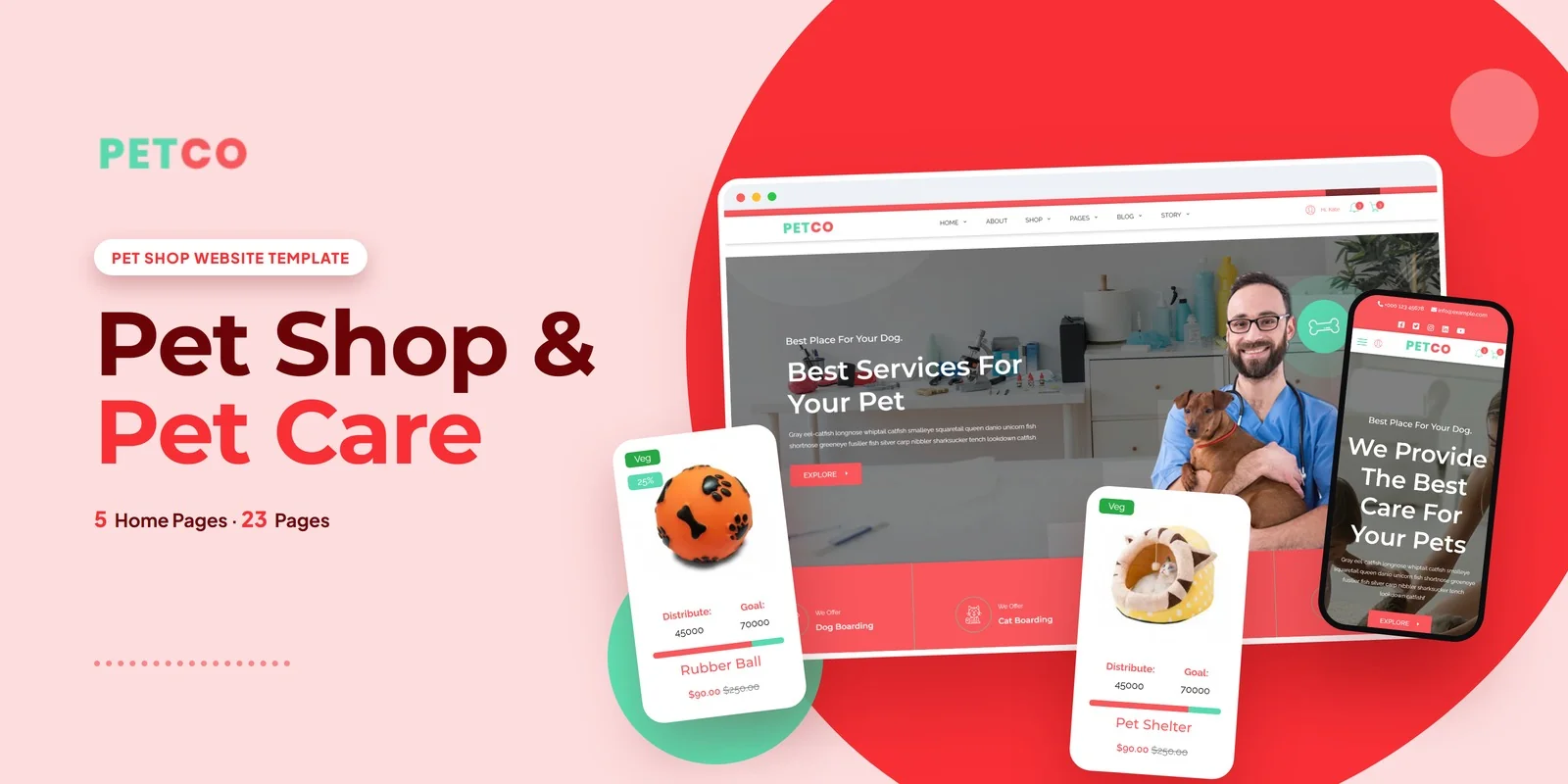
Petco is a medical clinic and healthcare e-commerce HTML5 template designed to meet every veterinary practice requirement outlined in this guide. Built for veterinary clinics, animal hospitals, pet wellness centres, and health-focused pet product retailers, it delivers the most comprehensive healthcare web presence — with 20 pages, an appointment booking form, a full e-commerce shop with price range filtering, case study showcasing, team profiles, and a complete blog section.
What Petco Includes
- 20 Fully Designed HTML5 Pages — complete veterinary practice web presence from homepage to checkout
- 2 Unique Home Layouts — distinct hero styles for different practice personalities and seasonal campaigns
- Appointment Booking Form — dedicated booking page for scheduling patient visits
- Full E-Commerce Shop — product archive, detail pages, cart, checkout, and wishlist for pet health products
- Price Range Slider — ion.rangeSlider for filtering health products by budget
- Case Studies Module — treatment portfolio archive plus individual case detail pages
- Services Module — services overview plus individual service detail pages for each treatment type
- Team Page — veterinary staff profiles grid with credentials and specialisations
- Blog Module (3 Formats) — grid, list, and full-article detail formats for pet health education
- CountTo Animated Statistics — patients treated, surgeries completed, years of practice
- EasyPieChart Progress Rings — animated circular indicators for practice performance metrics
- Authentication Module — login and registration pages for client accounts
- Slick Carousel — rotating testimonials, partner showcases, and service highlights
- Magnific Popup Lightbox — full-screen case study and facility photo viewing
Technical Foundation
Petco is built on Bootstrap 4 with Slick Carousel for testimonial and showcase rotations, Isotope grid filtering for case study and product browsing by category, ion.rangeSlider for price range filtering on the pet health product shop, Magnific Popup lightbox for full-screen image viewing, CountTo for animated practice statistics, EasyPieChart for progress indicator displays, Mean Menu for clean mobile navigation, and Chart.js for data visualisation. The dedicated appointment booking form — combined with a full e-commerce shop, case study portfolio, and client authentication — provides the integrated healthcare web experience that modern veterinary practices require.
The Healthcare E-Commerce Advantage: Petco combines clinical web presence with revenue-generating e-commerce in a single template. The appointment booking form converts website visitors into confirmed patients, while the full shop module with price range filtering generates supplementary revenue through pet health product sales. Case study pages demonstrate treatment competence through documented outcomes, team profiles build trust through visible credentials, and the blog module positions your practice as a pet health authority. At 20 pages with dedicated booking, shopping, and authentication functionality, Petco provides the depth that veterinary practices need without custom development — while competing platforms charge $200–500/month for comparable features.
Customisation Roadmap for Veterinary Clinics
Week One — Branding and Core Clinical Content: Photograph your facility, examination rooms, surgical suite, and team in action. Capture genuine moments of veterinary care — examinations, wellness visits, recovery celebrations. Replace all placeholder content, adjust brand colours to match your practice identity, and write individual service pages for each treatment type with clear descriptions of what each service includes, when it is recommended, and what pet owners should expect.
Week Two — Booking, Shop, and Team: Configure the appointment booking form with your service types, available time slots, and required patient information fields. Set up the pet health product shop with your product inventory, categories, and pricing. Create team profile pages with veterinary degrees, board certifications, specialisation areas, and personal touches about each vet’s own pets. Begin documenting case studies from recent successful treatments with anonymised patient details, treatment approach, and outcome description.
Week Three — Content, SEO, and Launch: Write your first three blog posts — a seasonal pet health checklist, a guide to choosing the right preventative care plan, and an introduction to your team and practice philosophy. Set up Google Business Profile with accurate hours, services, and emergency information. Configure Google Analytics 4 and conversion tracking on the appointment booking form and shop checkout. Test across all devices with emphasis on mobile emergency access. Deploy and submit to Google Search Console.
Frequently Asked Questions
Need Help Launching Your Veterinary Clinic Website?
MetropolitanHost provides professional web development services for HTML template deployments. Our team understands healthcare and veterinary industry website requirements and delivers clean, conversion-optimised implementations.
- WordPress Theme Installation — live in under 24 hours
- Full Website Package — complete front-to-back deployment
- Colour Customisation — match your practice brand across all pages
- Website Speed Optimisation — Core Web Vitals improvements
- Accessibility Compliance — WCAG audit and remediation