The spa and wellness industry in 2026 is a serious business, not a luxury afterthought. The global spa market is worth well over $100 billion and growing at a steady clip every year, driven by a culture that finally treats self-care, recovery, and stress relief as essentials rather than indulgences. In a sector this crowded, your website is no longer a digital brochure that sits quietly in the background. It is your reception desk, your treatment menu, your booking line, and your first impression all at once. A polished spa website template is what separates a fully booked treatment calendar from empty appointment slots.
Why Your Spa Website Is Your Most Important Asset
Most spas in a given city offer overlapping services. Swedish massage, deep tissue, hot stone, facials, body wraps, and aromatherapy appear on nearly every menu within a few miles of each other. When the treatments themselves look interchangeable, the deciding factor becomes the experience a prospective client has before they ever walk through your door. A spa website that loads fast, communicates calm, and makes booking effortless will win the client that a slower, cluttered competitor loses. This is not a soft branding claim. It is measurable in booking conversion rates, average ticket value, and how often first-time guests return.
Mobile traffic now accounts for the overwhelming majority of spa website visits. People search for “massage near me” on their phones during a stressful afternoon, compare day-spa packages during a lunch break, and book a couples treatment from the sofa on a Sunday night. If your spa website does not perform flawlessly on a 6-inch screen, you are effectively invisible to most of the clients actively looking for exactly what you offer. Every design decision, from the size of your booking button to how your treatment menu reflows on a narrow screen, has to start with mobile and scale up to desktop.
First impressions carry extra weight in wellness. A spa sells relaxation, trust, and the promise of feeling better, and your website has to communicate all three within seconds. A client who lands on a dated, slow, or chaotic page subconsciously assumes the treatment room will feel the same way. A serene, professional spa web design does the opposite: it lowers the guard, signals quality, and makes the decision to book feel safe. In an industry built entirely on how people feel, your website is the most powerful credibility tool you own.
What Makes a Great Spa Website
A Calming, Sensory Visual Identity
The single most important job of a spa website is to make the visitor feel calm before they have read a word. That feeling comes from generous white space, soft and natural color palettes, unhurried typography, and large, atmospheric imagery of treatment rooms, hands at work, and serene environments. A great spa website template builds these principles into its layout so you are not fighting the design to achieve a sense of calm. Crowded grids, harsh contrasts, and aggressive pop-ups break the spell instantly. The best wellness web design treats restraint as a feature, giving each element room to breathe the same way a good treatment gives the body room to relax.
Imagery is where this lives or dies. Full-width hero sections, lightbox galleries, and before-and-after showcases let prospective clients picture themselves in your space. A spa website template built for the industry includes these gallery patterns natively, with image popups and filterable grids that present your atmosphere and your results without forcing you to bolt on third-party plugins.
A Clear Treatment Menu and Service Pages
Your treatments are your products, and clients want to understand them before they commit. That means a structured services module: an overview page that lays out your full menu at a glance, plus individual service detail pages for signature treatments where you can explain the technique, the benefits, the duration, and the price. A spa website that hides its menu behind a single vague paragraph leaves the visitor guessing, and a guessing visitor does not book. The strongest spa website designs give each treatment category its own clearly organized space, so a client researching prenatal massage finds exactly what they need without wading through your entire facial lineup.
Service detail pages also do quiet SEO work. A dedicated, well-written page for “hot stone massage” or “lymphatic drainage facial” is far more likely to rank for those specific searches than a single catch-all services page. A template that ships with a proper services-plus-detail architecture gives you that ranking surface from day one.
Frictionless Booking and Contact
The entire purpose of a spa website is to turn interest into a booked appointment. Every extra tap between “I want this” and “I’m booked” costs you clients. The best spa templates put booking and contact front and center: a persistent call-to-action in the header, clear enquiry forms, prominent phone numbers, and a contact page with an embedded map and hours. Whether you take bookings directly through an integrated form or route clients to a scheduling tool, the path has to be obvious and short. Friction at this exact moment is the most expensive friction on the entire site.
Trust signals belong right alongside that booking path. Therapist and practitioner profiles with real credentials, genuine client testimonials, and animated statistics like treatments performed and years in practice all reduce the hesitation a first-time guest feels. A spa website template that includes team profile pages, testimonial sections, and counter-style achievement stats gives you the building blocks to convert a cautious browser into a confident booking.
Speed, Mobile Performance, and Search Visibility
Google’s Core Web Vitals directly influence where your spa appears in search results, and image-heavy wellness sites are frequently penalized for slow performance. Uncompressed treatment photography, heavy background video, and bloated scripts push load times past the point where most mobile users abandon a page. A quality spa website template is built on a lightweight framework with optimized assets and lazy loading, so the atmospheric imagery that sells your space does not sabotage your rankings. Target under 2.5 seconds for Largest Contentful Paint, and treat every additional second as lost bookings.
Mobile usability goes beyond simply shrinking the layout. Touch targets need to be large enough for thumbs, treatment filters have to work on narrow screens, and the booking form must be completable one-handed. A spa website template engineered mobile-first handles all of this for you, so a client booking from their phone has exactly the same effortless experience as one on a desktop.
4 Spa Website Templates Worth Using in 2026
We evaluated the full collection of spa and wellness templates in the MetropolitanHost catalog and selected the four HTML5 templates that deliver the best combination of calming design, feature depth, and real-world usability. Each one is fully responsive, built for the spa and wellness market, and available as a clean, well-documented HTML5 template. Here is the collection at a glance.
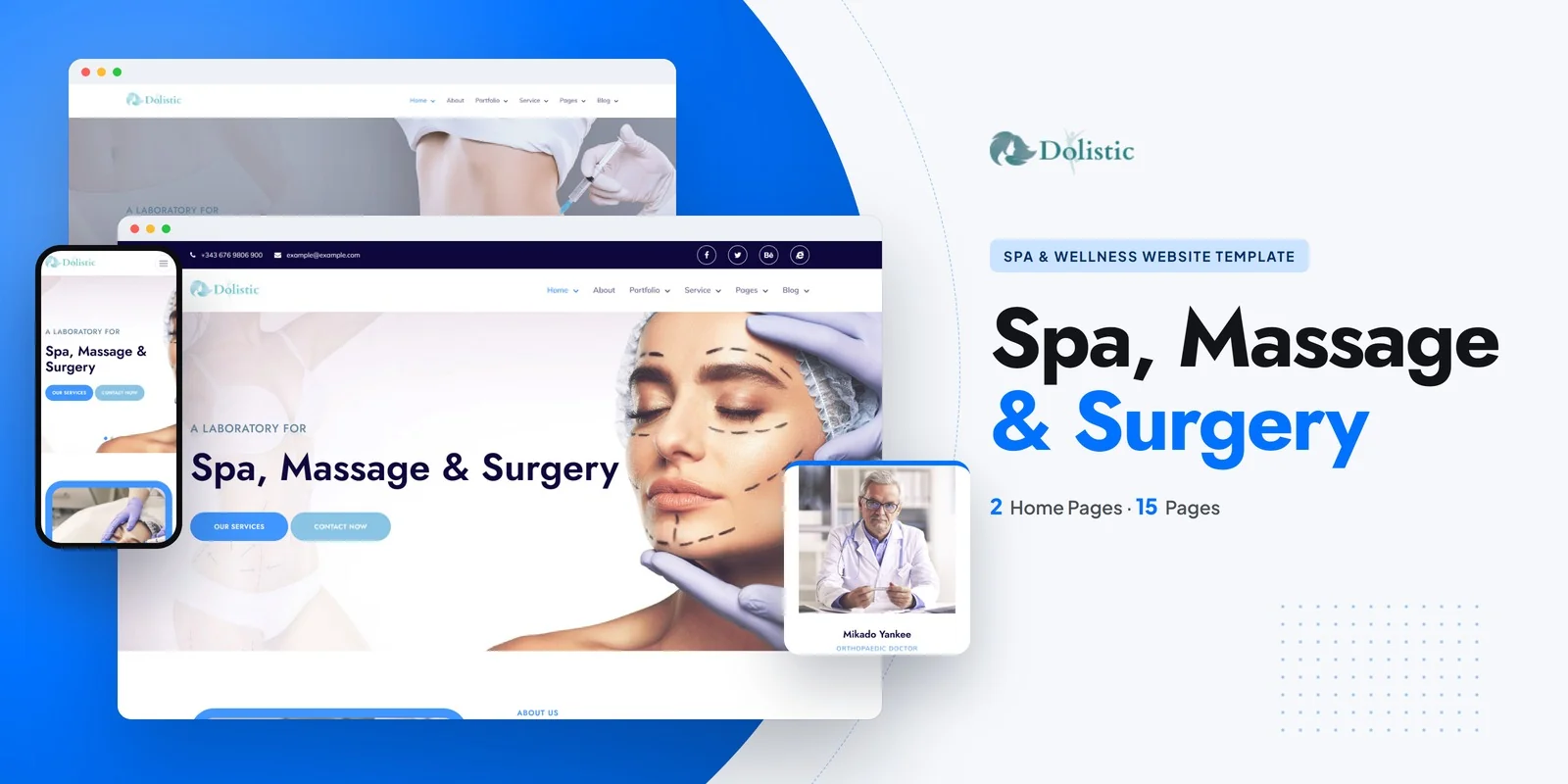
1. Dolistic (15 Pages)
Dolistic is a calm, professional spa website template built for spas, wellness centres, beauty clinics, medical aesthetics studios, and holistic health businesses. Across its 15 fully designed HTML pages it pairs two distinct home layouts with a complete services module that includes individual treatment detail pages, a filterable Isotope portfolio for showcasing treatment results and case studies, dedicated team therapist profiles, and a gallery page for your spa atmosphere. The design language is serene and editorial, the kind of restraint that makes a wellness brand feel established rather than improvised.
The portfolio and gallery features are the standout here. Isotope grid filtering lets visitors sort treatment results by category, which is ideal for a beauty clinic or medical aesthetics studio that wants to present before-and-after work cleanly. CounterUp animated statistics let you put treatments performed, happy clients, and years of expertise front and center as trust signals, while a Magnific Popup lightbox handles full-screen image viewing. The blog module ships in grid, sidebar, and full-article formats, giving you a real content marketing surface to publish wellness tips and capture organic search traffic over time.
Best for: Spas, beauty clinics, and medical aesthetics studios that want a serene, portfolio-driven site to showcase treatment results and build trust. View Live Demo
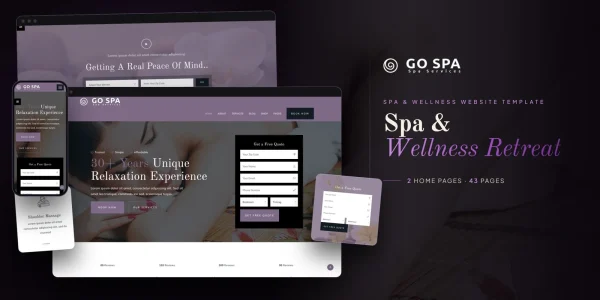
2. Gospa (43 Pages)
Gospa is the heavyweight of this collection and one of the most comprehensive spa website templates available anywhere. Across 43 fully designed HTML pages it covers nearly every scenario a growing wellness business will ever need: two home layouts, a services module with two overview styles plus detail pages, a portfolio showcase in four filterable layout styles, a team module with two directory styles and individual member pages, and six gallery layouts including dedicated before-and-after comparison views. It is built for the premium end of the beauty and wellness market, where presentation is everything.
What sets Gospa apart from simpler spa templates is its commercial depth. It ships with a full e-commerce shop for selling wellness and retail products, two pricing plan variants for memberships and treatment packages, a dedicated testimonials page, a clients logo gallery, and complete account management with login, signup, cart, and checkout flows. CounterUp statistics, a Countdown timer for seasonal promotions, WOW.js scroll animations, Isotope and Masonry grids, and a Magnific Popup lightbox round out a feature set that lets a luxury spa run memberships, sell products, and showcase transformations all from one cohesive site.
Best for: Luxury spas and beauty salons that want to sell products, run membership and package pricing, and showcase before-and-after transformations from a single comprehensive site. View Live Demo

3. Pinner (15 Pages)
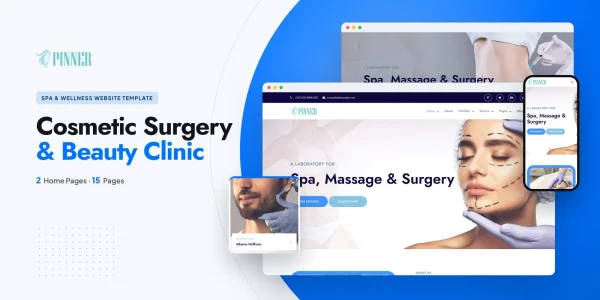
Pinner is a serene, wellbeing-driven spa website template built specifically for spas, wellness centres, massage studios, beauty salons, and holistic therapy providers. Its 15 fully designed HTML pages center on a portfolio gallery with individual detail pages, a services section with detail views, team profiles with their own detail pages, a gallery showcase, and a dedicated FAQ page. Two distinct home layouts give you room to test different first impressions, and the overall aesthetic leans into the calm, uncluttered look that wellness clients respond to.
The combination of team detail pages and a built-in FAQ page makes Pinner especially well suited to massage studios and therapy providers, where guests often want to know about specific practitioners and have practical questions answered before they book. Isotope grid filtering lets visitors narrow the portfolio or services by treatment type, Owl Carousel powers featured-treatment and testimonial sliders, CounterUp animates your client and milestone statistics, and Magnific Popup handles full-screen gallery viewing. It is a focused, confident template that gives a single-location spa everything it needs without the overhead of a marketplace-scale build.
Best for: Massage studios, wellness centres, and holistic therapy providers that want a focused site with strong team profiles and a built-in FAQ to answer guest questions before booking. View Live Demo
4. Randokli (24 Pages)
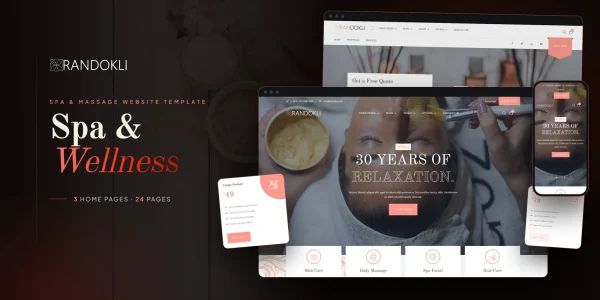
Randokli is a calming, booking-ready spa website template built for spas, wellness centres, massage therapists, day spas, and relaxation retreats. Across its 24 fully designed HTML pages it offers three distinct home layouts, a treatment services section organized around massage, hot stone, facial care, and herbal therapy, an editorial blog, and a booking-focused contact page. The three home variants are a genuine advantage: they let a day spa lead with treatments, a retreat lead with atmosphere, or a therapist lead with credentials, all from the same template.
Where Randokli stands out is its emphasis on bookings and trust on mobile. MeanMenu provides mobile-optimized responsive navigation so a client booking from a phone never fights the menu, while Slick carousels power featured-treatment and testimonial sliders. CounterUp animates years of relaxation, clients served, and treatment counters, and EasyPieChart adds animated treatment-skill and expertise charts that visually communicate competence at a glance. Isotope filtering lets visitors sort treatments by type or therapist, and a Magnific Popup lightbox handles the spa gallery imagery. For a day spa or massage therapist that wants a quick-to-launch, mobile-first, booking-driven site, Randokli is an excellent fit.
Best for: Day spas, massage therapists, and relaxation retreats that want a mobile-first, booking-driven site with multiple home layouts and clear treatment categories. View Live Demo
Essential Features Every Spa Website Needs
Whether you build from scratch or start with a spa website template, these eight features are non-negotiable for any spa, salon, or wellness business competing online in 2026.
- Clear treatment menu with service detail pages. An overview of your full menu plus individual pages for signature treatments lets clients understand technique, benefits, duration, and price before they book, and gives each treatment its own page to rank in search.
- Frictionless online booking or enquiry. A prominent, persistent booking or contact call-to-action with a short form is the single most important conversion element on a spa website. Every extra tap between interest and booking costs you clients.
- Mobile-responsive layout. With most spa traffic on phones, the entire experience, from treatment menu to booking button, must work flawlessly one-handed on a small screen.
- Atmospheric galleries and lightbox imagery. Full-width hero sections, filterable galleries, and before-and-after showcases let prospective clients picture themselves in your space, which is what actually drives the decision to book.
- Team and therapist profiles. Real practitioner pages with credentials and photos build the trust a first-time guest needs, especially for massage and therapy services where the relationship is personal.
- Client testimonials and trust signals. Genuine reviews and animated achievement statistics like treatments performed and years in practice reduce hesitation and should be visible, not buried on a sub-page.
- Blog and content section. A regularly updated blog with wellness tips and treatment guides drives organic search traffic and positions your spa as a knowledgeable, trustworthy resource.
- Fast page load speed. Target under 2.5 seconds for Largest Contentful Paint. Compress imagery, minimize scripts, and choose a template built on a lightweight, mobile-first framework so your visuals never cost you rankings.
Choosing the Right Template for Your Spa
Selecting a spa website template starts with understanding your business model. A single-location massage studio has very different needs than a luxury day spa that sells retail products and runs memberships. Templates like Gospa are built for that larger, commerce-driven operation, with a full e-commerce shop, membership pricing, and before-and-after galleries baked in. Dolistic and Pinner are tuned for focused, portfolio-led spas and wellness centres that want a serene, trust-building presence without commerce overhead. Randokli sits in between, built around bookings and multiple home layouts for day spas and therapists who want to launch fast. Match the template’s architecture to how you actually run your business, not to whichever one has the longest feature list.
Page count is a practical indicator of scope, but more pages does not automatically mean a better fit. A 43-page template like Gospa gives you maximum flexibility and room to grow into e-commerce and memberships, but it also takes more time to customize and populate. A 15-page template like Dolistic or Pinner can be live in days. Consider your timeline and resources honestly. A fully customized 15-page spa site that launches next week will generate more bookings than a half-finished 43-page project that never goes live. Every template in this list is a clean, well-documented HTML5 template with organized source code, so customizing it with your branding, treatments, and imagery is straightforward.
Budget matters, but consider it in context. A premium spa website template costs a fraction of what custom development runs, and you get a professionally designed, tested, and documented starting point engineered specifically for the wellness market. The real cost is not the template itself. It is the time required to make it yours. Choosing a template that already speaks the visual language of calm, with the gallery, services, team, and booking structures your spa needs, is what minimizes that effort and gets you to a fully booked calendar faster.
Start Building Your Spa Website
The wellness market is only getting more competitive, and clients now expect a spa’s website to feel as considered as the experience waiting for them in the treatment room. Spas that invest in professional spa web design now are building the brand equity and online presence that will carry their business forward as the industry matures. Every month you operate with an outdated website, or no website at all, is a month of lost bookings, missed organic traffic, and weakened brand perception. The four templates featured here are not concepts or wireframes. They are production-ready, mobile-responsive, professionally designed HTML5 templates built specifically for spas and wellness businesses.
Start by exploring the designs, testing the live demos, and identifying which template aligns with how you run your spa. Then customize it with your branding, fill it with your treatments and atmosphere, and launch. Your next client is already searching for a spa online. Make sure they find yours. Browse All Spa Templates and pick the right foundation for your business.