The cannabis industry in 2026 is no longer a novelty market. It is a mature, fiercely competitive retail sector where over 15,000 licensed dispensaries fight for customer attention across the United States. In this environment, your website is not just a digital brochure. It is the primary sales channel, brand experience, and trust-building tool that determines whether a customer buys from you or clicks over to a competitor. Professional dispensary website design is the price of entry.
Why Your Dispensary Website Is Your Most Important Asset
Most dispensaries carry overlapping product lines from the same regional cultivators and manufacturers. When the products on your shelves look identical to the shop two miles away, the differentiator becomes the buying experience. A dispensary website that loads fast, presents products clearly, and makes ordering painless will capture the customer that a slower, clunkier competitor loses. This is not speculation. It is measurable in conversion rates, average order values, and repeat visit frequency.
Mobile traffic now accounts for over 80% of dispensary website visits. Customers search for dispensaries on their phones while commuting, compare menus during lunch breaks, and place orders from their living rooms. If your cannabis website does not perform flawlessly on a 6-inch screen, you are invisible to the vast majority of your potential customers. Every design decision, from navigation layout to product image sizing, must start with mobile and scale up to desktop.
First impressions carry extra weight in cannabis. Many customers, especially those new to legal purchasing, approach dispensary websites with caution. They want to see professional branding, transparent product information, visible compliance with local regulations, and a checkout process that feels secure. A website that looks outdated or hastily assembled signals unreliability. In a regulated industry where trust is everything, your cannabis web design is your most powerful credibility tool.
What Makes a Great Cannabis Dispensary Website
Age Verification and Legal Compliance
Every cannabis dispensary website requires an age verification gate. This is a legal requirement in virtually every jurisdiction, not an optional feature. The best age gates are branded, full-screen overlays that load before any site content appears. They should feel integrated into the design, not bolted on as an afterthought. Beyond the age gate, compliance touches every element of your site: footer disclaimers, product labeling standards, state-specific legal language, and restrictions on health claims. A cannabis dispensary website template built for the industry handles these structural requirements from the start.
State regulations also dictate how you display pricing, promotions, and product imagery. California operates under different rules than Colorado, which differ from New York and Illinois. A well-structured marijuana website template provides the foundation to accommodate these variations without requiring a full redesign for each new market.
Mobile-First Performance
Google’s Core Web Vitals directly influence your search rankings, and dispensary websites are frequently penalized for poor performance. Heavy background videos, uncompressed product images, and bloated JavaScript libraries push load times past the 3-second mark where most mobile users abandon a page. A quality cannabis website template is built on a lightweight framework like Bootstrap 5, with optimized assets and lazy loading baked in from the start.
Mobile UX extends beyond responsive breakpoints. Touch targets must be large enough for thumbs. Product filters need to function on narrow screens without hiding behind confusing toggle menus. The checkout flow, if you offer online ordering, must be completable in as few taps as possible. Every unnecessary step between “Add to Cart” and “Place Order” costs you conversions.
Strain Catalog and Product Showcase
The product catalog is the core of any dispensary website. Customers want to browse strains by type (indica, sativa, hybrid), filter by THC and CBD percentage, compare products side by side, and read detailed descriptions before visiting your store or placing an order. Static product pages with a single photo and two sentences of copy are not competitive anymore. The best dispensary website designs include filterable strain grids, detailed product pages with multiple images, and integration points for live menu systems like Dutchie or Jane.
Brand Identity and Trust Signals
Cannabis businesses operate under a unique trust deficit. Your website needs to actively build confidence through visible trust signals: customer reviews displayed prominently (not buried on a sub-page), business licenses and certifications, professional team photos, and a clear company story. Generic stock photography and vague mission statements do not build trust. Specificity does. A cohesive visual identity across every page of your site creates the professional impression that turns first-time visitors into loyal customers.
8 Cannabis Website Templates Worth Using in 2026
We evaluated dozens of cannabis dispensary website templates and selected the eight that deliver the best combination of design quality, feature depth, and real-world usability. Each template is built on Bootstrap 5, fully responsive, and available in multiple formats including HTML5, React, Angular, and WordPress. Here is the full collection at a glance.
1. Budforest (22 Pages)
Budforest strips away marketplace complexity and focuses on what most single-location dispensaries actually need: a clean, conversion-optimized online shop. With 4 distinct homepage layouts, it gives you meaningful design variety without unnecessary bloat. The e-commerce pages are the highlight. Product grids with quick-view functionality, detailed product pages with tabbed information sections, a smooth cart experience, and a straightforward checkout flow all work together to guide visitors toward a purchase.
The blog system is well-integrated, supporting your SEO and content marketing efforts without feeling like an afterthought. The 4 homepage variants let you test different approaches: some emphasize featured products, while others lead with lifestyle imagery and brand storytelling. Budforest also includes product detail pages with sidebar navigation, giving customers multiple ways to browse your inventory. For a single dispensary that wants to sell online or showcase its menu, Budforest hits the sweet spot between depth and simplicity.
Best for: Single-location dispensaries and cannabis e-commerce shops that want a focused online store without marketplace overhead. View Live Demo
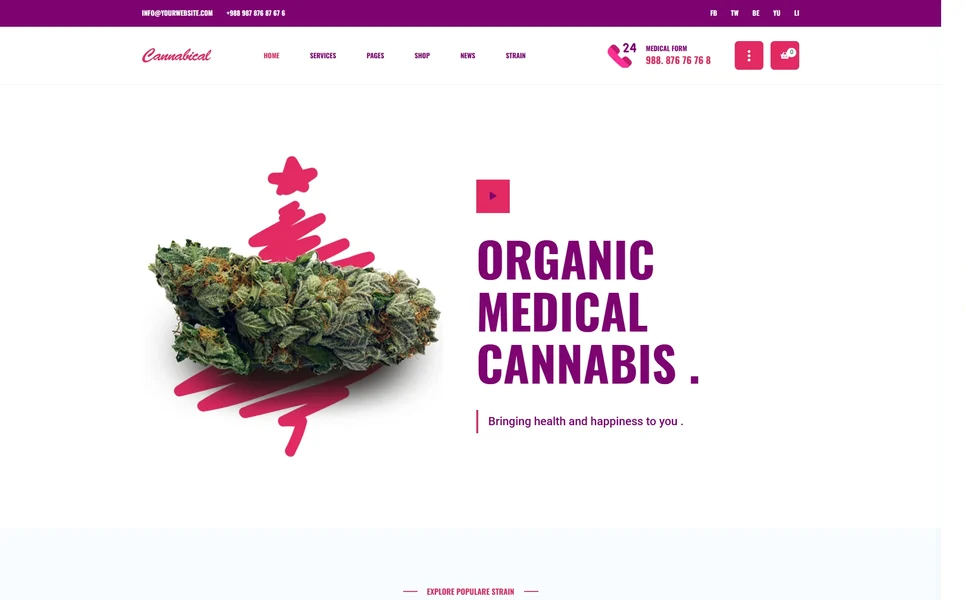
2. Cannabical (22 Pages)
Cannabical targets a different segment of the cannabis industry: consulting firms, cultivation advisors, compliance consultants, and cannabis brands that sell expertise rather than flower. With 3 homepage variations, it includes strain showcase sections in grid, masonry, and slider layouts, along with detailed service pages and team profile pages. The design is polished and corporate, communicating the authority and expertise that a consulting firm needs to win clients.
The strain display options are versatile enough to serve as a portfolio or product showcase depending on your use case. The grid layout works for catalog-style browsing, the masonry layout creates a visually dynamic gallery, and the slider is ideal for featuring premium or seasonal offerings on the homepage. Service detail pages include structured sections for process descriptions, pricing, FAQs, and call-to-action blocks, mirroring the layout patterns that convert visitors into leads for professional service businesses.
Best for: Cannabis consulting firms, cultivation advisors, compliance agencies, and brands focused on education and professional services rather than direct retail. View Live Demo

3. Herrer (31 Pages)
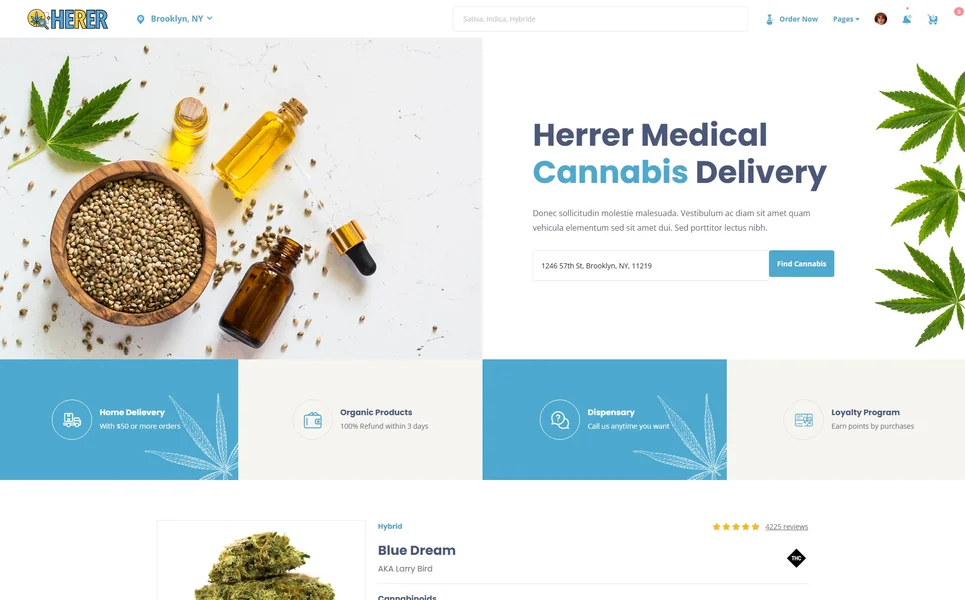
Herrer is built for dispensaries that offer delivery, one of the fastest-growing segments of the cannabis market. At 31 pages, it is one of the most feature-dense templates in this list. The standout elements are a geo-locator for finding nearby delivery zones, a vendor marketplace system, delivery tracking page layouts, and a robust product review system. The design communicates speed and convenience, which is exactly what delivery-focused customers are looking for when they open your site.
The marketplace functionality is well thought out. Vendor profile pages include product listings, ratings, delivery zone maps, and operating hours. For dispensaries operating in multiple delivery zones or partnering with third-party vendors, this structure provides a professional framework that would cost thousands to build custom. Product detail pages feature prominent review sections and related product suggestions, following proven e-commerce UX patterns that increase average order value. The complete checkout flow handles delivery address collection and zone validation.
Best for: Cannabis delivery services, dispensaries expanding into delivery, and marketplace platforms connecting customers with local delivery vendors. View Live Demo
4. Recreational (16 Pages)
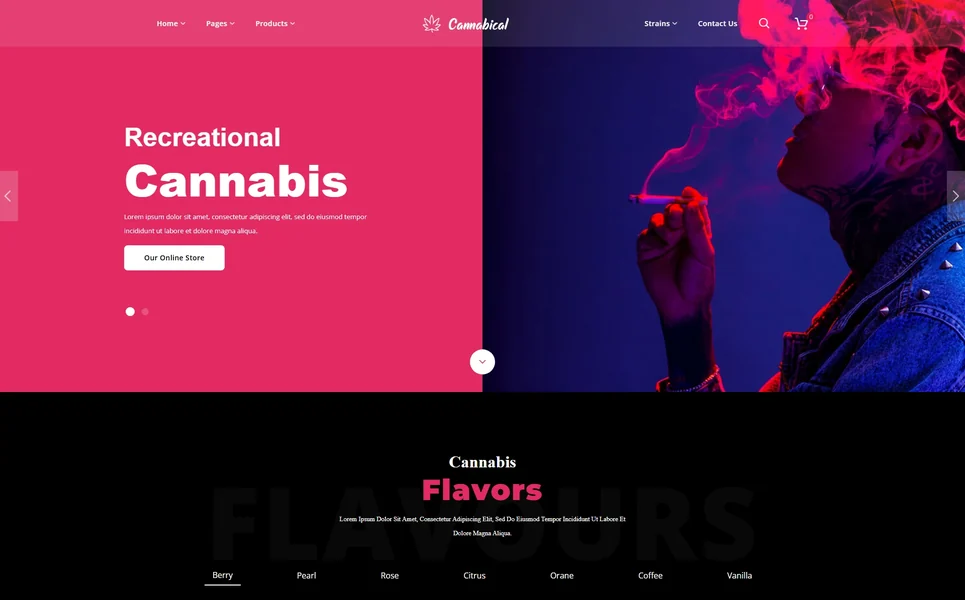
Recreational is a focused, efficient dispensary website design built for shops that sell recreational cannabis and want a streamlined online presence. At 16 pages, it is the most compact template in this collection, and that is deliberate. Every page serves a clear purpose. There is no padding with pages you will never use. The product comparison tool is a standout feature, letting customers compare strains across key attributes like price, THC content, and product type. The checkout flow is clean and minimal, reducing friction at the exact moment a customer is ready to buy.
The 16-page scope makes Recreational the fastest template to customize and launch. If you need a dispensary website live within days rather than weeks, this template gets you there without sacrificing design quality. The layout is modern and visually engaging, with strong product photography placement and clear navigation. For recreational dispensaries that want to compete online without investing months in a complex website build, Recreational delivers excellent value per page.
Best for: Recreational cannabis shops that want a fast-launching, focused e-commerce site without unnecessary complexity. View Live Demo
5. Webud (45 Pages)
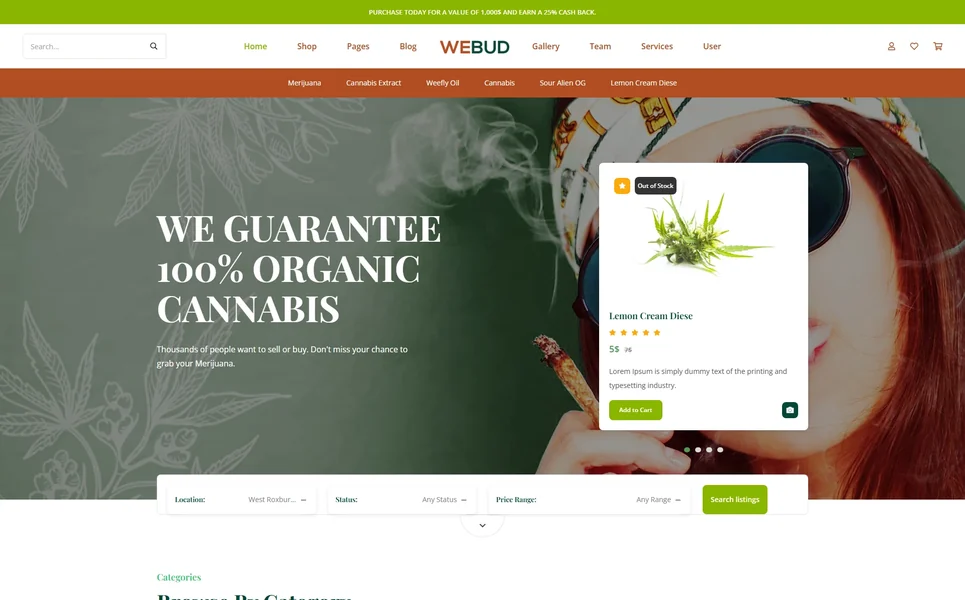
Webud is the heavyweight of this collection. With 45 pages, it is the most comprehensive cannabis website template available, designed for large-scale multivendor marketplaces. If you are building a platform where multiple cannabis brands sell through a single storefront, Webud provides the architecture. Vendor profiles include galleries, team member sections, product submission workflows, and performance dashboards. The product catalog supports 3 distinct gallery styles and deep category-based filtering.
The page count reflects genuine depth, not filler. Webud covers scenarios most templates ignore: dedicated team archive pages, multi-step product submission flows for vendors, brand photography galleries, and granular account management for both buyers and sellers. The design is refined and corporate-grade, suitable for cannabis businesses that need to project scale and professionalism. It handles the complexity of multi-party marketplaces without making the customer-facing experience feel cluttered.
Best for: Large cannabis marketplace platforms, multi-brand dispensary chains, and wholesale operations that need extensive vendor management capabilities. View Live Demo
6. Weedify (22 Pages)
Weedify offers a 22-page dispensary template with 4 homepage layouts and a design language that leans bolder than most in this list. Stronger typography, richer color contrasts, and more prominent call-to-action elements give it an energetic feel that works well for brands with a younger customer base. The distinguishing feature is the sidebar shop layout, which adds persistent category filters alongside the product grid. This is a meaningful upgrade for dispensaries carrying hundreds of SKUs across flower, edibles, concentrates, topicals, and accessories.
Sidebar filtering prevents customers from scrolling endlessly through unfiltered product grids. Shoppers can narrow results by category, potency, price range, or product type without losing their place. Weedify also includes all the expected pages: about, contact, blog with multiple post layouts, account management, and a complete cart-to-checkout flow. The detailed product pages provide ample space for strain descriptions, lab results, usage notes, and customer reviews.
Best for: Dispensaries with large product catalogs that need robust filtering, and operators who prefer a bolder visual identity for their cannabis e-commerce site. View Live Demo

7. Weedo Main (20 Pages)
Weedo takes a different approach from the standard dispensary shop template. It is built as a cannabis listing platform, functioning more like a directory where multiple dispensaries can be listed, compared, and reviewed. With 20 pages, it includes a dispensary directory system, pricing plan pages for listed businesses, and product comparison functionality. This architecture makes Weedo ideal for entrepreneurs building cannabis business directories, review platforms, or regional dispensary listing services.
The design uses spacious, card-based layouts that present dispensary listings with clarity. Each listing accommodates photos, descriptions, contact details, product highlights, and user ratings. The pricing plan pages are particularly well-executed for SaaS-style monetization, letting you offer tiered listing packages to dispensaries that want premium placement. A coming-soon page is also included, useful for building an email list before your platform officially launches.
Best for: Cannabis directory platforms, dispensary review sites, and multi-location chains that want a listing-style online presence. View Live Demo
8. Weefly (18 Pages)
Weefly rounds out this collection with an 18-page cannabis shop template that balances simplicity with substance. It includes a complete cart and checkout system, customer account pages for order tracking and profile management, and a blog system with multiple layout options including grid, list, and sidebar variations. The design is clean and contemporary, avoiding the overly dark or heavy-handed aesthetic that many cannabis website templates default to. Weefly proves that a dispensary site can look professional, inviting, and approachable.
The account system is worth highlighting. Returning customer management, including order history, saved addresses, and wishlist functionality, is something many dispensary templates overlook. These features increase customer lifetime value by making repeat purchases easier and faster. The multi-layout blog gives you flexibility to publish strain guides, industry news, and educational content that drives organic search traffic to your dispensary website over time.
Best for: Dispensaries that want a clean, approachable online shop with strong returning-customer features and built-in content marketing capabilities. View Live Demo


Essential Features Every Cannabis Website Needs
Whether you build from scratch or start with a cannabis dispensary website template, these eight features are non-negotiable for any dispensary competing online in 2026.
- Age verification gate. A branded, full-screen overlay that loads before any content appears. This is a legal requirement in nearly every jurisdiction and should look like part of the design, not a generic popup.
- Mobile-responsive layout. Your site must function flawlessly on smartphones and tablets. With over 80% of dispensary traffic on mobile, a poorly responsive site is functionally invisible to most of your customers.
- Filterable product catalog. Customers expect to browse by strain type, potency, price, and category. A searchable, filterable catalog with detailed product pages replaces printed menus and keeps your inventory current.
- Online ordering or menu integration. Whether you process orders directly or integrate with platforms like Dutchie, Weedmaps, or Jane, your website needs a clear path from browsing to purchasing.
- Blog and content section. A regularly updated blog drives organic search traffic and positions your dispensary as a knowledgeable resource. Publish strain reviews, usage guides, and local regulation updates to attract customers through Google.
- Customer reviews and testimonials. Visible, genuine reviews reduce purchase anxiety and build trust. Display them on product pages and your homepage, not on a page nobody visits.
- Store locator and contact details. Your address, phone number, hours, and a map should be accessible from every page. For multi-location dispensaries, a locator with zip code search is essential.
- Fast page load speed. Target under 2.5 seconds for Largest Contentful Paint. Compress images, minimize JavaScript, use a CDN, and choose a template built on a lightweight framework like Bootstrap 5.
Choosing the Right Template for Your Dispensary
Selecting a cannabis website template starts with understanding your business model. A single-location dispensary has different requirements than a multi-vendor marketplace or a delivery service. Templates like Herrer and Webud are built for large-scale operations with vendor management, delivery logistics, and multi-party workflows. Budforest and Recreational are designed for focused, single-shop e-commerce where speed and simplicity matter most. Cannabical targets service-based cannabis businesses that sell expertise rather than products. Match the template’s architecture to your actual use case, not to whichever one has the longest feature list.
Page count is a practical indicator of scope, but more pages does not automatically mean a better fit. A 45-page template like Webud gives you maximum flexibility and room to grow, but it also demands more time to customize and populate with content. A 16-page template like Recreational can be live in days. Consider your timeline and available resources honestly. A fully customized 16-page site that launches next week will generate more revenue than a half-finished 45-page project that never goes live. All eight templates in this article are available in multiple formats: HTML5 for the lightest footprint, React and Angular for dynamic single-page applications, and WordPress for teams that want CMS-powered updates without touching code.
Budget matters, but consider it in context. A premium cannabis dispensary website template costs a fraction of what custom development runs, and you get a professionally designed, tested, and documented starting point. The real cost is not the template purchase. It is the time required to customize it with your branding, products, and content. Choose a template with clear documentation and well-organized code to minimize that effort. Every template in this list is built on Bootstrap 5 with clean, commented source code and full documentation included.
Start Building Your Cannabis Website
The cannabis market is only getting more competitive. Dispensaries that invest in professional cannabis web design now are building the brand equity and online presence that will carry their businesses forward as the industry matures. Every month you operate with an outdated website, or no website at all, is a month of lost customers, missed organic traffic, and weakened brand perception. The eight templates featured in this article are not concepts or wireframes. They are production-ready, mobile-responsive, Bootstrap 5 templates built specifically for the cannabis industry.
Start by exploring the designs, testing the live demos, and identifying which template aligns with your business model. Then customize it with your branding, populate it with your products, and launch. Your next customer is already searching for a dispensary online. Make sure they find yours. Browse All Cannabis Templates and pick the right foundation for your business.