
The furniture industry is undergoing a fundamental transformation. What was once a business built entirely on showroom foot traffic and handshake deals has evolved into a digital-first marketplace where customers browse, compare, and purchase from the comfort of their living rooms. For furniture retailers, interior designers, and home decor brands, having a compelling online presence is no longer optional. It is the difference between thriving and becoming invisible.
But building a furniture store website is not the same as building any other ecommerce site. Furniture is a high-consideration purchase. Customers do not add a two-thousand-dollar sofa to their cart on impulse. They research materials, compare dimensions, visualize how pieces will look in their space, and read reviews before committing. Your website needs to support this entire decision-making journey with the right content, the right visuals, and the right user experience.
The State of Furniture Ecommerce in 2026
Online furniture sales have experienced remarkable growth over the past several years, and the trend shows no signs of slowing. Consumers have become comfortable purchasing large items online, driven by improved product photography, augmented reality tools, generous return policies, and faster delivery logistics.
For small and mid-sized furniture businesses, this shift presents both an opportunity and a challenge. The opportunity is access to a customer base that extends far beyond your physical location. The challenge is competing for attention in a crowded digital marketplace dominated by major players with enormous marketing budgets.
The key differentiator for smaller furniture businesses is not outspending the competition. It is out-designing them. A beautifully crafted, fast-loading, intuitive website creates a premium perception that builds trust and drives conversions. Your website is your digital showroom, and it needs to be just as thoughtfully designed as your physical space.
Why Your Furniture Website Design Matters More Than You Think
First impressions online happen in milliseconds. Research consistently shows that visitors form an opinion about a website within fifty milliseconds, and that opinion is almost entirely based on visual design. For furniture businesses, this is especially critical because your brand is inherently visual. You sell aesthetics. Your website must demonstrate that you understand good design before a customer even looks at your products.
Beyond first impressions, website design directly impacts your bottom line. Studies show that optimized checkout processes can increase conversion rates by up to thirty-five percent. Mobile-responsive design captures the growing segment of shoppers who browse on their phones. Fast page load times prevent the fifty-three percent of mobile users who abandon sites that take more than three seconds to load.
Every design decision, from the size of your product images to the placement of your add-to-cart button, influences whether a visitor becomes a customer or clicks away to a competitor. In furniture ecommerce, where average order values are high and purchase frequency is low, every lost conversion represents significant revenue.
Essential Elements of a High-Converting Furniture Website
Building a furniture website that converts requires more than just listing products with prices. You need to create an experience that guides customers through their decision-making process with confidence. Here are the elements that separate great furniture websites from mediocre ones.
High-Quality Product Photography
In furniture ecommerce, photography is everything. Customers cannot touch the fabric, test the cushion firmness, or see how the piece catches light in person. Your images must do all of that work. This means professional studio shots from multiple angles, lifestyle images showing furniture in styled room settings, close-up detail shots of materials and finishes, and scale reference images that help customers understand dimensions.
The investment in quality photography pays for itself many times over. Products with multiple high-resolution images consistently outperform those with a single photo, and research shows that customers interact with three-hundred-sixty-degree spin views four times longer than static images alone.
Intuitive Category Navigation
Furniture stores carry diverse product lines that span multiple categories, styles, materials, and price points. Your navigation system needs to make it effortless for customers to find what they are looking for. This means implementing multi-level category structures (Living Room, Bedroom, Dining, Office), filtering by attributes (material, color, size, price range), and sort options (price, popularity, newest arrivals).
A powerful search bar is equally important. Many customers arrive at your site knowing exactly what they want, and they expect to find it in seconds. Auto-suggest functionality, typo tolerance, and search by product code all enhance the experience.
Detailed Product Specifications
Furniture buyers need precise information to make confident decisions. Every product page should include exact dimensions (height, width, depth, seat height), weight, material composition, available colors and finishes, care instructions, warranty information, and assembly requirements. Missing any of these details gives customers a reason to hesitate, and hesitation kills conversions.
Room Visualization Tools
One of the biggest barriers to buying furniture online is uncertainty about how a piece will look in the customer’s actual space. Room visualization tools address this directly. From simple room scene photographs to advanced augmented reality features that let customers place virtual furniture in their rooms using their phone cameras, these tools dramatically reduce purchase anxiety.
While AR integration requires significant development investment, even basic lifestyle photography showing furniture in realistic room settings can substantially improve conversion rates.
Trust Signals and Social Proof
High-value purchases demand high trust. Prominently display customer reviews, ratings, and user-submitted photos of your furniture in their homes. Include trust badges for secure checkout, clear return policies, and delivery guarantees. A dedicated section showcasing press mentions, awards, or partnerships with recognized interior designers can further establish credibility.
Flexible Payment Options
Furniture is expensive. Offering buy-now-pay-later options through services like Klarna, Affirm, or Afterpay can significantly increase your average order value and conversion rate. Display financing options prominently, both on product pages and in the cart. A customer who sees they can pay two hundred dollars per month for a sofa is far more likely to complete the purchase than one staring at a twelve-hundred-dollar total.
The Custom Website vs. Template Decision
When it is time to build your furniture store website, you face a fundamental choice: hire a developer to build a custom site from scratch, or start with a professionally designed template. Both approaches have their place, and the right choice depends on your budget, timeline, and specific needs.
| Factor | Custom Development | Professional Template |
|---|---|---|
| Cost | $5,000 – $50,000+ | $15 – $69 one-time |
| Timeline | 2-6 months | 1-2 weeks |
| Design uniqueness | Completely unique | Customizable framework |
| Ongoing maintenance | Requires developer | Self-manageable |
| Mobile responsiveness | Built to spec | Built-in (Bootstrap 5) |
| Performance | Depends on developer | Optimized out of box |
| Risk | Higher (depends on team) | Lower (tested, reviewed) |
For most small to mid-sized furniture businesses, starting with a professional template is the pragmatic choice. You get a proven design foundation that can be customized to reflect your brand, launched quickly, and iterated upon as your business grows. The money you save on development can be redirected toward inventory, marketing, or photography, areas that directly drive revenue.
Optimizing Your Furniture Website for Search Engines
A beautiful website is worthless if nobody can find it. Search engine optimization for furniture websites requires a specific strategy that addresses how customers actually search for furniture online.
Keyword Strategy for Furniture
Furniture shoppers use a mix of broad and specific search terms. Broad terms like “modern sofa” or “dining table” have high volume but fierce competition. Long-tail terms like “mid-century modern walnut dining table seats six” have lower volume but much higher purchase intent. Your website should target both, with category pages optimized for broader terms and individual product pages targeting specific long-tail variations.
Product Page SEO
Every product page is a potential search engine landing page. Optimize each one with unique title tags that include the product name and key attributes, detailed meta descriptions that entice clicks, structured data markup for rich snippets in search results, image alt text that describes the product accurately, and internal links to related products and category pages.
Content Marketing for Furniture Brands
A blog or resource section positions your brand as an authority and captures informational search traffic. Topics like room layout guides, material comparison articles, furniture care tips, and interior design trend roundups attract potential customers at the top of the funnel and keep them engaged with your brand as they move toward a purchase decision.
Mobile Commerce and the Furniture Shopping Journey
The furniture shopping journey typically spans multiple sessions across multiple devices. A customer might discover a sofa on Instagram, research it on their phone during lunch, compare options on their laptop at home, and finally complete the purchase on their tablet from the couch. Your website must deliver a consistent, seamless experience across every touchpoint.
Mobile optimization for furniture goes beyond basic responsiveness. It requires touch-friendly image galleries with pinch-to-zoom, streamlined mobile checkout with digital wallet support, sticky add-to-cart buttons that remain visible as users scroll through product details, collapsible specification sections that keep pages clean without hiding information, and fast-loading images that adapt quality to the user’s connection speed.
The data is clear: mobile commerce accounts for an increasingly large share of furniture purchases, and the gap between mobile traffic and mobile conversions represents a massive opportunity for businesses that optimize their mobile experience.
Building Customer Loyalty Through Your Website
Acquiring a new customer costs five to seven times more than retaining an existing one. Your furniture website should include features that encourage repeat visits and purchases. Wishlist functionality lets customers save items they are considering, creating a reason to return. Email capture through tasteful pop-ups or embedded forms builds your marketing list. A loyalty or rewards program encourages repeat purchases and referrals.
User accounts that save purchase history and preferences make reordering easy and provide valuable data for personalized recommendations. Even something as simple as a “Complete the Look” section on product pages, showing complementary items that pair well with the viewed product, can increase average order value and deepen customer engagement.
Common Pitfalls in Furniture Website Design
Awareness of common mistakes helps you avoid them. Here are the issues that most frequently undermine furniture ecommerce websites.
Oversized, unoptimized images. High-quality photography is essential, but images that are not properly compressed will destroy your page load times. Use modern formats like WebP, implement lazy loading, and serve appropriately sized images for each device. A five-megabyte hero image might look stunning, but if it takes four seconds to load, most visitors will never see it.
Complicated checkout processes. Every additional step in your checkout flow is a point where customers drop off. Offer guest checkout, minimize form fields, provide multiple payment options, and show a clear progress indicator. The ideal furniture checkout takes no more than three steps from cart to confirmation.
Ignoring delivery information. Furniture delivery is a major concern for online buyers. Unclear shipping costs, vague delivery windows, and hidden fees are conversion killers. Be transparent about delivery timelines, costs, and what the delivery includes (will they bring it inside? assemble it? remove packaging?). Display this information on every product page, not just in a buried FAQ.
Thin product descriptions. A few bullet points and a single photo are not enough for a thousand-dollar purchase. Invest in rich product descriptions that tell the story of each piece: the inspiration behind the design, the craftsmanship involved, the materials selected and why. This content does double duty, building customer confidence while also providing keyword-rich text for search engines.
How Cozify Delivers a Complete Furniture Store Experience
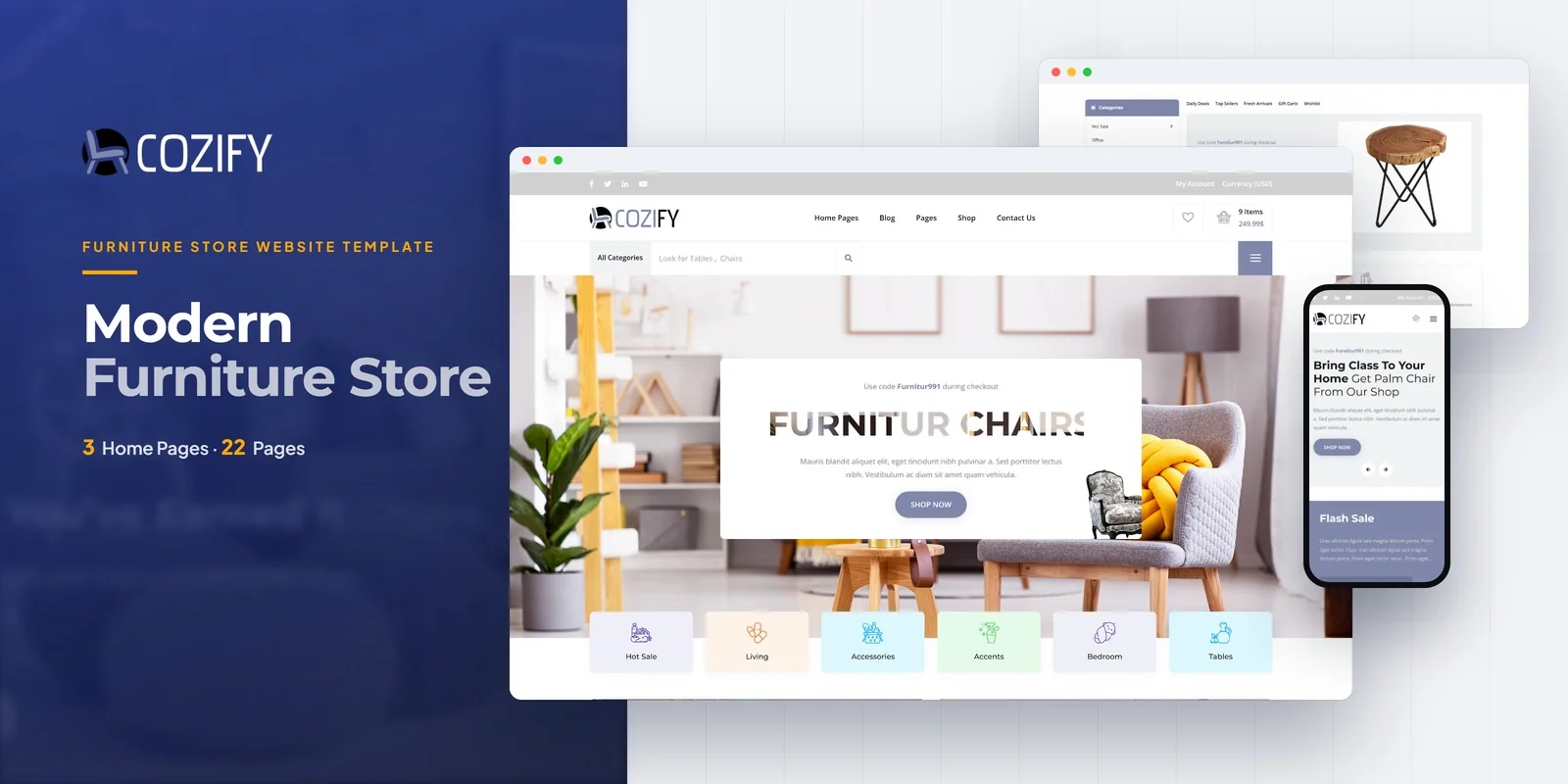
With all of these principles in mind, Cozify stands out as a furniture store website template designed specifically for the challenges and opportunities of modern furniture ecommerce. Built on Bootstrap 5, it delivers a responsive, fast-loading foundation that works flawlessly across all devices.
Cozify includes a thoughtfully designed product grid with hover effects that invite exploration, detailed product page layouts with space for multiple images and comprehensive specifications, category navigation with filtering capabilities, and a clean checkout flow that minimizes friction. The homepage features a striking hero section for your flagship collection, curated product showcases, testimonial areas, and brand storytelling sections.
What makes Cozify particularly well-suited for furniture businesses is its visual hierarchy. The template prioritizes imagery while maintaining the content structure needed for SEO and conversion optimization. Typography is clean and readable, spacing is generous enough to let products breathe, and the overall aesthetic communicates the quality and care that furniture buyers expect from a premium brand.
Explore the full Cozify template at demo.metropolitanhost.com/cozify/ to see how every element works together to create a compelling furniture shopping experience.
Frequently Asked Questions
Costs vary dramatically depending on your approach. A custom-built furniture ecommerce site typically runs from five thousand to fifty thousand dollars or more. Using a professional template like Cozify, your total investment is the template cost (around fifteen to sixty-nine dollars), hosting (five to thirty dollars per month for ecommerce-capable hosting), and a domain name (ten to fifteen dollars per year). Additional costs may include payment gateway fees and an SSL certificate if your host does not include one.
The best platform depends on your technical skill level and business size. WordPress with WooCommerce offers maximum flexibility and is ideal for businesses that want full control. Shopify provides a more managed experience with excellent ecommerce features built in. For businesses just starting out or those that want a fast launch, an HTML template with integrated shopping functionality provides a lightweight, high-performance foundation that can grow with your business.
Extremely important. Mobile devices account for the majority of web traffic, and furniture shoppers frequently browse on their phones during the research phase. While desktop still leads in actual purchase completion, the browsing and comparison phases increasingly happen on mobile. A site that performs poorly on mobile loses customers before they ever reach the decision stage. Mobile optimization includes responsive design, fast loading, touch-friendly galleries, and streamlined checkout.
At minimum, each product should have a clean studio shot on a white or neutral background, two to three additional angle shots, at least one lifestyle image showing the furniture in a styled room setting, and a detail close-up of materials or finishes. For higher-end pieces, consider three-hundred-sixty-degree spin photography or video walkarounds. Every image should be high resolution but properly optimized for web to maintain fast loading times.
Cart abandonment in furniture ecommerce tends to be higher than average due to high price points. Combat it by offering transparent shipping costs displayed before checkout, buy-now-pay-later financing options, guest checkout without forced account creation, abandoned cart email recovery sequences, and exit-intent offers or limited-time discounts. Also ensure your checkout is no more than three steps and supports all major payment methods including digital wallets.
A blog is one of the most effective tools for driving organic traffic to a furniture website. Topics like room styling guides, material care tips, design trend roundups, and before-and-after transformation stories attract potential customers during the research phase. This content builds brand authority, improves your search engine rankings, and gives you shareable material for social media. The key is consistency; publishing quality content regularly signals to both search engines and customers that your brand is active and knowledgeable.
Furniture-specific templates are designed around the unique needs of the furniture buying journey. They prioritize large product imagery, include space for detailed specifications and dimensions, feature room-scene layouts for lifestyle presentation, and have visual hierarchies that suit high-value, visually-driven products. General ecommerce templates often prioritize quantity and speed, which works for low-cost impulse purchases but fails to build the trust and confidence needed for furniture sales.
Shipping, Delivery, and the Last-Mile Challenge
One of the most significant differences between furniture ecommerce and other online retail is the complexity of delivery. A t-shirt fits in a padded envelope. A sectional sofa requires a dedicated truck, a delivery crew, and often assembly at the destination. How you handle shipping and delivery information on your website directly impacts conversion rates and customer satisfaction.
Transparency is the guiding principle. Display shipping costs and estimated delivery windows on every product page, not just at checkout. Customers who discover a three-hundred-dollar delivery fee at the last step of checkout abandon their carts at alarming rates. By presenting delivery information upfront, you set accurate expectations and avoid the frustration that leads to cart abandonment.
Consider offering tiered delivery options. Curbside delivery at a lower cost for customers who can handle the final steps themselves. Room-of-choice delivery where the team brings the furniture to the designated room. White-glove service that includes unpacking, assembly, and packaging removal. Each tier adds value and justifies a higher price point, while giving customers control over their experience and budget.
Your website should also address common delivery concerns proactively. How do you handle apartment buildings without elevators? What happens if the furniture does not fit through a doorway? What is the process for reporting damage during delivery? A comprehensive delivery FAQ section addresses these anxieties before they become objections that prevent purchase.
Returns, Warranties, and Building Long-Term Confidence
The fear of buying furniture online and being stuck with something that does not work is a powerful psychological barrier. Your return policy and warranty information are not just legal necessities. They are conversion tools. A generous, clearly communicated return policy dramatically reduces purchase anxiety.
Feature your return policy prominently on product pages, in the footer, and as a dedicated page in your main navigation. If you offer a thirty-day or sixty-day return window, make that a selling point, not fine print. If returns require specific conditions like original packaging or white-glove pickup, state those conditions plainly so there are no surprises.
Warranty information serves a similar trust-building function. Furniture is a long-term investment, and customers want assurance that their purchase is protected. Display warranty terms for each product, including what is covered (frame, fabric, mechanisms), the duration of coverage, and the process for making a claim. Brands that stand behind their products with strong warranties signal confidence in their craftsmanship, and customers notice.
Leveraging User-Generated Content
Some of the most powerful content on a furniture website comes from your customers, not your marketing team. User-generated content, including customer photos of your furniture in their homes, video reviews, and social media posts, provides authentic social proof that professional photography alone cannot replicate.
Encourage customers to share photos by including a card in deliveries with a hashtag and a small incentive, perhaps a discount on their next purchase. Create a dedicated section on your website, often called something like “In Your Home” or “Customer Gallery,” that showcases these real-world images. When potential customers see your sofa in someone’s actual living room rather than a styled photoshoot, it bridges the imagination gap and makes the purchase feel safer.
Integrate your Instagram feed on your website to create a living gallery of customer content and brand imagery. This keeps your website feeling dynamic and current without requiring constant manual updates, and it creates a virtuous cycle where customers share content to be featured on your site.
Analytics and Measuring Your Furniture Website Performance
Launching your furniture website is only the beginning. Continuous improvement based on real data is what separates successful ecommerce businesses from those that plateau. Set up comprehensive analytics from day one to track how visitors discover your site, how they navigate through your product catalog, where they drop off in the purchase journey, and which products generate the most interest versus actual sales.
Pay particular attention to your product page metrics. If a product page has high traffic but low add-to-cart rates, the issue might be insufficient photography, missing specifications, unclear pricing, or a lack of social proof. If your cart-to-purchase conversion rate is low, examine your checkout flow for friction points. Every metric tells a story, and reading those stories correctly leads to targeted improvements that compound into significant revenue gains over time.
Heat mapping tools reveal exactly how visitors interact with your pages. You might discover that customers are clicking on images expecting them to zoom, that important content is below the fold where few visitors scroll, or that your navigation categories do not match how customers think about furniture. These behavioral insights are invaluable for data-driven redesign decisions that improve user experience and drive more sales.
Launching Your Furniture Business Online
The furniture industry’s digital transformation is not a future trend. It is happening now, and businesses that establish a strong online presence are capturing market share while those without one fall behind. Your website is the foundation of your entire digital strategy, and getting it right from the beginning saves time, money, and missed opportunities down the road.
Whether you are launching a new furniture brand, bringing an established showroom online, or redesigning an underperforming website, the principles remain the same. Invest in quality imagery, prioritize user experience, optimize for mobile, build trust at every touchpoint, and choose a design foundation that supports your growth rather than limiting it.
The right template gives you a head start with proven design patterns, responsive layouts, and conversion-optimized structures, all while keeping your initial investment manageable and your launch timeline short. From there, it is about filling it with your unique story, your products, and your brand voice to create an online showroom that customers love to visit.