The furniture and home furnishings market is one of the largest consumer categories on earth, and it is moving online at a pace few retailers were prepared for. Global furniture e-commerce sales pushed past 250 billion dollars in 2024 and are projected to keep growing through the rest of the decade, with online now accounting for roughly a quarter of all furniture purchases in mature markets. Shoppers who once insisted on sitting on a sofa before buying it now research, compare, and check out entirely from a phone. If your furniture brand still relies on a slow, dated, or thin website, you are quietly handing those shoppers to competitors who invested in a proper furniture website template.
This guide walks through what actually separates a high-converting furniture store website from a forgettable one, and then showcases four production-ready, Bootstrap 5 furniture website templates from the MetropolitanHost catalog that you can deploy today. We evaluated the full furniture and home-decor collection, read through every page set, and selected four templates that cover the realistic range of furniture retail — from compact boutique showrooms to expansive multi-category stores. Every template below is a real, downloadable HTML5 template with a live demo you can click through before you commit.
Whether you sell handcrafted dining tables, modular sofas, mid-century lighting, or a full catalog of home furnishings, the right furniture website design is the difference between a browser who bounces and a buyer who fills a cart. Let us start with why that website matters more than most furniture retailers assume.
Why Your Furniture Website Is Your Most Important Asset
For a furniture business, the website is not a brochure — it is the showroom. A physical store can hold a few dozen pieces and serve one neighborhood. A well-built furniture website displays your entire catalog, in every finish and configuration, to every shopper within shipping range, twenty-four hours a day. That reach is precisely why the quality of your furniture website template has an outsized effect on revenue.
Furniture is also a considered purchase. People do not impulse-buy a 1,800 dollar sectional the way they grab a phone case. They return three, four, even five times — measuring their living room, comparing fabrics, reading reviews, and asking a partner. Across all of those visits, your website is doing the selling. A confusing layout, a slow product page, or a checkout that hides shipping costs introduces doubt at exactly the moment a high-value buyer is ready to commit. A clean, fast, trustworthy furniture store website removes that friction and lets the product do the work.
There is also a hard commercial reality behind the design choice. Furniture has high average order values and meaningful margins, which means even small conversion improvements compound into real money. Lifting conversion from 1.5 percent to 2 percent on a store doing six figures a month is not a rounding error — it is the cost of a new hire. The furniture website template you choose sets the ceiling on how well you can convert, because it dictates page speed, mobile behavior, product presentation, and the entire checkout path. Treat it as the foundation it is.
What Makes a Great Furniture Website
Not every attractive template makes a good furniture store. Home furnishings retail has specific demands — large imagery, variant-heavy products, considered-purchase psychology, and a mobile-first audience — and a great furniture website design is built around those realities rather than retrofitted to them. After reviewing dozens of options, four qualities consistently separate templates that sell furniture from templates that merely look nice.
Large, Lifestyle-Driven Product Imagery
Furniture sells on feeling as much as specification. A shopper needs to imagine the piece in their own home, which is why the best furniture website templates are built around generous, full-width imagery and roomy product galleries rather than cramped thumbnails. Look for templates that support multiple product photos, zoom on product detail pages, and lifestyle hero sections that show furniture in styled rooms — not floating on a white void. Strong galleries with lightbox views and clean grid-and-list shop layouts let your photography carry the emotional weight that closes a furniture sale.
Mobile-First, Fast-Loading Performance
More than half of furniture research now starts on a phone, and Google ranks and Core Web Vitals reward sites that load and respond quickly on mobile. Furniture imagery is heavy by nature, so a furniture website template that is engineered for performance — lazy-loaded media, lean Bootstrap 5 markup, and responsive layouts that reflow cleanly from a 27-inch monitor to a 5-inch screen — is non-negotiable. A template that looks gorgeous on desktop but stutters on a phone will lose the majority of your traffic before the product page even renders. Mobile-first is not a feature; it is the baseline.
Built-In E-Commerce and Variant Handling
Furniture products are rarely simple. A single sofa might come in eight fabrics, three sizes, and two arm styles; a dining set sells as a configurable bundle. A capable furniture website template ships with the full commerce scaffolding — shop archives, filterable categories, product detail pages, cart, checkout, wishlist, and account management — so you are not bolting e-commerce onto a marketing site after the fact. Price-range sliders, category filtering, and product comparison tools matter especially in furniture, where shoppers narrow by budget and weigh two pieces side by side before buying. The more of this that comes pre-built, the faster you launch.
Trust, Brand Story, and Content Depth
Because furniture is expensive and shipped, trust is the quiet conversion lever. Shoppers want to know who made the piece, how it ships, what the return policy is, and whether other buyers were happy. The strongest furniture website designs include the supporting pages that build that confidence — an about and craftsmanship story, a blog for styling guides and care content, clear shipping and legal pages, and space for reviews and testimonials. A blog module is not filler; styling and buying-guide content is exactly what furniture shoppers search for, and it pulls organic traffic straight into your store. A template with real content depth lets you tell that story without custom development.
4 Furniture Website Templates Worth Using in 2026
Each of the four furniture website templates below is a Bootstrap 5, fully responsive HTML5 template from the MetropolitanHost collection, with a live demo you can explore before you decide. They are ordered to span the realistic range of furniture retail — from the most expansive, store-locator-driven catalog to a focused showroom build. Page counts and features below are taken directly from each template, not estimated.
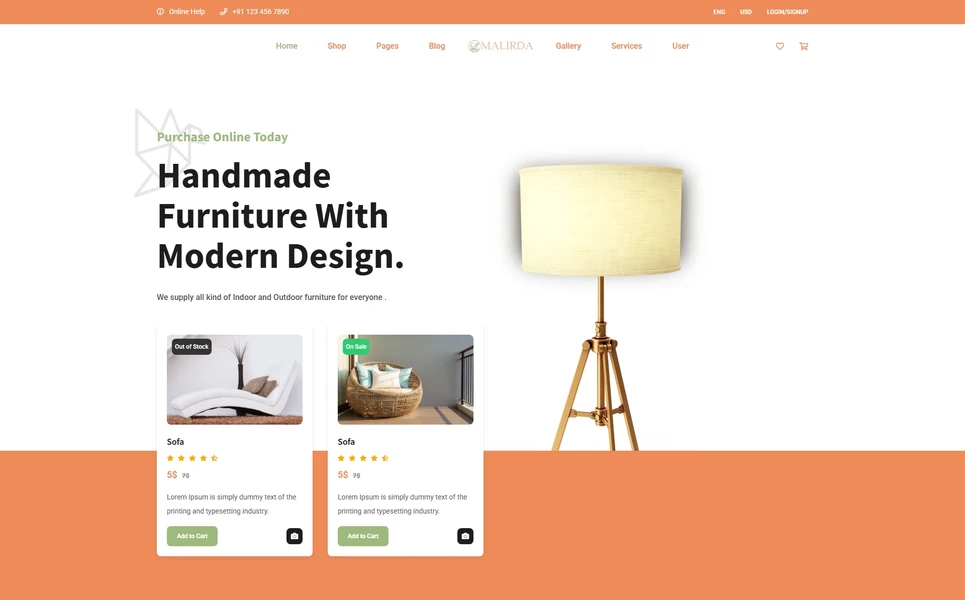
1. Malirda — The Full-Catalog Furniture Store
Malirda is the most expansive furniture website template in this lineup, and it is built for retailers who carry a deep catalog and want shoppers to find a physical location as well as buy online. With 39 fully crafted HTML pages, three unique home layouts, and a product shop in both grid and list formats, Malirda gives a growing furniture brand room to scale. Its standout for furniture retail is map-based store discovery — ideal if you run one or more showrooms — paired with two product detail page styles, a gallery in three distinct formats, product comparison, and jQuery Zoom magnification so shoppers can inspect wood grain and upholstery up close. Select2-enhanced filtering and countdown promotional timers round out a craftsmanship-focused, design-forward build.
Pages: 39 HTML pages. Best for: established furniture retailers with a large catalog and one or more physical showrooms who want store-locator discovery alongside a full online shop.
2. Sabor — The Lifestyle-Driven Furniture Brand
Sabor is a refined, lifestyle-driven furniture website template built for indoor furniture retailers, home-decor brands, and home furnishing distributors that want a strong content presence alongside the shop. It packs 38 fully crafted HTML pages with three unique home layouts and multiple shop archive layouts, so your catalog has room to breathe. What sets Sabor apart is its built-in blog module in a grid format — perfect for styling guides, care tips, and seasonal lookbooks that pull organic search traffic — supported by Isotope category sorting, Select2 filtering, Slick carousels, and a Magnific Popup lightbox for clean, large product imagery. It is a polished, production-ready choice for a brand that sells through storytelling as much as specification.
Pages: 38 HTML pages. Best for: home-decor and furniture brands that lead with content and lifestyle marketing and want an integrated blog driving traffic into the shop.

3. Splindit — The Versatile Commerce-First Store
Splindit is a versatile, commerce-driven furniture website template aimed at furniture stores that also stock a broader range — general e-commerce platforms, online department stores, and multi-category retailers built around furniture and home goods. It ships with 38 fully crafted HTML pages, three unique home layouts, and shop grid plus multiple list-view variants, so dense catalogs stay browsable. For furniture specifically, its dedicated gallery pages and compare-products functionality let shoppers study pieces in detail and weigh two options side by side, while ionRangeSlider price filtering helps budget-driven buyers narrow quickly. Select2 dropdowns, Slick carousels, and a Magnific Popup lightbox keep the heavy imagery fast and tidy. Splindit is the pick when furniture is your anchor category but not your only one.
Pages: 38 HTML pages. Best for: furniture stores with a wide, mixed catalog that need strong filtering, product comparison, and gallery-led merchandising across many categories.
4. Farwa — The Showroom and Seating Specialist
Farwa is a rich, content-complete furniture website template built specifically with sofa and seating showrooms, furnishing boutiques, and home-decor stores in mind. With 30 or more fully crafted HTML pages, two unique home layouts, and multiple shop archive layouts, it strikes a balance between depth and focus — substantial enough for a real catalog without the sprawl of a department store. Farwa includes two product detail styles, a full blog module in both sidebar and grid variants, and the complete commerce path of cart, checkout, wishlist, coming-soon, 404, and account management. It is an expansive yet curated build, well suited to a specialist seating or boutique furniture brand that wants a premium, showroom-style presentation online.
Pages: 30+ HTML pages. Best for: sofa and seating showrooms or curated furniture boutiques that want a premium, showroom-style site with a full blog and complete checkout flow.
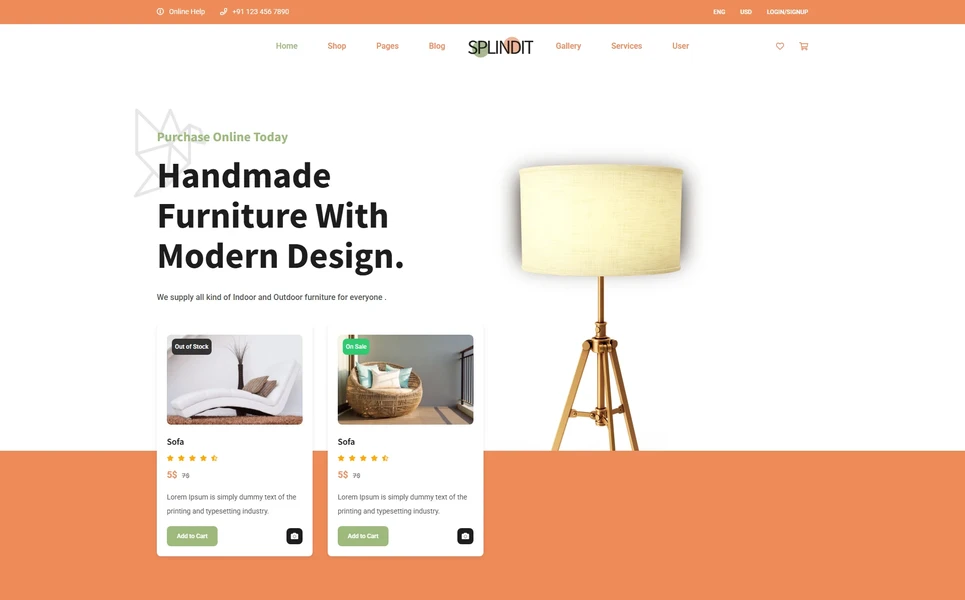

Across these four furniture website templates you have the full spectrum covered: Malirda for the large multi-showroom retailer, Sabor for the content-led lifestyle brand, Splindit for the wide mixed catalog, and Farwa for the focused showroom specialist. Each is Bootstrap 5, responsive, and production-ready, so the differentiator is fit — match the template to your catalog size, your marketing style, and whether physical showrooms are part of your story.
Essential Features Every Furniture Website Needs
Before you commit to any furniture website template, confirm it covers the fundamentals that furniture retail specifically demands. These are not nice-to-haves — each one maps directly to how furniture shoppers research, compare, and buy. Use this checklist to pressure-test any template, including the four above.
- Large, zoomable product imagery with multiple photos per piece and lifestyle hero sections, so shoppers can inspect finish and fabric and picture furniture in their own space.
- Filterable shop archives with price-range sliders, letting budget-conscious furniture buyers narrow by category, style, and price without scrolling endlessly.
- Product comparison tools so shoppers can weigh two sofas or dining sets side by side — a near-universal step in considered furniture purchases.
- Variant and configuration support for fabrics, sizes, finishes, and bundles, since most furniture products are anything but single-option.
- A complete commerce path — cart, checkout, wishlist, and account management — with transparent shipping and a friction-free flow for high-value orders.
- Mobile-first, fast-loading performance built on lean Bootstrap 5 markup, because the majority of furniture research happens on a phone and Core Web Vitals reward speed.
- An integrated blog and content module for styling guides, care tips, and buying advice that earns organic search traffic and feeds the shop.
- Trust pages and social proof — about and craftsmanship story, shipping and returns, reviews and testimonials — to reassure buyers spending on a major purchase.
If a template you are considering is missing two or more of these, keep looking. The cost of a thin foundation shows up later as custom development, lost conversions, or a rebuild — all far more expensive than choosing the right furniture website template at the start.
Choosing the Right Template
With the four furniture website templates above all meeting the essentials, the decision comes down to fit rather than quality. Start with catalog size. If you carry hundreds of SKUs across many categories, a sprawling build like Splindit or the 39-page Malirda gives you room to grow; if you sell a focused range of seating or curated pieces, Farwa’s tighter, showroom-style structure will feel more coherent and convert better than an oversized template you never fill.
Next, weigh your marketing style. Brands that win on content — styling guides, lookbooks, care advice — should lean toward a template with a strong blog module like Sabor or Farwa, because that content depth pulls organic furniture-shopper traffic directly into the store. Then factor in your physical footprint: if showrooms are central to your business, Malirda’s map-based store discovery is a genuine differentiator that the others do not match. Finally, look at the merchandising tools your shoppers actually use — price-range sliders, product comparison, and gallery views all matter more in furniture than in most categories, so favor the template whose commerce features line up with how your customers buy.
Because every one of these is built on Bootstrap 5 with clean, responsive markup, you are not trading performance for features in any direction. Click through each live demo with your own catalog in mind, picture your best-selling pieces in the product grid and on the detail page, and choose the furniture website template that frames your products the way you want shoppers to see them.
Start Building Your Furniture Website
A furniture website is the showroom that never closes, and the template you build it on sets the ceiling on how well it sells. Each of the four furniture website templates in this guide — Malirda, Sabor, Splindit, and Farwa — is a real, production-ready, Bootstrap 5 HTML5 template with a live demo, a complete commerce flow, and the imagery and merchandising tools furniture retail demands. Any one of them will launch you far faster, and on far stronger foundations, than building from scratch.
The best next step is simple: open the demos, match a template to your catalog and your marketing style, and start building. When you are ready to see the full range of options, explore the complete collection and find the furniture website design that fits your brand.