Healthcare is one of the few industries where a website is not just a marketing tool. It is often the first interaction a patient has with a medical practice, and that first impression determines whether they book an appointment or move on. A poorly designed medical website signals disorganization. A professional one signals competence, trust, and care.
This guide covers the best medical website templates available in 2026. Each one is built specifically for healthcare providers, from private clinics and multi-specialty hospitals to pharmacy networks and wellness centers. We break down the features, page counts, and design decisions that matter most for patient-facing websites.
Why Medical Websites Require Specialized Design
A medical website is not a restaurant site with different colors. Healthcare websites carry specific obligations that generic templates simply cannot address. Patients arrive anxious, uncertain, and often in a hurry. They need to find their doctor, confirm office hours, and book an appointment within seconds. If your website makes that process difficult, patients will call a competitor instead.
Trust is the central design challenge. Patients are sharing personal health information when they fill out contact forms or request appointments online. The visual design of your website needs to communicate professionalism and security at every scroll point. Clean typography, clinical color palettes, proper whitespace, and credible imagery all contribute to this perception. A cluttered layout with stock photos of smiling people in lab coats does the opposite.
There is also the practical matter of accessibility and compliance. Medical websites must accommodate users with disabilities, older patients who may struggle with small text, and mobile users who account for over 60% of healthcare-related searches. A medical website template needs to handle all of this out of the box, because building these features from scratch adds weeks of development time and significant cost.
What Makes a Great Healthcare Website Template
Not every medical template is worth your time. The difference between a usable healthcare template and a mediocre one comes down to four areas that directly affect patient acquisition and retention.
Patient Trust and Credibility
The template must look like a real medical practice built it. That means professional color schemes rooted in blues, greens, or whites. It means structured layouts with clear visual hierarchy, not trendy parallax effects that distract from the information patients need. Doctor credentials, certifications, and facility photos should have dedicated, prominent sections. Testimonial areas need to feel authentic, not like a generic review carousel borrowed from an e-commerce theme.
Appointment Booking Integration
Online appointment booking is no longer optional for medical practices. Over 70% of patients prefer to schedule appointments digitally. The best medical website templates include pre-built booking forms with fields for patient name, preferred doctor, service type, date, time, and special requests. Some templates go further with doctor availability grids that show weekly schedules at a glance. The booking form should be accessible from every page, typically as a persistent call-to-action button in the header or a dedicated section on the homepage.
Doctor and Staff Profiles
Patients want to know who will be treating them before they walk through the door. A strong medical template provides structured profile pages for each physician, complete with photo, specialty, education, experience, and social or professional links. The homepage should feature a team section that highlights key staff members with at least 4 to 5 profiles visible without scrolling through pagination. Profile cards should link to individual detail pages where patients can learn more and, ideally, book directly with that specific doctor.
Mobile Access and Speed
A patient searching for a nearby clinic on their phone at 9 PM is not going to wait 4 seconds for your homepage to load. Medical templates must be fully responsive across all breakpoints, and they need to be lightweight enough to load quickly on mobile connections. Look for templates built on Bootstrap 5, which provides a solid responsive grid system without excessive JavaScript overhead. Lazy-loaded images, optimized asset delivery, and minimal render-blocking resources are the technical details that separate fast medical sites from sluggish ones.
4 Best Medical Website Templates (2026)
These four templates represent the strongest options for healthcare providers who want a professional web presence without starting from a blank canvas. Each one has been tested for responsive performance, code quality, and real-world usability for medical practices.
1. Clinic – Medical Clinic HTML Template
Clinic is the most comprehensive medical template in this roundup, and it earns that position with 19 fully designed pages spread across 3 distinct homepage layouts. This is not a single-page template stretched thin. Every section of a modern medical practice gets its own dedicated page, from service listings and department breakdowns to a full shop section with 4 layout variations.
The homepage opens with a strong hero section and immediately moves into 8 specialized service cards covering areas like internal medicine, dentistry, and otolaryngology. Below that, a department display showcases 4 featured departments with images, descriptions, and an embedded video player. The appointment booking form is detailed and practical, collecting patient name, preferred doctor, service type, phone number, date, time, and special requests in a single view.
What sets Clinic apart is the doctor schedule grid. Instead of just listing staff names, it displays a full weekly availability table so patients can see exactly when each physician is in the office. The template features 5 doctor profiles on the homepage alone, each with specialization labels and social media links. Add in a blog section, patient testimonials, newsletter subscription, and multilingual support with English, German, and Japanese options, and you have a template that can serve a multi-specialty clinic without modification.
2. Medical – Cannabis Dispensary and Medical Center Template
Medical takes a different approach by targeting the growing medical cannabis and wellness sector. With 13 pages across multiple layout options, this template bridges the gap between clinical credibility and retail functionality. It is built for dispensaries, wellness clinics, and medical cannabis providers who need both a patient-facing informational site and a working online store.
The homepage uses a tabbed interface to display 6 medical conditions (chronic pain, neuropathy, cancer, epilepsy, HIV/AIDS, and multiple sclerosis) with associated product recommendations for each. This is a smart design decision that helps patients navigate by their condition rather than by product category. The template includes product type showcases for sublingual tinctures, tablets, vaporization oils, oral sprays, and other formulations, along with THC/CBD ratio categories that simplify product selection.
The shop section is fully built out with product listing pages, detail views, cart, checkout, and wishlist functionality. On the clinical side, you get a physician section with referral information, prescribing guidelines, and a team directory with 4 doctor profiles. A blog section, patient testimonial carousel with video support, and appointment booking round out the feature set. This template fills a niche that very few medical templates address, and it does so with professional design that avoids the stereotypes common in this industry.


3. Medtab – Clinic Network and Doctor Directory Template
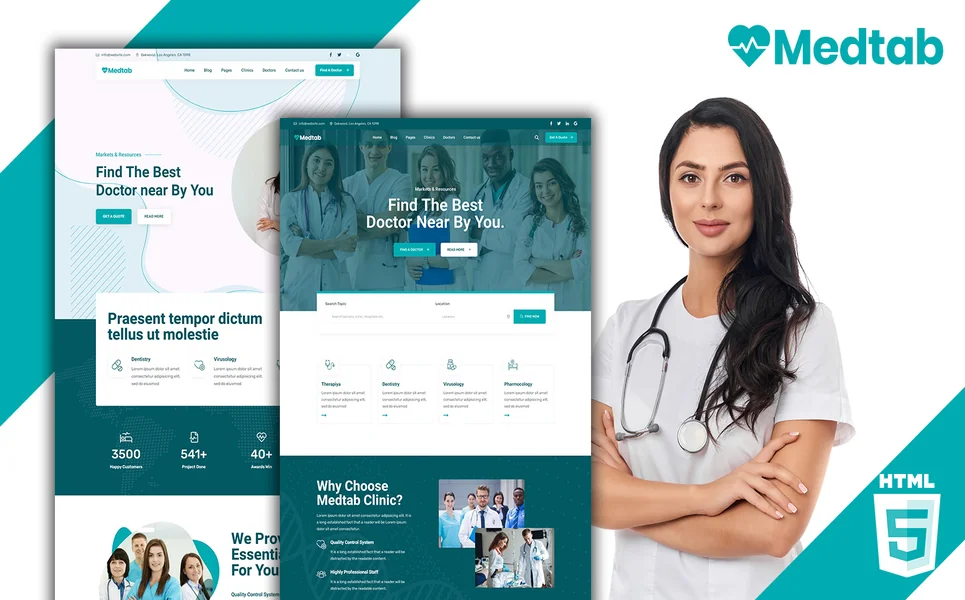
Medtab is designed for healthcare networks and multi-location clinics that need to help patients find the right doctor at the right location. With 19 pages organized across 6 main sections, this template prioritizes the patient journey above all else. The core concept is a three-step process: search for a specialist, book an appointment, and leave feedback. That simplicity is reflected in the layout and navigation structure.
The standout feature is the doctor finder with location-based filtering. Patients can search for physicians by specialty and proximity, which is essential for clinic networks with multiple branches. The homepage presents this search functionality prominently alongside stats that build credibility (the demo shows 340+ customers and 120+ years of combined experience). Service cards cover specialties including therapy, dentistry, virology, and pharmacology.
The template includes dedicated sections for clinic listings (3 layout options), doctor directories (3 layout options), a blog with 3 view styles, and 5 utility pages. The appointment booking system uses a visual 3-step workflow that guides patients through the scheduling process. Testimonial and newsletter sections are included, and the entire template is built with a clean, modern aesthetic that works equally well for a single practice or a regional healthcare group.
4. Medvita – Medical Clinic and Wellness Center Template
Medvita is the most versatile template in this list, with 25 pages and 4 homepage variations that give you significant flexibility in how your practice presents itself online. This template targets medical clinics, wellness centers, and healthcare providers who also sell health-related products. The combination of clinical service pages and a complete e-commerce section makes it suitable for practices that want a single website handling both patient services and product sales.
The shop section includes 5 pages covering product listings, individual product detail views, shopping cart, checkout, and a wishlist feature. On the clinical side, Medvita offers structured pages for services, case studies, team profiles, FAQ, and appointment scheduling. The case studies section is a notable addition that most medical templates overlook. It gives practices a way to showcase treatment outcomes and build patient confidence through documented results.
With 4 distinct homepage layouts, Medvita lets you test different content arrangements before committing to a final design. The blog section supports both grid and list views with individual article detail pages. An Instagram gallery integration adds a social media dimension that helps practices maintain an active, approachable online presence. Whether you run a physiotherapy clinic, a dermatology practice, or a wellness center that sells supplements, Medvita provides the page structure you need without requiring custom development.

Essential Features for Medical Websites
Beyond the specific templates reviewed above, any medical website you build should include these core features. If your chosen template does not support them natively, plan for custom development or plugin integration.
- Online appointment scheduling with date, time, doctor selection, and service type fields. Patients should be able to book without calling your office.
- Doctor profile pages with photo, credentials, specialty, education background, and a direct booking link. Each physician should have a dedicated URL.
- Mobile-first responsive design that renders cleanly on screens from 320px to 2560px. Over 60% of healthcare searches happen on mobile devices.
- Fast page load times under 3 seconds. Patients searching for urgent care will not wait for a slow site. Optimize images, minimize CSS/JS, and use lazy loading.
- SSL certificate and secure forms for any page that collects patient information. HTTPS is mandatory for healthcare sites, not optional.
- Clear contact information on every page, including phone number, address, hours of operation, and an embedded map. Make it impossible for patients to miss your contact details.
- Patient testimonials presented in a credible format with names (or initials) and context. Video testimonials perform better than text-only reviews.
- Blog or health resources section for publishing educational content. This supports SEO, establishes authority, and gives patients a reason to return to your site between visits.
Choosing the Right Medical Template
The right template depends on your practice type and patient volume. A solo practitioner running a family medicine office has different needs than a 20-physician multi-specialty group. Start by listing the pages you actually need. If you are a single-location clinic, a template with 19 well-designed pages will serve you better than one with 80 pages you will never use. If you operate multiple locations, prioritize templates with location-based search and multi-clinic directory features.
Consider your growth trajectory. A template with multiple homepage variations and modular sections gives you room to evolve your site without rebuilding from scratch. If you plan to sell health products, supplements, or medical supplies online, choose a template with a built-in shop section rather than bolting on e-commerce later. Templates like Medvita and Medical already include full shopping cart, checkout, and product detail pages.
Pay attention to the code quality and framework. Templates built on Bootstrap 5 offer the best combination of responsive reliability, browser compatibility, and developer familiarity. Check that the template uses semantic HTML, clean CSS class naming, and well-organized JavaScript. These technical details do not affect what patients see, but they directly impact how quickly a developer can customize the template and how well search engines can crawl your content.
Build Your Medical Practice Website
A professional website is the most cost-effective investment a medical practice can make in patient acquisition. The templates in this guide provide a proven starting point with pre-built appointment systems, doctor profiles, service pages, and responsive layouts. Instead of spending months on custom development, you can have a polished, patient-ready website live within days.
Every template reviewed here is available for immediate download and customization. Pick the one that matches your practice type, customize the content with your branding and physician information, and launch a site that converts visitors into booked appointments.