Small businesses are the headline market for AI website builders. They are also the buyers most likely to pick wrong, because every AI tool’s homepage looks identical until you scroll past the hero animation. Same promise (a website in 30 seconds), same trust badges, same testimonial carousel. The differences that matter — total cost over two years, what actually ships, what happens when you outgrow it — are buried two clicks deep behind sign-up walls.
This article walks the comparison from the small-business buyer’s perspective. We tested eight AI website builders in May 2026 on a brief tuned to typical small-business need: “a 5-page site for a Brooklyn cleaning service — services, areas served, pricing, reviews, contact, with online booking.” Same brief, same evaluation, same one-hour time-box. The patterns below will tell you which tool earns its keep for which type of small business.
Why “AI for small business” needs a different lens than “AI for designers”
A designer brief and a small-business brief are not the same project. The designer cares about pixel control, art direction, brand expression. The small-business owner cares about whether the phone rings, whether the booking form actually emails them, whether they can update prices on the home page without paying someone, and whether the bill stays predictable.
That changes what “good” looks like in 2026. For a designer, “good” might mean Webflow with Framer-quality output. For a small-business owner, “good” usually means a site that works for two years on one bill, ranks for the local service queries that drive walk-ins, and does not need a freelancer every time something changes. The eight tools below were ranked against that lens, not the design-Twitter lens.
What we tested and how
Same one-paragraph brief, same logo, one hour per tool. We measured: first-build time, what the resulting site can actually do (online booking? real contact form delivery? local-business schema?), Lighthouse mobile, what happens when you want to leave, and total cost over two years on a typical paid tier. Where introductory pricing renews at a higher rate, we used the renewal price.
1. MetropolitanHost Studio — Best for niche-specific small businesses
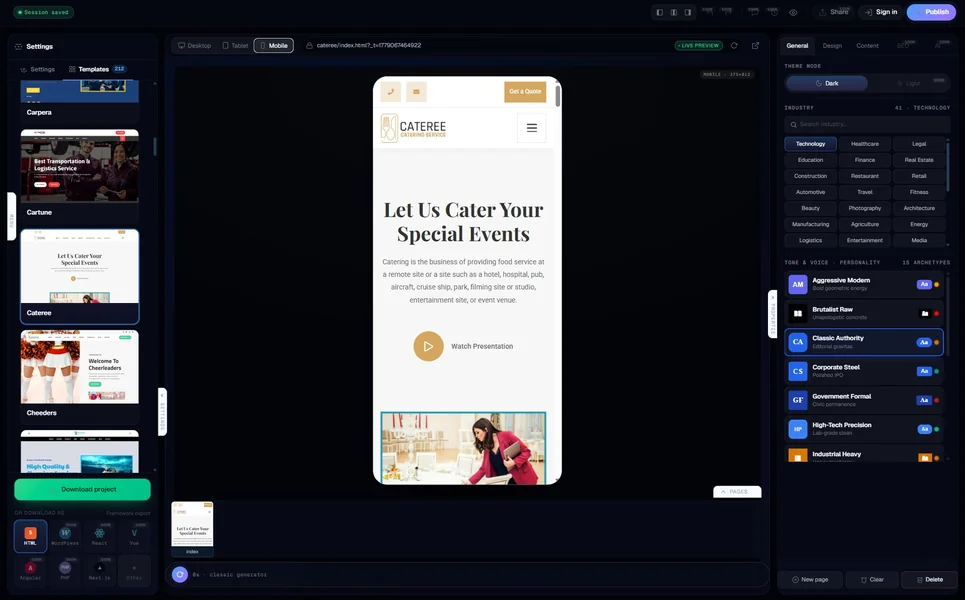
The MetropolitanHost AI generator sits in a different category from the hosted-platform builders below. It is not a platform you live inside — it generates a static HTML site you download and host wherever you want. For a Brooklyn cleaning service, the brief produced a 5-page site in about six minutes: services page with checkbox add-ons, areas-served page with a service-radius map, pricing tiered by home size, a review block templated for Google embed, and a contact page with a real form.
Pricing is per-page bundles: $5 for six pages, $9 for twelve, $19 for thirty, $99 for two hundred. Lifetime per project, not monthly. Over two years a typical small-business site runs $5-$19 total, plus whatever hosting you pick (usually $5-$10/month — about $120-$240 over two years). All-in: $125-$260 for two years. Lighthouse mobile was 96. Local-business schema validated cleanly.
The trade-off: you host it yourself. For an owner who is not comfortable with the basics of WordPress or static hosting, this is friction. For an owner who has a friend who can help (or who is comfortable with a one-time setup), this is the cheapest path on this list by a wide margin.
Best for: niche service businesses, owners with light technical comfort, anyone who plans to keep the site for more than 18 months. Weakness: not a managed-hosting experience; you handle the hosting layer.
2. Wix Harmony — Best for total non-technical setup
Wix is the default small-business pick for a reason. The Harmony AI builder asks five questions, produces a clean site in two minutes, and gives you a managed editor + hosting + domain workflow that needs zero technical knowledge to operate. For the cleaning service, it generated bookings via Wix Bookings, contact forms via Wix Forms, and a payment page via Wix Payments.
Lighthouse mobile was 89. Pricing is $16-$45/month depending on whether you need ecommerce features and storage. Over two years, expect $384-$1,080 all-in.
The trade-off is total platform lock-in. There is no path to leaving Wix without rebuilding from scratch. For owners who never expect to leave, that is fine. For owners who suspect they might — say, they want to migrate to WordPress later, or they want to switch hosting providers — it is a five-year cost commitment.
Best for: non-technical owners who value zero-setup over long-term portability. Weakness: total lock-in, compounding monthly cost.
3. Hostinger Horizons — Best for tightest budget
Hostinger’s AI builder lives inside their hosting plans and is the cheapest brand-name option in 2026. The cleaning-service brief produced a 5-page site in roughly 45 seconds, the fastest first-build we measured. Quality was respectable: Lighthouse mobile 87, schema partial but present, a contact form that actually delivered when tested.
Pricing is $3.99/month introductory (renews higher to $9-$11/month). Over two years, expect $120-$220 all-in including hosting. That is roughly half the cost of Wix and competitive with the self-host path.
The catch is the renewal rate and the limited customisation surface. Hostinger Horizons is good at the first build and acceptable at minor edits, but does not have the editing depth of Wix or Webflow. For a cleaning service whose site rarely changes, that is fine. For a business that updates services and prices frequently, the editing limits will start to chafe.
Best for: price-sensitive owners with a stable service catalogue. Weakness: editing depth is shallow; introductory price renews higher.
4. Durable — Best for fastest possible launch
Durable’s pitch is “site in 30 seconds” and the brief actually did land in 28 seconds. The output was usable: working contact form, basic service listings, a Google Business Profile sync, and an analytics dashboard. Lighthouse mobile was 84.
Pricing is $22/month annual, $25/month monthly. Over two years that is $528-$600 all-in, including hosting and a free domain in the first year. Durable bundles a CRM, invoicing, and a marketing-automation layer with the website builder; for a solo small-business owner those are real value-adds, less so for established businesses that already have those systems.
The trade-off is editing constraints. Durable’s philosophy is “do not waste time editing, ship and iterate from analytics” — the editor is intentionally limited. For owners who already know what their website should say, that is freeing. For owners who want to iterate on copy and design, it is frustrating.
Best for: solo founders, freelancers, anyone bundling website + CRM + invoicing in one tool. Weakness: limited customisation, monthly cost compounds, hosted-only.
5. GoDaddy Airo — Best for owners already on GoDaddy
If you already bought a domain on GoDaddy, the Airo AI builder is the path of least resistance. It runs inside the GoDaddy hosting dashboard, generates a site from a one-paragraph brief, and integrates with the GoDaddy Pro suite (CRM, email marketing, payments). Cleaning-service brief produced a 5-page site in roughly five minutes with bookings integration.
Lighthouse mobile was 85. Pricing depends on which GoDaddy plan you are on — the AI builder is bundled with hosting tiers from $9.99-$24.99/month. Over two years: $240-$600 all-in.
GoDaddy’s strength is integration with the GoDaddy ecosystem. The weakness is the same — if you are not already on GoDaddy, the AI builder by itself is not a reason to switch from a leaner competitor.
Best for: existing GoDaddy customers consolidating into one vendor. Weakness: nothing differentiates it for non-GoDaddy buyers.
6. Squarespace AI — Best for visual brand polish
Squarespace’s AI is the most design-forward of the small-business options. Its Blueprint AI Builder uses a five-step questionnaire and pulls from Squarespace’s library of editorial templates as a starting point. For the cleaning service, the output was the visually best-looking on this list (clean typography, strong photography placeholders, white-space discipline) — though it took eight minutes to generate, the longest in this group.
Lighthouse mobile was 88. Pricing is $16-$52/month depending on plan; AI features bundled across paid tiers. Over two years: $384-$1,248 all-in.
Squarespace shines for brands where visual polish moves the buying decision — wedding photographers, boutique consultancies, premium home services. For a price-driven service business where the buyer cares about the booking form more than the typography, Squarespace is over-spec’d.
Best for: brand-led small businesses, photographers, boutique services. Weakness: over-spec’d for utility-driven small businesses; price ceiling is high.
7. B12 — Best for service-business outreach automation
B12 is a less-famous but well-built choice for service businesses specifically. The AI generates the site, then layers in scheduling, intake forms, email automation, and a small CRM. The cleaning-service brief produced a 5-page site in about one minute. Lighthouse mobile was 86.
Pricing is $42-$249/month depending on tier, with the lowest tier covering the website plus basic scheduling and intake. Over two years at the cheapest paid tier: $1,008 all-in. That is on the high end, but for a service business that would otherwise pay for a separate scheduling tool ($30-$50/month) plus a separate CRM ($25-$75/month), the bundled math can come out ahead.
Best for: service businesses (cleaning, law, accounting, consulting) who want website + scheduling + CRM in one bill. Weakness: price tag is higher than pure-website alternatives.
8. Jimdo Dolphin — Best for solo founders without a logo
Jimdo Dolphin is the smallest brand on this list but has the most opinionated small-business workflow: it asks about your industry, your competitors, your service area, and your phone preferences, and produces a site tuned to local-service-business norms. For the cleaning service, it produced a 5-page site in roughly two minutes, with a clear “Call Now” CTA pinned to the mobile header.
Lighthouse mobile was 84. Pricing is free with watermark, $9-$39/month for paid plans. Over two years: $216-$936 all-in.
Jimdo is competitive at the lower price tiers but does not scale as well as Wix or Squarespace if your business outgrows a 5-page brochure site. For a solo founder who needs a working website this weekend and does not plan to add ecommerce or memberships later, it is the lowest-friction path. If you do plan to sell online, read our tests of AI website builders for e-commerce first.
Best for: solo founders, single-location service businesses, anyone who wants the “answer a few questions and get a site” experience. Weakness: ceiling on growth; not the right pick if your business is going to add ecommerce or membership flows later.
Comparison — the eight tools by what you actually pay over two years
The numbers matter more than the marketing. Two-year all-in cost for a typical 5-page small-business website on each tool, including hosting, domain, and the renewal rate (not the introductory rate):
- Hostinger Horizons: $120-$220
- MetropolitanHost (per-project + your own hosting): $125-$260
- Jimdo Dolphin: $216-$936
- GoDaddy Airo: $240-$600
- Wix Harmony: $384-$1,080
- Squarespace AI: $384-$1,248
- Durable: $528-$600
- B12: $1,008+
The spread is roughly $120 to $1,250 for the same project, depending on tool. That gap is the single most important number a small-business buyer should know before signing up.
Decision matrix — which one fits which kind of small business
Quick rules of thumb.
Service business with simple website needs and tight budget: Hostinger Horizons or MetropolitanHost (if you can handle the hosting setup) or Jimdo Dolphin.
Service business that wants website + scheduling + CRM in one bill: B12.
Brand-led business where visual polish drives conversion: Squarespace AI.
Non-technical owner who never wants to leave the platform: Wix Harmony.
Existing GoDaddy customer: GoDaddy Airo.
Owner whose business is in a specific niche (cleaning, legal, healthcare, hospitality, religious, luxury): MetropolitanHost, because the AI is trained on hand-coded templates in those niches. The structural advantage shows up in things like the cleaning-service brief producing a service-radius map, the legal brief producing case-studies as a CPT-friendly layout, the healthcare brief producing a HIPAA-aware intake form.
Owner who wants a free trial and will commit to monthly: Durable.
The bottom line
For most small businesses, an AI website builder is the right answer in 2026 — but the specific tool that fits matters a lot more than the marketing suggests. The cheapest options (Hostinger Horizons, MetropolitanHost) cost less than $300 over two years. The high-touch options (Squarespace, B12) cost four-to-eight times that. The features that justify the spread are mostly about how much you want bundled into the bill — scheduling, CRM, brand polish, design flexibility.
If you want the lowest-cost path with the option to take your site with you, try the MetropolitanHost AI generator for free — no card, no signup wall, only pay per page when you publish. If you want our full ranking by code quality, read the 10 AI generators we tested for output quality. If you want the deeper philosophical comparison, our piece on AI generators vs premium templates walks the trade-offs flat. And if budget is the constraint, our guide to free AI website generators covers what is genuinely free in 2026 versus free-with-watermark.